

Russet-backed Oropendola vs Green Oropendola
Psarocolius angustifrons versus Psarocolius viridis
Play a quiz with Russet-backed Oropendola and Green Oropendola
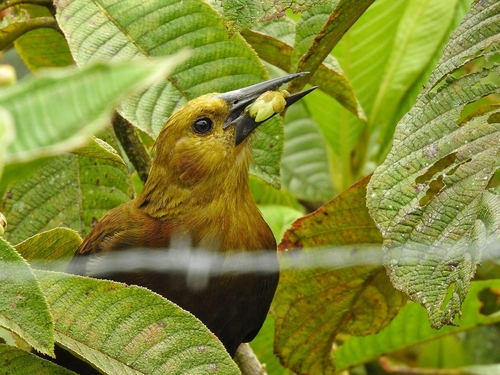 Russet-backed Oropendola
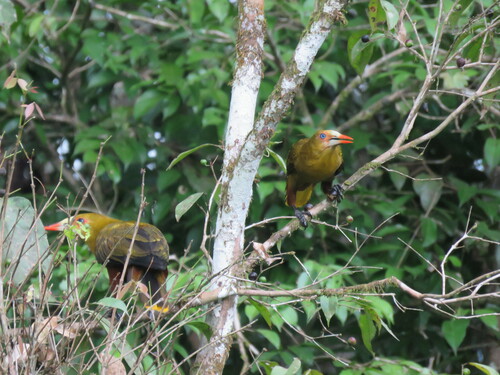 Green Oropendola
In short
The most reliable field mark for separating Russet-backed Oropendola from Green Oropendola is overall coloration: Russet-backed is largely brown or chestnut with a russet tinge, while Green Oropendola is distinctly yellowish-olive with chestnut only on the rump, undertail, and belly. Bill color is also diagnostic: Green Oropendola has a striking two-toned bill (pea-green at the base, orange-red at the tip), whereas Russet-backed Oropendola's bill is usually blackish or, in some subspecies, ivory or orange-yellow. Both species show yellow outer tail feathers, but the body and head colors, as well as facial and bill details, are key. Juvenile differences are subtle, but Green Oropendola juveniles are duller and have less chestnut below. Always check for the combination of body color, bill pattern, and facial skin when identifying these birds.
Identification tips
- Overall body color: Russet-backed Oropendola is brown to chestnut with a russet tinge; Green Oropendola is yellowish-olive overall. This is the fastest visual cue in good light (all ages).
- Bill color: Green Oropendola has a two-toned bill (pea-green at base, orange-red at tip) with a swollen casque; Russet-backed Oropendola's bill is usually blackish, ivory, or orange-yellow depending on subspecies, but never bicolored in this way (all ages, but especially adults).
- Facial skin and lores: Green Oropendola shows pink to dull orange lores and orbital skin; Russet-backed lacks this, having a plain face (adults, perched or close views).
- Iris color: Green Oropendola adults have a pale blue iris; Russet-backed Oropendola has a dark brown iris (except some subspecies with blue eyes). Juveniles of both have dark brown eyes, so this is only useful for adults.
- Rump and undertail: Both species have yellow outer tail feathers, but Green Oropendola has a chestnut rump, uppertail coverts, belly, thighs, and crissum, contrasting with the olive body; Russet-backed's rump is paler russet-brown, and the chestnut does not extend below.
- Wing color: Green Oropendola's wings are dusky olive; Russet-backed's are brownish or rufescent, matching the body.
- Juvenile differences: Green Oropendola juveniles are duller, with less chestnut below and a grayish wash on the underparts; Russet-backed juveniles have a yellower head and a duller yellow tail. These differences are subtle and require close views.
- Tail pattern: Both have dusky central tail feathers and yellow outer tail feathers, but Green Oropendola's outermost tail feathers have dusky olive edges, while Russet-backed's have dusky brown edges and tips.
- Crest: Adult males of both species have a nape crest, but this is not a reliable separator since both show it and females lack it.
- Subspecies confusion: Some Russet-backed subspecies (e.g., P. a. oleagineus) are more olive, but none match the strong olive and chestnut contrast or the bicolored bill of Green Oropendola. Always check bill and body color together.
- Perched vs. in flight: Perched birds show bill and facial color best; in flight, overall body color and tail pattern are most visible. Juvenile flight patterns are not distinctive in these notes.
- Voice: Russet-backed Oropendola's song is variable but often starts low and ends with a crescendo; Green Oropendola's voice is not described here, so use visual marks first.
- Habitat: If in French Guiana, Guyana, or Suriname, only Green Oropendola occurs. Elsewhere, both may be present.
- Size: Green Oropendola is slightly larger and heavier, but this is not a reliable field mark without direct comparison.
- Pitfalls: Beware of subspecific variation in Russet-backed Oropendola, which can show yellowish or rufous tones and lighter bills. Always confirm with bill pattern and overall body color.
Size
Both species are large oropendolas, but Green Oropendola is slightly heavier on average (male mass ~405 g, female ~215 g [wikidata]) compared to Russet-backed Oropendola (male 250–470 g, female 170–230 g [wikipedia]). Length is similar: Green Oropendola males average 48.5 cm, females 37 cm; Russet-backed males 44–48 cm, females 34–38 cm. In the field, this size difference is subtle and not reliable for separation.
Plumage
Juveniles of both species resemble adults but are duller overall. Green Oropendola juveniles have less chestnut on the underparts and a grayish wash below, with dark brown eyes, while Russet-backed juveniles have a yellower head and duller yellow tail. In adults, Russet-backed Oropendola (nominate and most subspecies) is mostly brown or chestnut with a russet tinge, paler rump, and a dark or ivory bill. Green Oropendola adults are yellowish-olive overall, with chestnut restricted to the rump, undertail, belly, and thighs, and a distinctive two-toned bill (pea-green base, orange-red tip) plus a pale blue iris. Both species have yellow outer tail feathers and dusky central tail feathers, but Green Oropendola's wings are dusky olive, while Russet-backed's are brownish. Subspecific variation in Russet-backed can add yellowish or rufous tones to the head or bill, but never the strong olive and bicolored bill of Green Oropendola.
Behaviour
Both species are social, foraging and nesting in groups, and both display by bowing and wing-shaking while perched. Green Oropendola forages mainly in the canopy and sometimes follows red-throated caracaras, while Russet-backed Oropendola is described as noisy and social but with less detail on specific foraging associations. Both nest colonially, but Green Oropendola colonies are typically smaller (up to 10 nests). These behavioral differences are subtle and not reliable for field separation.
Habitat
Both species overlap in much of their range (Bolivia, Brazil, Colombia, Ecuador, Peru, Venezuela), but Green Oropendola also occurs in French Guiana, Guyana, and Suriname. Both inhabit humid forests, often in the canopy. Habitat is not a reliable separator except at the eastern edge of the range, where only Green Oropendola is found.
Voice
Both species are vocal, with males singing from perches during display. Russet-backed Oropendola's song varies by subspecies but often starts low and rises to a crescendo, with calls like 'Schweep!' and 'C'LAK'. Green Oropendola's vocalizations are not detailed in the notes, but both species are described as noisy. Vocal differences are likely but not well documented for field separation in these notes.
Russet-backed Oropendola · Green Oropendola · My Tricky Birds