

Rüppell's Warbler vs Moltoni's Warbler
Curruca ruppeli versus Curruca subalpina
Play a quiz with Rüppell's Warbler and Moltoni's Warbler
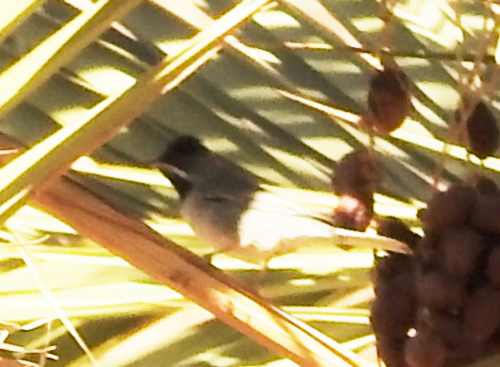 Rüppell's Warbler
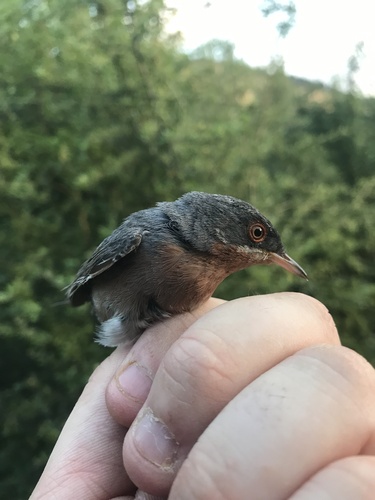 Moltoni's Warbler
In short
The most reliable field mark for separating Rüppell's Warbler from Moltoni's Warbler is the striking black head and throat with a sharp white malar streak ('moustache') in adult male Rüppell's, a feature never shown by Moltoni's. Female and immature Rüppell's have a plain grey head and back with a brownish tinge, while Moltoni's of all ages lack any black on the head and show warmer underparts, especially in males. Both are small, slim warblers, but Rüppell's is slightly slimmer and longer-tailed. Vocalizations differ: Rüppell's has a slower, deeper rattle, while Moltoni's gives a faster, higher-pitched insect-like song. Range and habitat can help: Rüppell's breeds in Greece and Turkey, Moltoni's in Italy and Tyrrhenian islands.
Identification tips
- Adult male Rüppell's Warbler shows a black head and throat with a bold white malar streak ('moustache')—this is unique among these two and diagnostic in the field.
- Moltoni's Warbler never shows black on the head or throat at any age or sex; males have a plain grey head and salmon-pink underparts.
- Female and immature Rüppell's Warbler are plainer grey above with a brownish tinge and pale throat, lacking the black of males but still colder and greyer than Moltoni's.
- Moltoni's females and immatures are very similar to Western Subalpine Warbler, with warm underparts and no strong head pattern; beware confusion in this plumage.
- Both species have fine, pointed bills and brown legs, so bill and leg color are not useful for separation.
- Rüppell's has red eyes, a subtle but sometimes visible feature at close range, while Moltoni's does not have this noted.
- No distinctive upperwing or flight pattern differences are described for either species, so do not rely on wing panels or trailing edges for separation.
- Rüppell's is slightly slimmer and more elongated than Moltoni's, but this is subtle and best used as supporting evidence.
- Vocalizations are a key separator: Rüppell's gives a slower, deeper rattle; Moltoni's sings a faster, higher-pitched, insect-like song with a dry 'trill zerr' call.
- Geographic range is important: Rüppell's breeds in Greece and Turkey, Moltoni's in Italy and Tyrrhenian islands. Out-of-range records should be scrutinized.
- Both species prefer shrubby, open habitats, so habitat type is not diagnostic, but location is.
- In mixed flocks or migration, focus on head pattern and voice—these are the most reliable clues.
- In poor light or distant views, beware that female and immature Rüppell's can look very plain, so try to confirm with voice or location.
- If you see a warbler with a black head and white moustache, it is never Moltoni's.
- If the underparts are distinctly salmon-pink and the head is plain grey, suspect Moltoni's, especially in Italy or nearby islands.
Size
Both species are small warblers in the Curruca genus and similar in size, but Rüppell's is described as slimmer than Sardinian Warbler, while Moltoni's is typical for subalpine warblers. No direct measurement comparison is available, but in the field, Rüppell's may appear slightly more elongated and fine-billed. Size is not a strong separator between these two.
Plumage
No detailed age-specific wing or flight pattern marks are described for either species in the available notes, so separation relies on head and underpart coloration, especially in adult males. Adult male Rüppell's is unmistakable with its black head and throat divided by a white malar streak, while Moltoni's males have a plain grey head and salmon-pink underparts without any black. Female and immature Rüppell's are plainer grey above with a brownish tinge and pale throat, lacking the black of males but still showing a colder, greyer tone than Moltoni's, which are warmer and more similar to Western Subalpine Warbler. Juvenile and female Moltoni's are nearly indistinguishable from Western Subalpine Warbler, with no black or strong contrast on the head or throat. Both species have fine, pointed bills and brown legs, but Rüppell's shows red eyes, a subtle but sometimes visible feature.
Behaviour
Both species behave like typical Curruca warblers: active, often skulking in low shrubs, and quick to dive into cover. Rüppell's may appear slightly more elongated and agile, but this is subtle and not a reliable field mark. No major behavioral differences are noted that would separate these two in the field.
Habitat
Rüppell's Warbler breeds in Greece, Turkey, and neighboring islands, typically in dry, scrubby habitats. Moltoni's Warbler is restricted to Italy and islands of the Tyrrhenian Sea. If seen in the core breeding range of one species, this is a strong clue. Both prefer shrubby, open habitats, so habitat structure is not a separator, but geographic context is very helpful.
Voice
Rüppell's Warbler has a slower, deeper rattle compared to the Sardinian Warbler, while Moltoni's Warbler gives a faster-paced, higher-pitched song described as a rapid succession of insect-like notes, often with a dry 'trill zerr' call. If you hear a fast, high-pitched, insect-like song, suspect Moltoni's; a slower, deeper rattle points to Rüppell's. Vocalizations are especially useful for separating females and immatures, which are otherwise very similar.