

Rüppell's Griffon vs Griffon Vulture
Gyps rueppelli versus Gyps fulvus
Play a quiz with Rüppell's Griffon and Griffon Vulture
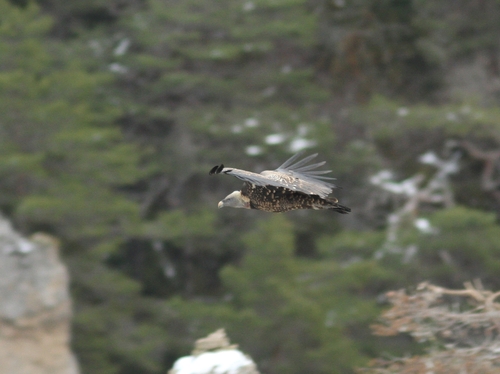 Rüppell's Griffon
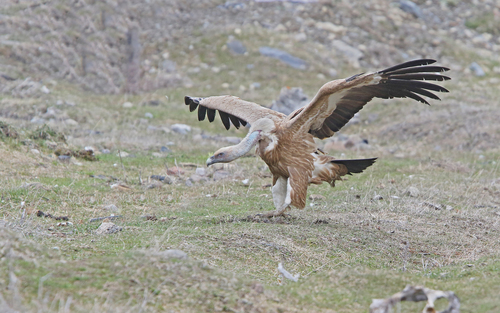 Griffon Vulture
In short
The most reliable way to separate Rüppell's Griffon from Griffon Vulture is by careful attention to plumage tone and underpart contrast, especially in flight. Rüppell's Griffon shows a distinctly mottled, darker brown appearance with a contrasting pale underbelly, while Griffon Vulture is overall paler and buffier, with a more uniform look and strong contrast between pale coverts and dark flight feathers. Both are massive vultures with similar structure, but Griffon Vulture is slightly heavier and longer-winged on average. Juvenile and immature plumages are not described in detail for either species in the sources, so adult and general field marks are most useful. Habitat and range can help: Rüppell's is a resident of the Sahel and East Africa, while Griffon Vulture is Eurasian.
Identification tips
- Overall Tone in Flight: Rüppell's Griffon appears much darker and more mottled in flight, with a brownish or blackish look and a contrasting pale underbelly. Griffon Vulture is paler overall, with buff body and wing coverts and a classic two-tone wing (pale coverts, dark flight feathers).
- Head and Neck: Rüppell's has a thin, dirty-white fluffy covering on the head and neck, with a white collar that is less broad and neat than Griffon Vulture's. Griffon Vulture has a striking white head and a broad, clean white neck ruff.
- Underparts: The underbelly of Rüppell's is distinctly paler than the rest of the body, creating a contrast with the darker upperparts. Griffon Vulture's underparts are more uniformly buff.
- Crop Patch: Rüppell's shows a deep brown crop patch, which may be visible at close range. Griffon Vulture lacks this feature.
- Bill: Griffon Vulture has a yellow bill, which can be a useful mark at close range. Bill color is not specified for Rüppell's in the sources.
- Flight Silhouette: Both are long-winged and broad, but Griffon Vulture may appear even bulkier and longer-winged. Structure is similar and not always reliable for separation.
- Tail: Both have short tails, not a strong field mark for separation.
- Juvenile/Immature Plumage: No detailed differences are given in the sources for young birds. Use adult field marks with caution on immature birds.
- Habitat and Range: In Europe, North Africa, and Asia, expect Griffon Vulture. In the Sahel and East Africa, Rüppell's is more likely, but both can occur together in East Africa. Always consider location.
- Behavior at Carcass: Both species feed in mixed vulture flocks. Rüppell's may be more persistent at tough remains, but this is not a field mark.
- Voice: Not useful for separation; both are mostly silent except when feeding or at the nest.
- Size: Griffon Vulture is heavier and slightly larger on average, but size overlap is considerable and not reliable in the field unless birds are side by side.
- Eye Color: Rüppell's has a yellow or amber eye (if seen well); eye color is not specified for Griffon Vulture in the sources.
- Context: If you see a very dark, mottled vulture with a pale belly among paler birds, suspect Rüppell's. If the bird is strikingly pale with a white head and ruff, it's likely Griffon Vulture.
- Pitfalls: Both species are large, pale-headed vultures with white neck ruffs and can occur together in East Africa, so always check multiple features.
Size
Both species are among the largest Old World vultures, but Griffon Vulture is, on average, heavier (mean body mass 8328g vs. 7570g for Rüppell's) and slightly longer (93–122 cm vs. 85–103 cm). Wingspans overlap but Griffon Vulture can reach up to 2.8 m, slightly longer than Rüppell's maximum of 2.6 m. In the field, both appear huge, but Griffon Vulture may look even bulkier and longer-winged, especially when seen side by side. However, size alone is unreliable due to overlap and variation.
Plumage
No detailed age-specific upperwing or flight pattern differences are described in the sources for juveniles or immatures. For adults, Rüppell's Griffon is overall mottled brown to blackish above, with a contrasting whitish-brown underbelly and a thin, dirty-white head and neck covered in fluff. The white collar at the base of the neck is present but not as broad or clean as in Griffon Vulture. The crop patch is deep brown, and the head is bare. Griffon Vulture adults are much paler overall, with a white head, broad white neck ruff, yellow bill, and buff body and wing coverts that contrast strongly with the dark flight feathers. In flight, Griffon Vulture shows a classic two-tone wing: pale coverts and dark primaries/secondaries, while Rüppell's appears darker and more mottled, lacking the strong pale/dark contrast. Juvenile/immature plumage is not detailed for either species, so these contrasts are best used for adults or birds in general.
Behaviour
Both species are obligate scavengers, feeding almost exclusively on carrion and often gathering in large numbers at carcasses. Rüppell's Griffon is noted for following game herds and is highly specialized for feeding on tough remains, sometimes consuming hide and bone. Both species are generally silent except at nests or carcasses, where they can be noisy. Rüppell's Griffon is famous for its ability to soar at extreme altitudes, but this is not a field mark. Social and feeding behavior is broadly similar.
Habitat
Rüppell's Griffon is resident mainly in the Sahel region and East Africa, often associated with open savannas and cliffs for nesting. Griffon Vulture is Eurasian, with a range extending from Iberia and the Mediterranean across southern Europe, North Africa, and into Asia. It is absent from sub-Saharan Africa except as a rare vagrant. Habitat overlap is minimal, but both prefer open country and cliffs for nesting. If seen in Europe or western Asia, it is almost certainly Griffon Vulture; in the Sahel or East Africa, Rüppell's is the default, though both can occur together at large carcasses in East Africa.
Voice
Both species are generally silent, becoming vocal only at nests or when feeding at carcasses. They may squeal or make harsh noises in these contexts, but voice is not a reliable field mark for separation.