

Rufous Turtle Dove vs Mourning Dove
Streptopelia orientalis versus Zenaida macroura
Play a quiz with Rufous Turtle Dove and Mourning Dove
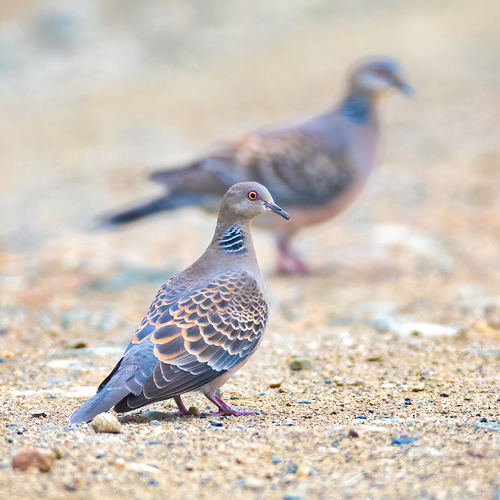 Rufous Turtle Dove
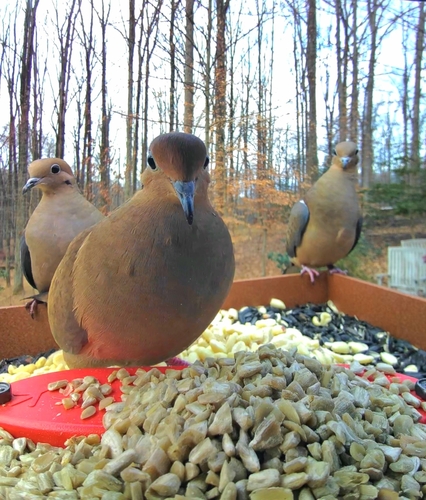 Mourning Dove
In short
The most reliable field mark between Rufous (Oriental) Turtle Dove and Mourning Dove is the combination of size, neck patch, and wing pattern. Rufous Turtle Dove is noticeably larger and bulkier, with a broad black-and-white striped neck patch and a scaly, dark-centered wing pattern, while Mourning Dove is more slender, with a plain face, subtle neck iridescence, and black-spotted, pale brown wings. Juvenile Mourning Doves can look scaly, but their overall color is paler and their tail is very long and pointed with white outer edges. In flight, Rufous Turtle Dove shows a wedge-shaped tail with variable terminal bands, while Mourning Dove’s tail is long, pointed, and white-edged. Both species have similar overall dove shapes, but their structure and plumage details are distinctive with careful observation.
Identification tips
- Size and structure: Rufous Turtle Dove is larger and bulkier, with a thicker neck and more robust body. Mourning Dove is slender, long-tailed, and smaller overall. Use this when both are seen in the same area or with familiar doves for scale.
- Neck patch: Rufous Turtle Dove has a bold black-and-white striped patch (silver-tipped feathers) on the side of the neck, visible in all ages. Mourning Dove lacks this; males may show subtle iridescence but never a striped patch.
- Wing pattern (all ages): Rufous Turtle Dove shows a scaly effect on the upperwing coverts, with brownish feathers and dark centers. Mourning Dove has plain pale brown wings with distinct black spots, never scaly.
- Juvenile confusion: Juvenile Mourning Doves can look scaly, but the effect is less extensive and the bird is paler and more uniform brown. Rufous Turtle Dove’s scaly pattern is more pronounced and covers more of the wing.
- Tail shape in flight: Rufous Turtle Dove has a wedge-shaped tail with a variable terminal band (white or grey, depending on subspecies), while Mourning Dove’s tail is very long, pointed, and edged with white outer feathers contrasting with black inners.
- Face and eye: Mourning Dove has a dark crescent below the eye and a blue orbital ring. Rufous Turtle Dove lacks a bare eye ring and has a more uniform face.
- Breast color: Mourning Dove has a pinkish breast, especially in males; Rufous Turtle Dove’s breast is less pink and more subdued.
- Flight style: Mourning Dove takes off with sharp, whistling wingbeats and flies swiftly and directly. Rufous Turtle Dove’s flight is more relaxed and direct, less hurried.
- Bill and legs: Mourning Dove has a short, dark bill and reddish legs. Rufous Turtle Dove’s bill and legs are not distinctive for separation in the field.
- Sex differences: Male Mourning Doves have a bluish-gray crown and iridescent neck patch; females are browner and lack the blue crown. Rufous Turtle Dove shows less sexual dimorphism in the field.
- Subspecies tail band (advanced): Some Rufous Turtle Dove subspecies (meena) have a white tail tip like European Turtle Dove, but this is variable and not always reliable. Mourning Dove’s white tail edges are always present and contrast with black inners.
- Habitat context: Rufous Turtle Dove is Asian, found in woodlands and forest edges; Mourning Dove is North American, in open country and suburbs. Use context only if vagrancy is unlikely.
- Vocalization: If you hear a soft, owl-like coo, it is Mourning Dove. Rufous Turtle Dove’s call is not described here, so use voice only to confirm Mourning Dove.
- Perched posture: Mourning Dove often sits upright and slim; Rufous Turtle Dove perches more horizontally and appears heavier.
- Pitfall: Do not rely on overall brown color or vague 'turtle dove' names; focus on neck patch, wing pattern, and tail shape for a confident ID.
Size
Rufous Turtle Dove is larger and heavier than Mourning Dove. The Turtle Dove is about the size of a Eurasian Collared Dove, making it noticeably bulkier and longer than the Mourning Dove, which is a medium-sized, slender dove (about 31 cm in length, 112–170 g). Mourning Doves have a more delicate, streamlined appearance, while Rufous Turtle Doves are more robust, especially in the chest and neck. The Turtle Dove’s size difference is most evident when both species are seen together or compared to familiar doves.
Plumage
- Juvenile/immature birds: Juvenile Mourning Doves have a scaly appearance due to pale feather edges, but their overall color is darker and more uniform brown than adults. Rufous Turtle Dove of all ages shows a scaly effect on the wing coverts, but with darker centers and browner tones than the orange-brown of European Turtle Dove. This scaly look is more pronounced and extensive in Rufous Turtle Dove, especially on the upperwing.
- Adults: Rufous Turtle Dove has a bold black-and-white striped patch on the side of the neck (silver-tipped feathers), a less pink breast, and brownish wings with dark-centered feathers. Mourning Dove adults have a plain face with a subtle iridescent patch on the neck (males), black spots on the wings, and a long, pointed tail with white outer edges and black inner feathers. The underparts of Mourning Dove are lighter and often pinkish, especially in males. The Rufous Turtle Dove’s tail is wedge-shaped with a variable terminal band (white or grey, depending on subspecies), while Mourning Dove’s tail is long, pointed, and white-edged.
- Face and eye: Mourning Dove has a distinctive crescent of dark feathers below the eye and a blue orbital ring, while Rufous Turtle Dove lacks a bare eye ring and has a more uniform face.
Behaviour
Rufous Turtle Dove has a more relaxed and direct flight compared to the swift, whistling wingbeats and darting flight of Mourning Dove. When displaying, male Rufous Turtle Doves flap noisily and glide down with an outspread tail. Mourning Doves often take off with a sharp whistling sound from their wings and fly in a straight, fast line. Perched, Mourning Doves often appear slim and upright, while Rufous Turtle Doves look more robust and horizontal. Rufous Turtle Dove nests are more substantial and built higher in trees, while Mourning Doves use flimsy nests in a variety of locations.
Habitat
Rufous Turtle Dove is native to Asia and found in woodlands, forest edges, and sometimes urban parks, especially during migration and winter. Mourning Dove is widespread and abundant across North America, favoring open country, fields, suburban areas, and woodland edges. Overlap is rare except in vagrancy situations; context can help, but is not diagnostic if both are possible.
Voice
Mourning Dove’s call is a soft, plaintive coo (cooOOoo-wooo-woo-woooo), often mistaken for an owl at a distance. Rufous Turtle Dove’s vocalizations are not described in the provided notes, so voice is not a reliable separator here unless Mourning Dove’s distinctive call is heard.