

Rufous-capped Spinetail vs Spix's Spinetail
Synallaxis ruficapilla versus Synallaxis spixi
Play a quiz with Rufous-capped Spinetail and Spix's Spinetail
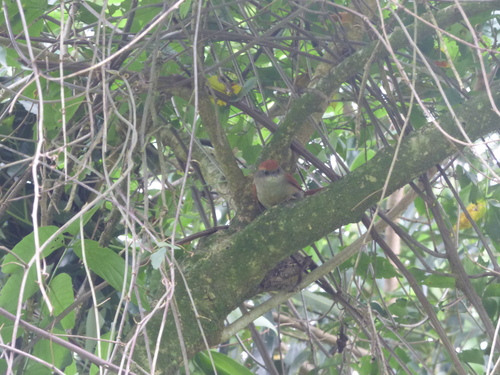 Rufous-capped Spinetail
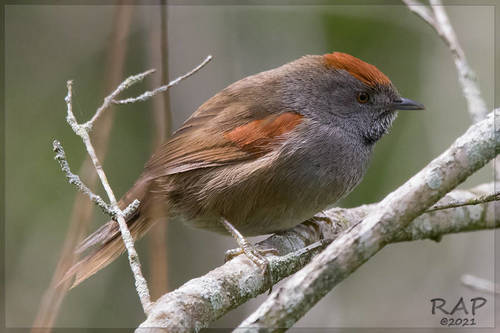 Spix's Spinetail
In short
The most reliable field mark to separate Rufous-capped Spinetail from Spix's Spinetail is the color and extent of rufous on the crown and upperparts: Rufous-capped has a striking, bright orange-rufous crown and nape, while Spix's shows a duller, more localized rufous crown. When seen well, Rufous-capped also has a much wider, buffy supercilium and a chestnut tail, contrasting with Spix's narrower pale gray supercilium and dark brown tail. Juveniles of both species are duller, but Rufous-capped juveniles still show a rufous-tinged crown, while Spix's juveniles have a grayish brown crown and ochraceous underparts. Both species are similar in size and structure, but careful attention to head pattern and tail color is key. Vocalizations are quite different and can clinch the ID if heard.
Identification tips
- Crown color (all ages): Rufous-capped Spinetail always shows a bright orange-rufous crown and nape, which is broad and obvious; Spix's has a more limited rufous crown, often duller and less extensive, especially in juveniles.
- Supercilium: Rufous-capped has a wide, buff supercilium, standing out against dark lores and ear coverts. Spix's shows a narrower, pale gray supercilium on a grayish brown face.
- Tail color: Rufous-capped's tail is chestnut and stands out as warmer and brighter than the back; Spix's tail is dark brown, matching the back and less contrasting.
- Back and wing color: Rufous-capped has a rufescent brown back and mostly chestnut-brown wings. Spix's back is dark brown, and the wings are dark brown with rufous edges on the coverts, but not as uniformly rufous as Rufous-capped.
- Throat and breast: Rufous-capped has a whitish throat with faint gray streaks and a tiny tawny chin spot (often missing in juveniles); Spix's has a grayish white throat with blackish lower throat feathers edged gray, forming a subtle patch.
- Juvenile differences: Juvenile Rufous-capped is duller but keeps a rufous-tinged crown and ochraceous/brownish underparts. Juvenile Spix's has a grayish brown crown (not rufous) and ochraceous brown underparts, with a less distinct throat patch.
- Iris color: Both have reddish brown to orange irides, not a useful separator.
- Bill and legs: Both have a black maxilla and grayish mandible, with greenish gray to gray legs; not a strong field mark.
- Tail shape: Both have graduated tails with pointed tips, so tail shape alone is not diagnostic.
- Flight views: Neither species shows a strong wing panel or contrasting upperwing pattern in flight; rely on head and tail color if seen from above.
- Habitat context: If seen in dense bamboo in forest understorey, especially in southern Brazil or Argentina, suspect Rufous-capped. In more open, shrubby second growth or disturbed habitats, especially in Uruguay or higher elevations, Spix's is more likely.
- Behavior: Both are skulking and often in pairs, but Spix's is more likely in open or secondary habitats.
- Vocalizations: Listen for a dry, rattling trill (Rufous-capped) versus a musical, bubbling phrase (Spix's). Voice is often the easiest separator if seen poorly.
- Range overlap: Both occur in much of southeastern South America, but Spix's is more widespread and common, especially in disturbed habitats.
- Pitfalls: Duller juveniles of both species can be confusing; focus on crown color (rufous vs grayish brown) and supercilium width (broad buff vs narrow pale gray) for best results.
Size
Both species are very similar in size and mass, with Rufous-capped Spinetail averaging 14.0 g and Spix's Spinetail 13.0 g [wikidata]. Rufous-capped is slightly shorter (13–17 cm) compared to Spix's (16–17 cm), but this overlap makes size unreliable in the field. Structure, including tail shape and bill, is similar and not a strong separator.
Plumage
Juvenile and adult plumages are both important for separation. Rufous-capped Spinetail of all ages shows a broad, buff supercilium and a bright orange-rufous crown and nape, with a rufescent brown back and chestnut tail. Juveniles are duller but retain a rufous-tinged crown and have an ochraceous or brownish wash below. Spix's Spinetail adults have a more restricted rufous crown, a pale gray supercilium, and a generally darker brown back and tail; the tail is dark brown rather than chestnut. Their wing coverts are dark brown with rufous edges, and the throat is grayish white with blackish lower throat feathers edged gray. Juvenile Spix's have a grayish brown crown (not rufous) and ochraceous brown underparts, with a less distinct throat patch. In flight, neither species shows a strong wing panel or contrasting upperwing pattern, so focus on head and tail coloration.
Behaviour
Both species forage in pairs and often join mixed-species flocks. Rufous-capped Spinetail is more strongly associated with bamboo stands and tends to stay in the forest understorey, occasionally moving up to the mid-storey or even the ground. Spix's Spinetail is more of a generalist, frequently occupying dense, shrubby second growth and a range of low, brushy habitats, sometimes benefiting from deforestation. Both are active, skulking birds that can be difficult to see well.
Habitat
Rufous-capped Spinetail is most often found in the undergrowth and edges of evergreen forests, especially where Chusquea bamboo is present, and is more tied to forested landscapes. Spix's Spinetail is more flexible, occurring in a variety of dense, shrubby habitats including fields, pastures, gallery forests, savannas, and secondary growth, and is generally more tolerant of disturbed or open areas. Both overlap widely in range (Argentina, Brazil, Paraguay), but Spix's extends into Uruguay and is often found at higher elevations (up to 2,200 m).
Voice
Their songs are quite distinct. Rufous-capped Spinetail gives a fast, nasal series (e.g., "di-di-di-réét" or "tdrrrWit") and a low-pitched trill or dry rattle as a call. Spix's Spinetail sings a five-syllable phrase with a bubbling quality ("sweet! bee bee bee bee") and a repeated "wee'tiddledidee"; its calls are also more musical and varied. If you hear a dry rattle, think Rufous-capped; if you hear a bubbly, musical phrase, think Spix's.
Rufous-capped Spinetail · Spix's Spinetail · My Tricky Birds