
Ruff vs Curlew Sandpiper
Calidris pugnax versus Calidris ferruginea
Play a quiz with Ruff and Curlew Sandpiper
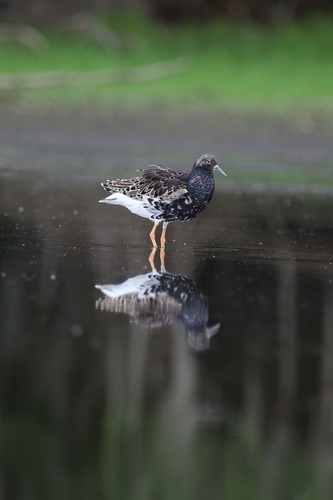 Ruff
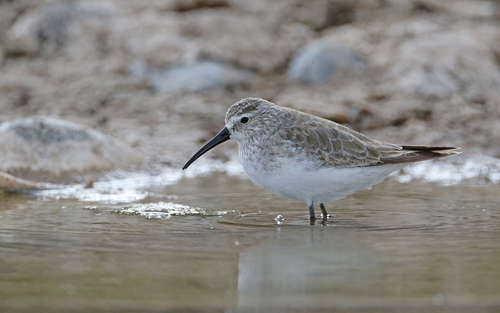 Curlew Sandpiper
In short
The most reliable field separation between Ruff and Curlew Sandpiper is structure: Ruff is bulkier, pot-bellied, with a small head, long neck, and long legs, while Curlew Sandpiper is more streamlined and compact. In flight, Curlew Sandpiper shows a bold white wing stripe and a large white rump patch, both more striking than the Ruff’s faint wing bar and white tail ovals. Juvenile and non-breeding birds of both species can appear scaly above, but Ruff is always larger and longer-legged, with a slower, deeper wingbeat. Use a combination of size, shape, and flight pattern for the most reliable separation, especially among immatures.
Identification tips
- Size and structure: Ruff is always larger, heavier, and bulkier than Curlew Sandpiper, with a pot-bellied look, long neck, and long legs. Even female Ruff dwarfs Curlew Sandpiper. Use this first, especially in mixed flocks.
- Leg color: Ruff’s leg color varies (greenish in juveniles, pink/orange in adults, sometimes red-orange in breeding males), while Curlew Sandpiper always has dark grey to black legs. This is helpful at close range, but beware of mud or lighting.
- Bill shape: Ruff has a medium-length, straight bill; Curlew Sandpiper’s bill is longer, finer, and distinctly downcurved, especially in adults. Juvenile Curlew Sandpiper may have a slightly straighter bill, so use with caution.
- Flight pattern: In flight, Curlew Sandpiper shows a broad, clear white wing stripe and a large white rump patch extending up the back—diagnostic at any age. Ruff only shows a thin, faint wing bar and white ovals at the tail sides, never a full rump patch.
- Upperwing pattern (juveniles/immatures): Juvenile Ruff has a neat, scale-like upperpart pattern with dark centers and buff underparts; Curlew Sandpiper juvenile is also scaly above but less contrasting, with a slimmer tail and more even buff tones.
- Body shape in flight: Ruff appears heavy-bodied with a small head and long neck; Curlew Sandpiper is more streamlined, with a proportionally longer, finer bill and a less pot-bellied look.
- Plumage (breeding season): Male Ruff in full breeding plumage is unmistakable with ornate ruff and head tufts. Female Ruff is more muted but still larger and bulkier than Curlew Sandpiper, which is brick-red below and on the head in breeding plumage, with a white supercilium.
- Non-breeding plumage: Both species become duller, but Ruff remains larger and more pot-bellied, with variable leg color and a plain face; Curlew Sandpiper is greyer above, white below, with a clear white supercilium and always dark legs.
- Face pattern: Curlew Sandpiper has a white eyebrow (supercilium) and a more contrasting face, especially in non-breeding plumage; Ruff’s face is plainer and rounder.
- Feeding behavior: Ruff feeds with a slow, upright gait and often wades deeper; Curlew Sandpiper is more rapid and probes with a lower stance.
- Habitat context: If inland, especially in flooded fields or freshwater marshes, Ruff is more likely; on tidal mudflats or saltpans, especially in large flocks, Curlew Sandpiper is more probable.
- Wingbeat: Ruff’s flight is slower and deeper; Curlew Sandpiper is quicker and more agile.
- Tail pattern: Curlew Sandpiper shows a large white rump patch in flight; Ruff only has white ovals at the tail sides.
- Sexual dimorphism: Only Ruff shows strong sexual dimorphism (males with ornate ruff/tufts in breeding); Curlew Sandpiper sexes are similar, with males slightly brighter in breeding plumage.
- Pitfalls: Juvenile Ruff can be confused with Curlew Sandpiper due to scaly upperparts, but always check size, structure, and flight pattern. Bill shape and leg color help but are less reliable at distance or in poor light.
Size
Ruff is substantially larger and heavier than Curlew Sandpiper. Adult Ruff averages 136 g in mass, while Curlew Sandpiper is much lighter (44–117 g). Ruff females measure 22–26 cm in length with a 46–49 cm wingspan; Curlew Sandpiper is 18–23 cm long with a 38–46 cm wingspan. Even the smallest Ruff (female) is bulkier and longer-legged than the largest Curlew Sandpiper. In the field, Ruff’s pot-bellied, long-necked look and long legs stand out, while Curlew Sandpiper is more compact and lower to the ground.
Plumage
For juveniles and non-breeding birds, both can show scaly upperparts, but Ruff juveniles have a strong buff tinge below and a more pronounced scale-like pattern above, while Curlew Sandpiper juveniles are buff-tinged but more evenly scaly and slimmer-tailed. In flight, Curlew Sandpiper of all ages shows a broad, clear white wing stripe and a large white rump patch extending up the back, sometimes with red barring in adults. Ruff in flight has only a thin, indistinct white bar on the wing and white ovals at the sides of the tail, not a full rump patch. Adult male Ruff in breeding plumage is unmistakable with elaborate ruff and tufts, but females and immatures are more subtly marked. Curlew Sandpiper in breeding plumage is rich reddish below and on the head, with a white supercilium and dark legs, while Ruff females and non-breeding birds are more muted grey-brown with variable blotching. Leg color is variable in Ruff (greenish in juveniles, pink to orange in adults, some males with red-orange in breeding), but always dark in Curlew Sandpiper.
Behaviour
Ruff is often seen in loose, sometimes large, flocks in marshes and wet meadows, feeding with a slow, deliberate gait, and stands upright with a long neck. Curlew Sandpiper is more likely to be found in tighter flocks on tidal flats and saltpans, feeding with a more rapid, probing motion and a lower stance. In flight, Ruff has a slower, deeper wingbeat, while Curlew Sandpiper is quicker and more agile. Ruff’s social structure is complex during breeding, but this is rarely relevant in field separation outside the lekking season.
Habitat
Ruff breeds in marshes and wet meadows across northern Eurasia and winters in a wide range of wetland habitats, often inland, including flooded fields and lakes. Curlew Sandpiper breeds in Arctic bogs and coastal lowlands, but winters almost exclusively on coastal tidal mudflats and saltpans. Overlap can occur on migration and in winter, but Curlew Sandpiper is much more tied to saline or brackish coastal habitats, while Ruff is more flexible and often found inland.