
Ruddy Shelduck vs Garganey
Tadorna ferruginea versus Spatula querquedula
Play a quiz with Ruddy Shelduck and Garganey
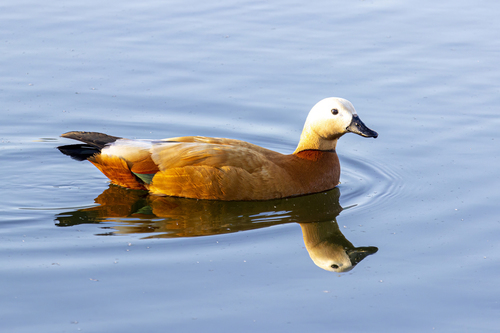 Ruddy Shelduck
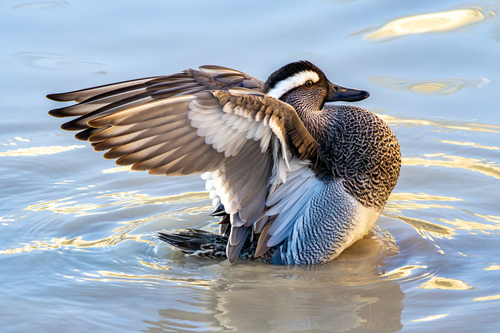 Garganey
In short
The most reliable field mark to separate Ruddy Shelduck from Garganey in any age or season is size and structure: Ruddy Shelduck is a large, heavy-bodied, orange-brown waterfowl with a pale head and striking white wing-coverts (especially obvious in flight), while Garganey is a much smaller, compact dabbling duck with a bold white supercilium (male) and no orange tones. In flight, Ruddy Shelduck shows broad white wing panels and black flight feathers, whereas Garganey (male) flashes a pale blue speculum with white borders. Juvenile and female Garganey can be confused with other small ducks, but never show the shelduck's size or color. Voice, habitat, and behavior also differ, but focus on size, structure, and wing pattern for fast separation.
Identification tips
- Size and structure: Ruddy Shelduck is much larger and bulkier than Garganey, with a long neck and upright stance. Garganey is compact, teal-sized, and sits low in the water. This is the fastest field check at any distance.
- Body color: Ruddy Shelduck is orange-brown overall with a paler (sometimes whitish) head; Garganey is never orange, always brown or grey with strong facial markings (especially in males and females/juveniles).
- Head pattern (male Garganey): Male Garganey shows a bold white supercilium (broad crescent over the eye) on a brown head, unique among ducks. Ruddy Shelduck never has this mark.
- Head color (female/juvenile Ruddy Shelduck): Females and juveniles have a pale, sometimes whitish head, contrasting with the orange-brown body. Garganey of any age never shows this contrast.
- Wing pattern in flight: Ruddy Shelduck (all ages) shows broad white wing-coverts and black flight feathers, very striking in flight. Garganey (male) shows a pale blue speculum with a white border; females have a less obvious but still pale-edged speculum. No Garganey shows the shelduck's white wing panel.
- Tail and rump: Ruddy Shelduck has a black tail and rump, contrasting with the orange body. Garganey's tail is brown and not contrasting.
- Bill and legs: Ruddy Shelduck has a black bill and dark grey legs, proportionally larger than Garganey's small, grey bill and legs. Garganey's bill is more typical of dabbling ducks, while shelduck's is stouter.
- Behavior: Ruddy Shelduck often stands upright on land and may be seen away from water. Garganey is almost always on or near water, dabbling or feeding in flocks.
- Voice: Loud, nasal honking (Ruddy Shelduck) vs. crackling call (male Garganey) or weak quack (female Garganey). If you hear a honk, it's not a Garganey.
- Habitat context: Ruddy Shelduck may be found on open lakes, rivers, or even dry land; Garganey prefers shallow, vegetated wetlands and is rarely far from cover.
- Sex and age pitfalls: Female and juvenile Ruddy Shelduck can appear duller and paler-headed, but never show the strong face pattern of Garganey. Female Garganey can be confused with other small ducks, but not with the large, pale-headed shelduck.
- Seasonal changes: Ruddy Shelduck males lose the black collar in eclipse plumage, but body color and size remain distinctive. Garganey males lose some brightness in eclipse but retain the supercilium.
- Flock composition: Garganey often in tight flocks of small ducks; Ruddy Shelduck usually in pairs or small groups, sometimes mixed with geese or larger ducks.
- When perched: Ruddy Shelduck's white wing-coverts are mostly hidden when at rest, but the orange body and pale head still stand out. Garganey shows no white wing panel at rest.
- Juvenile confusion: Juvenile Ruddy Shelduck is darker brown but still large and pale-headed; juvenile Garganey is small, brown, and shows strong face pattern. Always check size and head color in young birds.
Size
Ruddy Shelduck is far larger and heavier than Garganey: 58–70 cm in length with a 110–135 cm wingspan and a body mass around 1230 g [wikidata]. Garganey is a small dabbling duck (not measured here, but much smaller by all field experience). In the field, Ruddy Shelduck appears goose-sized, with a long neck and upright posture, while Garganey is teal-sized, compact, and sits lower in the water. Even at a distance or in mixed flocks, the size gap is immediately apparent.
Plumage
Juvenile and adult Ruddy Shelduck of both sexes show orange-brown body plumage with a paler (often whitish in females and juveniles) head, black tail and flight feathers, and broad white wing-coverts that are especially conspicuous in flight but mostly hidden when perched. Males in breeding plumage have a narrow black collar, which is lost in eclipse and in juveniles/females. Garganey males in breeding plumage are unmistakable: brown head with a bold white supercilium (broad crescent over the eye), grey body, and loose grey scapulars. In flight, they show a pale blue speculum with a white border, and white-edged tertials when swimming. Female and juvenile Garganey are brown with strong face markings: pale eyebrow, dark eye line, pale lore spot bordered by a second dark line. They never show orange tones or a pale head. No age or sex of Garganey shows the shelduck's white wing-coverts or orange body. In all ages, Garganey lacks the shelduck's black tail and flight feathers.
Behaviour
Ruddy Shelduck is often seen standing upright on land, sometimes well away from water, and may nest in holes or cliffs. It tends to be bolder and more terrestrial than Garganey, which is a classic dabbling duck, feeding by tipping up or dabbling at the water's surface. Garganey often feeds in flocks, especially on migration and in winter, and is rarely seen far from water. Female Garganey may shake their heads frequently when dabbling, a subtle behavioral clue.
Habitat
Both species can occur on large inland water bodies, but Ruddy Shelduck is more likely to be found on open lakes, reservoirs, rivers, and sometimes well away from water, especially in its breeding range. Garganey breeds in marshes and shallow wetlands with abundant vegetation, and is strictly migratory, wintering in tropical regions. In winter, Garganey forms large flocks on shallow lakes and marshes. If you see a large, orange-brown duck on a bare shore or open steppe, it's likely Ruddy Shelduck; a small, brownish duck in a vegetated marsh is more likely Garganey.
Voice
Ruddy Shelduck gives loud, nasal honking calls, easily heard at a distance, both on the ground and in flight. The calls differ between sexes, but both are loud and distinctive. Garganey males have a crackling mating call, while females are mostly silent, sometimes giving a weak quack. In mixed flocks, the shelduck's voice is much more prominent and goose-like.