

Ruddy Duck vs White-headed Duck
Oxyura jamaicensis versus Oxyura leucocephala
Play a quiz with Ruddy Duck and White-headed Duck
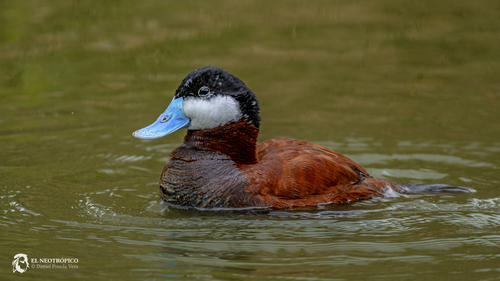 Ruddy Duck
 White-headed Duck
In short
The best field mark to separate Ruddy Duck from White-headed Duck is the head pattern in adult males: Ruddy Duck males have a blackish cap with bright white cheeks, while White-headed Duck males show a mostly white head with a black crown and neck. Females and immatures are trickier, but note the cheek pattern: female Ruddy Ducks have a blurry stripe across a pale cheek patch, while female White-headed Ducks show a darker cap and cheek stripe on a pale face. In flight, both species have dark upperwings, so wing pattern is not a reliable separator. Structure is similar, but White-headed Duck is slightly bulkier and longer. Bill color in breeding males (blue in both) is not diagnostic, but bill size and shape may help with careful observation.
Identification tips
- Adult male head pattern: Ruddy Duck has a blackish cap with bright white cheeks; White-headed Duck shows a mostly white head with a black crown and neck. This is the most reliable field mark for adult males in all seasons.
- Female/immature head pattern: Female Ruddy Duck has a pale cheek patch with a blurry dark stripe; female White-headed Duck has a white face with a darker cap and a more distinct cheek stripe. Look for the clarity and placement of the cheek stripe.
- Bill color (breeding males): Both species' breeding males have blue bills, so this is not diagnostic. In non-breeding season, Ruddy Duck's bill turns gray, while White-headed Duck's bill color is less variable but still dark in females.
- Body color (adult males): Ruddy Duck males in breeding plumage are rich chestnut below the neck; White-headed Duck males are reddish-grey. This is subtle and can be hard to judge in poor light.
- Tail posture: Both species have long, stiff tails often held upright, but this is not a separator between them.
- Size and structure: White-headed Duck is bulkier and longer than Ruddy Duck, but the difference is subtle and may be hard to judge without direct comparison.
- Flight pattern: Both species have rapid wingbeats and fly low over water. In flight, both show solidly dark upperwings, so do not rely on wing pattern for separation.
- Bill shape: Ruddy Duck has a short, stout, scoop-shaped bill; White-headed Duck's bill is also broad but may appear slightly larger in proportion to the head in the field, especially in males.
- Behavior: Ruddy Duck is more likely to perform the 'bubbling' display (male beating bill on breast to create bubbles). If observed, this is diagnostic for Ruddy Duck.
- Habitat context: In the UK, a stiff-tailed duck with these features is more likely to be Ruddy Duck (unless in a known White-headed Duck site); in Spain, White-headed Duck is more likely, but beware of introduced Ruddy Ducks and hybrids.
- Hybridization: Be aware that hybrids occur and can show intermediate features, especially in Spain and the UK. If the bird shows a mix of head patterns or intermediate bill color, consider hybrid origin.
- Sex and season: Always consider sex and season, as non-breeding males and females of both species are duller and more similar. Focus on head pattern and cheek stripe clarity.
- Cheek stripe in females/immatures: The cheek stripe in female White-headed Duck is usually sharper and darker than in Ruddy Duck, where it is blurry and less distinct.
- Bill color in females: Female White-headed Duck has a dark bill; female Ruddy Duck's bill is duller and less contrasting.
- Plumage pitfalls: Do not rely on upperwing pattern in flight for any age or sex, as both species show solidly dark wings.
Size
White-headed Duck is noticeably heavier on average (665 g vs 545 g for Ruddy Duck) and slightly longer (43–48 cm vs Ruddy Duck's smaller, more compact build) [wikidata, wikipedia]. In the field, this translates to a somewhat bulkier, longer-bodied impression for White-headed Duck, though both are small, stiff-tailed ducks. Females of both species are smaller than males, but the difference between species is still apparent.
Plumage
-
Juvenile/immature/first-winter: Both species lack strong wing pattern in flight; upperwings appear solidly dark, so flight views of young birds are not diagnostic by wing panel or trailing edge. Focus on head pattern: Ruddy Duck immatures/females show a pale cheek patch with a blurry dark stripe, while White-headed Duck females/immatures have a pale face with a darker crown and a more distinct cheek stripe.
-
Adult male breeding: Ruddy Duck: blackish cap, bright white cheeks, rich chestnut body, bright blue bill. White-headed Duck: mostly white head with black crown and neck, blue bill, reddish-grey body.
-
Adult male non-breeding: Ruddy Duck: duller gray-brown above, paler below, gray bill, still with white cheeks and darker cap. White-headed Duck: less vibrant, but retains white head with black crown and neck.
-
Adult female: Ruddy Duck: brownish overall, pale cheek patch with blurry dark stripe. White-headed Duck: grey-brown body, white face with dark cap and cheek stripe, dark bill.
-
In flight: Both show solidly dark upperwings, so wing pattern is not useful for separation.
Behaviour
Both species are diving ducks with a preference for swimming and diving over flying. Ruddy Ducks are known for holding their stiff tails cocked upward and rarely fly, preferring to swim away from danger. When they do fly, it's with rapid wingbeats low over water. White-headed Ducks also prefer to swim away from threats and are reluctant to fly. Both species forage underwater, but Ruddy Ducks are particularly noted for tactile foraging with their bills. Courtship displays differ: Ruddy Duck males perform a unique 'bubbling' display, beating their bill on their breast to create bubbles.
Habitat
Both species inhabit marshy lakes and ponds with open water and dense marginal vegetation. Ruddy Duck is native to the Americas but has established invasive populations in Europe, especially the UK. White-headed Duck is native to Spain, North Africa, and parts of Asia, and is now endangered due to habitat loss. In regions where both occur (notably Spain and the UK), context may help: Ruddy Duck is more likely in the UK, White-headed Duck in Spain, but both can occur together due to introductions and hybridization.
Voice
Neither species is very vocal. Ruddy Duck males produce a distinctive drumming or 'bubbling' sound during courtship by beating their bill on their breast, often creating visible bubbles. White-headed Duck vocalizations are not described in the sources, so voice is not a reliable separator in the field.