

Rosy-billed Pochard vs Redhead
Netta peposaca versus Aythya americana
Play a quiz with Rosy-billed Pochard and Redhead
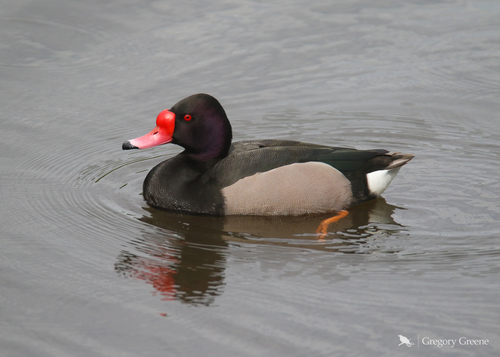 Rosy-billed Pochard
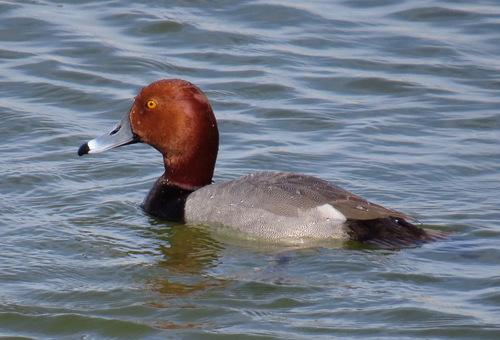 Redhead
In short
The most reliable field mark between Rosy-billed Pochard and Redhead is the male's bill: Rosy-billed Pochard males have a bright red bill with a large, rounded knob at the base, while Redhead males show a pale blue bill with a black tip and no knob. In flight, Rosy-billed Pochard of both sexes show a striking white stripe across the primaries and secondaries, visible only with wings outstretched, while Redhead lacks this feature. Females and immatures are trickier, but Rosy-billed Pochard females have a bluish-gray bill and a contrasting white crissum (under-tail area), unlike the more uniformly brown Redhead female. Both species are similar in size and shape, so focus on bill color/shape, wing pattern in flight, and under-tail contrast for confident separation.
Identification tips
- Male bill shape and color: Rosy-billed Pochard males have a bright red bill with a large, rounded knob at the base; Redhead males have a pale blue bill with a black tip and no knob. This is the single most reliable field mark for adult males in all seasons.
- Wing pattern in flight (all ages/sexes): Rosy-billed Pochard shows a broad white stripe across the primaries and secondaries, visible only when wings are outstretched. Redhead lacks any such white wing panel; its upperwing is plain gray-brown.
- Under-tail (crissum) contrast (females/immatures): Female and immature Rosy-billed Pochards have a sharply contrasting white crissum (under-tail area), while Redhead females and immatures are more uniformly brown below.
- Female/immature bill color: Rosy-billed Pochard females and immatures have a bluish-gray bill with a black tip; Redhead females have a duller, more uniformly grayish bill, lacking the blue tone.
- Male head color (breeding): Redhead males have a coppery-red head and neck with yellow eyes; Rosy-billed Pochard males have a purplish-black head and red eyes. In nonbreeding season, Redhead males become browner but still lack the bill knob.
- Eye color (males): Redhead males have yellow eyes; Rosy-billed Pochard males have red eyes. This is subtle at distance but can help with close views.
- Bill knob (males): Only Rosy-billed Pochard males have a prominent bill knob, which becomes larger and brighter in the breeding season.
- Side and breast color: Both species have gray sides and black breasts in males, so this is not a reliable separator.
- Leg color: Rosy-billed Pochard legs are yellow to orange (sometimes gray in females), but this is rarely visible in the field.
- Flight style: Rosy-billed Pochard may appear to have faster, more labored wingbeats and a slightly less agile takeoff due to blunt-tipped wings and rear-placed legs, but this is subtle and not diagnostic on its own.
- Habitat and range: Rosy-billed Pochard is South American, Redhead is North American. Out of range, check all field marks carefully.
- Vocalizations: Both are quiet; Rosy-billed Pochard gives a deep, quiet honk, while Redhead males have cat-like or cough-like calls in courtship. Voice is rarely useful for separation.
- Eclipse/nonbreeding plumage: Rosy-billed Pochard males do not have a dull eclipse plumage, unlike some other ducks, but Redhead males do become browner in nonbreeding season. Bill and wing marks remain the best clues.
- Jizz/structure: Both are medium-sized, rounded diving ducks. Structure is not a reliable separator between these two.
- Juvenile confusion: Juvenile Rosy-billed Pochards look like females but are darker below; the white crissum and bluish bill still help separate from juvenile Redhead.
Size
Both species are very close in size and mass: Rosy-billed Pochard averages 1092.5g and Redhead 1045g [wikidata], with similar lengths (Rosy-billed up to 56cm, Redhead 40–56cm) and wingspans (Rosy-billed 72–84cm, Redhead 74–84cm) [wikipedia]. Males of both species are slightly larger than females, but this difference is subtle and not useful in the field. Overall, size is not a reliable separator between these two ducks.
Plumage
Juvenile and female Rosy-billed Pochards are brown overall but show a distinctive white crissum (under-tail area) and a bluish-gray bill with a black tip. In contrast, female and immature Redheads are more uniformly brown, lacking the sharply contrasting white under-tail. In flight, Rosy-billed Pochard of all ages and sexes display a broad white stripe across the primaries and secondaries, visible only when the wings are fully outstretched—a key mark not present in Redhead. Adult male Rosy-billed Pochards have a purplish-black head and neck, gray sides, and a bright red bill with a large knob, while Redhead males have a coppery-red head, pale blue bill with a black tip, and yellow eyes. Nonbreeding male Redheads lose the copper tone and become browner, but still lack the bill knob and white crissum. Both species have gray sides and black breasts, but the bill and under-tail area are the best plumage clues.
Behaviour
Both species are diving ducks, but Rosy-billed Pochard often feeds more like a dabbling duck, tipping up for seeds and aquatic plants. Both are strong fliers, but Rosy-billed Pochard has blunt-tipped wings and requires faster wingbeats to take off, sometimes appearing less agile on land due to rear-placed legs. These subtleties are rarely diagnostic in the field, but may be noticed with prolonged observation.
Habitat
Rosy-billed Pochard is endemic to South America (Argentina, Chile, Paraguay, Uruguay, southern Brazil), favoring lakes, marshes, and rice fields, while Redhead is native to North America. If seen in their typical ranges, geography is a strong clue, but both can occur as vagrants. Both species use similar wetland habitats, so context is only helpful when combined with range.
Voice
Rosy-billed Pochard has a deep, quiet 'honk' that is less conspicuous than a Mallard's. Redhead males produce a cat-like call and a cough-like sound during courtship, but neither species is highly vocal or likely to be identified by voice alone in the field.