
Rook vs Common Raven
Corvus frugilegus versus Corvus corax
Play a quiz with Rook and Common Raven
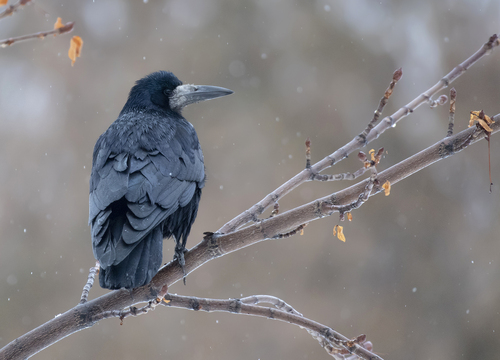 Rook
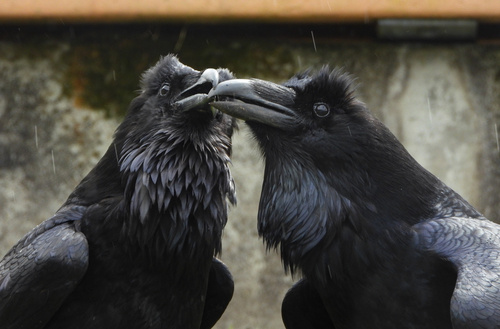 Common Raven
In short
The most reliable field mark to separate Rook from Common Raven is the Rook's bare, whitish facial skin at the base of the bill, which is present in adults but absent in juvenile Rooks and all ages of Raven. In flight, Common Raven shows a long, wedge-shaped tail and broader wings, while Rook has proportionally longer, narrower wings and a more squared tail. Juvenile Rooks can be tricky, as they lack the bare facial skin and may resemble crows or small ravens, but their thinner beak and shaggier leg feathering help. Ravens are much larger and bulkier, with a heavier, more arched bill and a shaggier throat. Both are all-black, but subtle differences in structure and flight style are key in the field.
Identification tips
- Bare whitish facial skin (adults only): Adult Rooks have a pale, featherless patch around the bill base and in front of the eye. No Raven of any age shows this; juvenile Rooks lack it until about six months old.
- Bill structure: Raven's bill is much larger, heavier, and more arched, with long bristles above the base. Rook's bill is thinner and more pointed, especially in juveniles.
- Throat feathers: Raven has a shaggy, pointed 'beard' of throat feathers, especially obvious when calling. Rook's throat is less shaggy, but the leg feathering is shaggier and laxer than Raven.
- Tail shape in flight: Raven's tail is long and wedge-shaped (diamond or triangular when spread), while Rook's tail is more squared or slightly rounded.
- Wing shape in flight: Raven has broader wings with longer 'fingers' (primary feathers) and a larger wing area, giving a more stable, soaring flight with less flapping. Rook's wings are proportionally longer and narrower, and flight is more direct and less soaring.
- Size and bulk: Ravens are much larger and heavier, with a more massive head and bill. If the bird looks crow-sized or only slightly larger, it's not a Raven.
- Plumage gloss: Both are glossy black, but Rook often shows a blue or bluish-purple sheen in sunlight; Raven is more iridescent overall.
- Juvenile confusion: Juvenile Rooks lack the pale facial skin and can look like small Ravens or crows. Look for the thinner bill and shaggier leg feathering to separate from Raven.
- Leg feathering: Rook's legs appear shaggier due to laxer feathering, especially compared to the smoother-legged Raven.
- Iris color (close views): Juvenile Raven has a blue-grey iris and pinkish gape; both species have dark brown irises as adults.
- Vocalization: Rook gives high-pitched 'caw' calls; Raven's deep croak is unmistakable and much lower in pitch.
- Behavior: Rooks are often in flocks, especially in open farmland; Ravens are usually solitary or in pairs, except for subadult roosts.
- Habitat: Rook favors farmland and human-altered landscapes; Raven is more likely in wild, remote, or mountainous areas.
- Flight style: Ravens soar and glide with little flapping, often performing acrobatics. Rooks have a steadier, more direct flight.
- Context: If seen in a rookery (large colony of nests), it's a Rook. Ravens do not nest colonially.
Size
Common Raven is substantially larger and heavier than Rook. Raven averages about 946 g in mass and 66 cm in length, with a wingspan up to 153 cm, making it one of the heaviest passerines. Rook is about half the mass (454 g), shorter (44–46 cm), and has a wingspan up to 99 cm. In the field, Ravens appear bulkier, with a larger head and bill, and a more imposing presence both perched and in flight.
Plumage
- Juvenile/immature birds: Juvenile Rooks lack the adult's bare whitish facial skin, appearing all-black with a slight greenish gloss and brownish-black on the hind neck, back, and underparts. Their beak is thinner than a Raven's, and they have shaggier leg feathering. Juvenile Ravens are also all-black but duller than adults, with a blue-grey iris and pinkish gape at first. No bare facial skin at any age in Raven.
- Adults: Adult Rooks are glossy black with a blue or bluish-purple sheen in sunlight, dense silky feathers on the head and neck, and a distinctive bare whitish patch at the bill base. Ravens are also glossy black, but with a more iridescent sheen, shaggy throat feathers, and a large, arched bill. The tail is wedge-shaped in Raven, more squared in Rook. Both have dark brown irises, but only Rook shows the pale facial skin in adulthood.
Behaviour
Rooks are highly gregarious, often seen in noisy flocks and nesting in colonies (rookeries), especially in open farmland or near human settlements. They forage in groups and are rarely solitary. Ravens are more often seen alone or in pairs, especially adults, and are less likely to form large flocks except among subadults at roosts. Ravens soar with less wing-flapping and can be seen performing acrobatic flight displays. Rooks tend to have a more direct, purposeful flight, often commuting between feeding and roosting sites.
Habitat
Rooks are birds of open country, farmland, and rural areas across the Palearctic, often near human habitation and agricultural land. They are rarely found in truly wild or mountainous areas. Ravens have a much broader habitat range, found across the Northern Hemisphere in wild, remote, and rugged landscapes—mountains, forests, coastlines, tundra, and deserts—as well as occasionally in open country. If you see a large corvid in a wild, remote area, it is much more likely to be a Raven; in farmland or near villages, Rook is more likely.
Voice
Rook calls are higher-pitched and less resonant than Raven, often described as 'kaah' or 'caw', typical of crows. Common Raven has a deep, sonorous croak, much lower and more powerful than any Rook vocalization. Even at a distance, the Raven's call is distinctive and carries further. Vocalizations are a strong clue if the bird is calling.