

Rock Partridge vs European Honey-buzzard
Alectoris graeca versus Pernis apivorus
Play a quiz with Rock Partridge and European Honey-buzzard
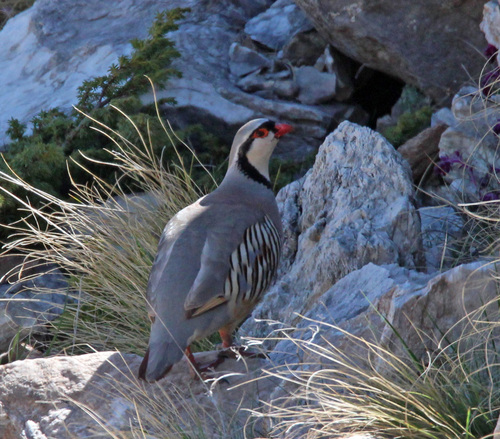 Rock Partridge
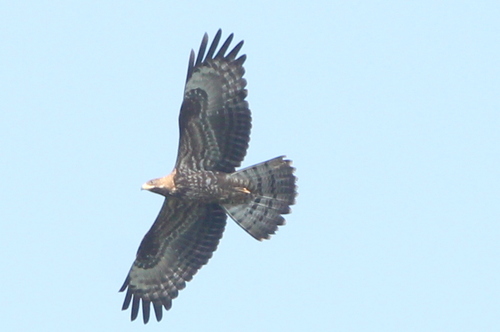 European Honey-buzzard
In short
The most reliable way to separate Rock Partridge from European Honey-buzzard is by overall structure and flight style: Rock Partridge is a plump, ground-dwelling gamebird with rounded wings and short flights, while European Honey-buzzard is a long-winged raptor that soars with flat, outstretched wings and a small, protruding head. In all ages, the partridge shows a white face with a sharply defined black gorget, whereas the honey-buzzard has a small, blue-grey (male) or brown (female) head and a much longer tail with distinctive dark bars. If seen in flight, note the honey-buzzard’s long, flat wings and long tail, which are never matched by the partridge. Even on the ground, the partridge’s red legs and rotund shape are unlike any raptor. Confusion is most likely at a distance or in poor views, but careful attention to shape and flight will always separate them.
Identification tips
- Flight style is diagnostic: Rock Partridge flies only short distances, low to the ground, on rounded wings; European Honey-buzzard soars for long periods on flat, broad wings with a long tail. If you see a bird circling high or gliding, it is not a partridge.
- Structure: Partridge is plump, short-necked, with a small, rounded head and short tail; honey-buzzard is long-necked, small-headed, with a long tail and long wings. The honey-buzzard’s head often protrudes forward in flight, sometimes with a slight downward kink.
- Face pattern: Rock Partridge always shows a white face with a sharply defined black gorget (neck band); honey-buzzard has a plain blue-grey (male) or brown (female) head, never with a gorget or white face.
- Leg color: Partridge has conspicuous red legs, visible when perched or walking; honey-buzzard’s legs are not visible at a distance and never bright red.
- Tail pattern: Honey-buzzard has a long tail with two narrow dark bars and a broad subterminal bar; partridge’s tail is short and not distinctly barred.
- Wing shape: Partridge’s wings are short and rounded; honey-buzzard’s are long, broad, and held flat in soaring flight.
- Plumage color: Partridge is light brown above, grey on the breast, buff on the belly, with rufous streaks on the flanks; honey-buzzard is variable but never shows this combination or the partridge’s face pattern.
- Behavior: Partridge prefers to run when disturbed and is almost always seen on the ground; honey-buzzard is usually seen soaring or perched in trees.
- Habitat: Partridge is found in rocky, open, or mountainous areas; honey-buzzard is a woodland and forest specialist.
- Voice: Partridge’s call is a harsh, repeated ga-ga-ga-ga-chakera; honey-buzzard’s is a clear, whistled peee-lu.
- Sex differences: Only relevant for honey-buzzard—males have a blue-grey head, females brown. Partridge shows little sexual dimorphism in the field.
- Juvenile confusion: Juvenile honey-buzzards can mimic Buteo buzzards but never show the partridge’s face or body shape; juvenile partridges look like adults but may be duller.
- Size impression: Honey-buzzard appears much larger and longer-winged than partridge, especially in flight.
- Common pitfalls: At a distance, a partridge flushed into flight may appear raptor-like for a moment, but note the short, rounded wings and direct, low flight.
- Context clues: If you see a bird walking or running in open rocky terrain, it is a partridge; if soaring high or displaying over woodland, it is a honey-buzzard.
Size
Rock Partridge is a medium-sized, heavy-bodied gamebird (average mass ~632.5g [wikidata]), compact and rotund. European Honey-buzzard is a much larger bird overall, with a body length of 52–60 cm and a wingspan of 130–150 cm [wikipedia], but is not as heavy-bodied as it looks—its mass overlaps with the partridge but its long wings and tail make it appear much larger and more elongated in flight. The partridge is always short-winged and chunky, while the honey-buzzard is long-winged and slim, especially when soaring.
Plumage
No age-specific upperwing or flight marks are described for Rock Partridge, but its plumage is distinctive: adults and immatures alike have a light brown back, grey breast, buff belly, white face with a sharply defined black gorget, and rufous-streaked flanks. The legs are red. European Honey-buzzard, in all ages, has a much more raptor-like pattern: long wings, a long tail with two narrow dark bars and a broad subterminal bar, and a small head. Males have a blue-grey head; females are browner and slightly larger. The honey-buzzard’s underparts and upperparts are variable, but it never shows the partridge’s face pattern, gorget, or red legs. In flight, the honey-buzzard’s wings are flat and broad, with a longer tail and fewer tail bars than typical Buteo buzzards. Juvenile honey-buzzards can superficially resemble Buteo buzzards, but never look like a partridge.
Behaviour
Rock Partridge is terrestrial, preferring to run rather than fly when disturbed; flights are short, low, and on rounded wings. It is almost always seen on the ground or making brief, direct flights. European Honey-buzzard is a soaring raptor, often seen gliding high on flat wings, with a distinctive long-necked, small-headed profile. It spends much time in the air and, when on the ground, is secretive and usually in forested areas. The partridge’s behavior—walking or running in open rocky areas—is never matched by the honey-buzzard.
Habitat
Rock Partridge is native to southern Europe and favors rocky hillsides, open scrub, and mountainous terrain. It is a ground-dweller, rarely venturing into dense forest. European Honey-buzzard breeds in woodland and forested areas across Europe and western Asia, and is rarely seen in open rocky habitats. If you see a bird in open, rocky terrain, especially on the ground, it is almost certainly a partridge; a soaring bird over woodland is likely a honey-buzzard.
Voice
Rock Partridge has a noisy, repeated call described as ga-ga-ga-ga-chakera-chakera-chakera. European Honey-buzzard’s call is a clear, whistled peee-lu. The partridge’s call is much harsher and more repetitive, while the honey-buzzard’s is a simple, plaintive whistle. Vocalizations are rarely confused if heard well.