

Ring-necked Duck vs Tufted Duck
Aythya collaris versus Aythya fuligula
Play a quiz with Ring-necked Duck and Tufted Duck
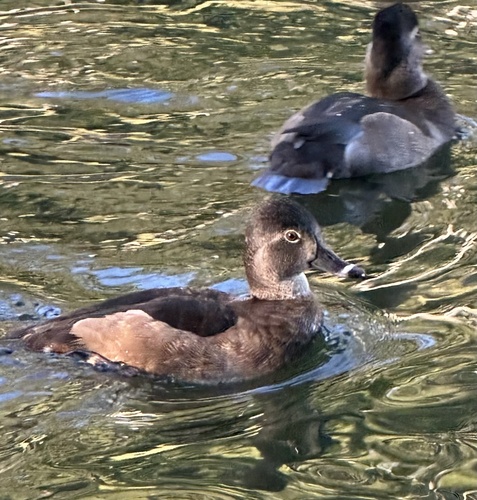 Ring-necked Duck
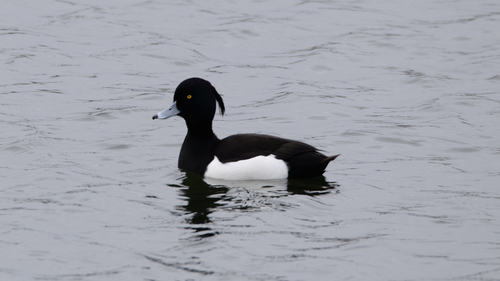 Tufted Duck
In short
The most reliable field mark for separating Ring-necked Duck from Tufted Duck is the presence of a prominent head tuft in Tufted Duck males, which is absent in Ring-necked Duck. Both species are medium-sized diving ducks with similar body shapes and contrasting black-and-white plumage in males, but careful attention to head shape, bill pattern, and subtle plumage differences is needed, especially in females and immatures. Ring-necked Duck males show two pale rings on the bill and a more angular, peaked head, while Tufted Duck males have a rounded head with a distinct rear tuft. Females of both species are brown, but Ring-necked females have a pale eye ring and subtler bill markings. Habitat and range can help: Ring-necked Duck is North American, Tufted Duck Eurasian, but vagrants do occur. Voice and behavior are rarely diagnostic at a distance.
Identification tips
- Head tuft (male Tufted Duck): Adult male Tufted Ducks have a long, drooping tuft at the rear of the head, visible at rest and in flight. Ring-necked Duck never shows a tuft; its head is peaked and angular, especially at the rear crown. This is the single most reliable mark for adult males.
- Bill pattern (both sexes): Ring-necked Duck of both sexes shows two pale rings on a gray bill: one near the tip and one at the base. Tufted Duck has a plain blue-gray bill with a black tip but lacks the double ring pattern.
- Head shape: Ring-necked Duck has a noticeably angular, peaked head profile, with the highest point toward the rear crown. Tufted Duck has a more rounded head, especially in females and non-breeding males, except for the tuft in males.
- Male flank color: Both males have white flanks, but Tufted Duck's are brighter and more extensive, contrasting sharply with the black upperparts. Ring-necked Duck's white flanks are separated from the black back by a vertical gray line and often look less clean.
- Breast and back (male): Ring-necked Duck males have a white breast and black back, while Tufted Duck males are all black above except for the white flanks.
- Female face pattern: Female Ring-necked Ducks show a distinct pale eye ring and a pale line behind the eye, plus a more contrasting face. Female Tufted Ducks have a plainer brown face, sometimes with a small pale patch at the bill base but lacking a strong eye ring.
- Female bill: Female Ring-necked Ducks have a dark bill with a subtle pale band near the tip; Tufted Duck females have a blue-gray bill with a black tip and may show a small pale area at the base, but not a full band.
- Eye color: Male Ring-necked Ducks have bright yellow eyes; Tufted Duck males have golden yellow eyes. Female Ring-necked Ducks have brown eyes with a white ring, while female Tufted Ducks have darker eyes and lack the ring.
- Neck ring: The cinnamon neck ring of Ring-necked Duck is rarely visible and should not be relied on as a field mark.
- Voice: Calls are not usually helpful, but if heard, female Ring-necked Duck gives a trrr, female Tufted Duck a harsh 'karr.'
- Habitat and range: Use with caution. Ring-necked Duck is expected in North America, Tufted Duck in Eurasia, but both species can occur as vagrants.
- Juvenile/immature flight: No distinctive upperwing or flight pattern differences are described for separating juveniles or immatures in flight between these two species. Focus on head shape and bill pattern if possible.
- Courtship behavior: If observed, Tufted Duck males may give a 'wit-oo' whistle, but this is rare outside the breeding season.
- Mixed flocks: Both species may associate with scaup and other Aythya ducks. Be cautious of scaup confusion, especially with female Tufted Duck, but note the tuft (male) or face pattern (female) for separation.
- Pitfalls: Female and immature plumages are the most challenging. Always check for the presence or absence of a tuft, head shape, bill pattern, and face markings before relying on overall color or size.
Size
Both species are small-to-medium diving ducks and are very close in size, with Ring-necked Duck averaging about 707.5 g in body mass [wikidata]. Males are slightly larger than females in both species, but this is not a reliable field mark. Length and wingspan overlap considerably, so size alone is not a safe separator in the field.
Plumage
No distinctive age-specific upperwing or flight pattern marks are described for either species that reliably separate immatures or juveniles in flight. In adult males, Tufted Duck is all black with white flanks and a prominent head tuft, while Ring-necked Duck males have a shiny black angular head, black back, white breast, and flanks, plus two white rings on a gray bill. The cinnamon neck ring of Ring-necked Duck is rarely visible. Female Ring-necked Ducks are grayish-brown with a pale eye ring and a dark bill with a faint pale band, while female Tufted Ducks are brown with paler flanks and sometimes a small pale area at the bill base. Tufted Duck females lack the strong eye ring and have a more uniform face. Both species have yellow or golden eyes in males, but female Ring-necked Ducks have brown eyes with a white ring.
Behaviour
Both species are diving ducks and often feed by diving or dabbling. No major behavioral differences are described that are useful for field separation. Both may be seen in mixed flocks with other Aythya ducks and can be wary or approachable depending on location.
Habitat
Ring-necked Duck is native to North America and is found on freshwater ponds and lakes, especially in wooded or boreal regions. Tufted Duck is native to northern Eurasia and is also found on freshwater lakes and ponds, with partial migration. While habitat and range can be helpful, vagrants of both species occur, so always confirm with plumage and structure.
Voice
Vocalizations are not usually diagnostic at a distance. Female Ring-necked Duck gives a trrr call, while female Tufted Duck gives a harsh, growling 'karr' in flight. Males of both species are mostly silent, with Tufted Duck males giving a simple 'wit-oo' whistle in courtship. Calls are rarely heard in typical field conditions outside the breeding season.