
Redwing vs American Robin
Turdus iliacus versus Turdus migratorius
Play a quiz with Redwing and American Robin
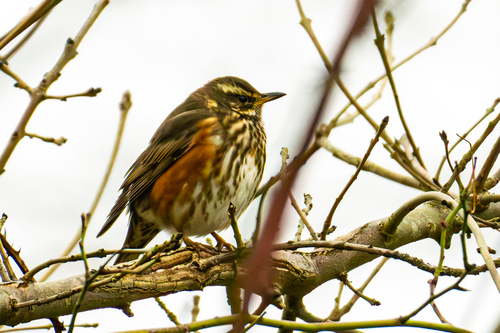 Redwing
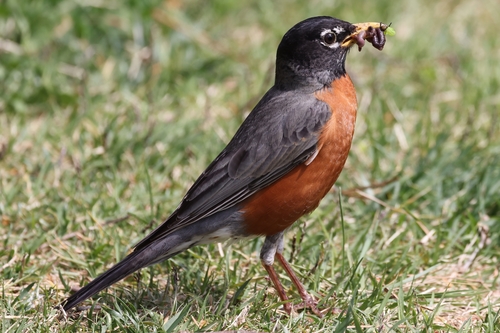 American Robin
In short
The most reliable field mark to separate Redwing from American Robin is the Redwing’s bold creamy white supercilium (eyebrow) and the distinctive rusty-red patches on its flanks and underwing, which are never shown by American Robin. American Robin, in contrast, has a solid reddish-orange breast and lacks both the strong supercilium and red underwing. Juvenile American Robins have spotted breasts, but never show the Redwing’s combination of white eyebrow and red flanks. Both are medium-sized thrushes, but American Robin is noticeably bulkier and longer. In flight or perched, focus on the face pattern and underwing color for a quick and confident separation.
Identification tips
- Supercilium (eyebrow): Redwing always shows a bold, creamy white supercilium, visible in all ages and plumages. American Robin never has a true supercilium, only broken white eye arcs.
- Red Flanks and Underwing: Redwing has rusty-red flanks and underwing coverts, visible both perched and especially in flight. American Robin never shows red on the flanks or underwing.
- Breast Color: American Robin has a solid reddish-orange breast (adults), while Redwing has white underparts with dark brown spots.
- Head Pattern: Redwing’s head is brown with a strong white supercilium; American Robin’s head is darker (gray to blackish in males), with white arcs above and below the eye but no full eyebrow.
- Juvenile Plumage: Juvenile American Robins have a spotted breast and whitish wing coverts, but lack the Redwing’s supercilium and red flanks. Juvenile Redwings look like adults, with all key marks present.
- Size and Structure: American Robin is bulkier, longer, and heavier than Redwing. Redwing is more compact and slimmer.
- Bill: American Robin’s bill is mainly yellow with a dark tip (especially in winter); Redwing’s bill is less brightly colored and more uniformly dark.
- Belly and Undertail: American Robin has a white belly and undertail coverts contrasting with the orange breast; Redwing’s underparts are white with spots, and the undertail is not sharply contrasting.
- Sex Differences: Female American Robins are duller but still lack the supercilium and red flanks; Redwing sexes are similar.
- Flight View: In flight, Redwing’s red underwing and flanks are diagnostic; American Robin’s underwing is plain and never red.
- Habitat and Range: In North America, American Robin is common; Redwing is extremely rare. In Europe, Redwing is common in winter; American Robin is a vagrant.
- Behavior: American Robins are bolder around people and often seen in gardens; Redwings are shyer and more likely in rural fields and hedges.
- Vocalization: Redwing’s flight call is a clear whistle; American Robin’s is a sharp 'tut' or 'whinny.' Song is not usually diagnostic unless learned well.
- Season: Both species can occur in flocks outside the breeding season, but context (location and time of year) helps confirm ID.
- Pitfalls: Do not confuse American Robin’s white eye arcs for a supercilium; always check for the full creamy eyebrow and red flanks of Redwing.
Size
American Robin is consistently larger and heavier than Redwing. Redwing averages about 62 g in body mass, with a length of 20–24 cm and wingspan of 33–34.5 cm. American Robin averages 77.3 g, with a length of 23–28 cm and wingspan of 31–41 cm. In the field, American Robin appears bulkier and longer-bodied, while Redwing is more compact and slightly slimmer. This size difference is usually noticeable when both species are seen together, but can be subtle if seen alone.
Plumage
Juvenile American Robins have a pale, spotted breast and whitish wing coverts, but never show a strong supercilium or red flanks. Juvenile and adult Redwings of all ages have a prominent creamy white eyebrow and rusty-red flanks and underwing, which are diagnostic in all plumages. Adult American Robins have a uniform reddish-orange breast, gray to blackish head with white eye arcs (not a full supercilium), and a white belly and undertail. Redwings, by contrast, have brown upperparts, white underparts with dark spots, and always show the red flanks and underwing, plus the bold supercilium. Female American Robins are duller but still lack the Redwing’s face and flank pattern. First-year American Robins may retain some juvenile feathers but do not acquire the Redwing’s key marks.
Behaviour
Both species are thrushes and may be seen foraging on lawns or in open areas, often hopping or running on the ground. American Robins are more likely to be seen in urban parks and gardens, sometimes in large flocks in winter, and are not shy around people. Redwings are more often found in flocks during migration and winter, especially in open fields, hedgerows, or woodland edges, and are generally more wary. Flight style is similar: steady, direct, with bursts of rapid wingbeats, but American Robin may appear heavier and more deliberate in flight.
Habitat
Redwing breeds in northern Europe and the Palearctic, favoring conifer and birch forests and tundra, and winters in open country, hedgerows, and woodland edges. American Robin is widespread across North America, breeding in a variety of habitats including forests, gardens, parks, and urban areas, and winters from southern Canada to central Mexico. In Europe, American Robin is a rare vagrant; in North America, Redwing is extremely rare. If you are in North America, the default is American Robin; in Europe, Redwing is far more likely.
Voice
Redwing’s song is varied and includes short, whistling, and sometimes harsh introductory notes followed by a complex, fast pattern. Its flight call is a clear, whistling note. American Robin’s song is a series of rich, melodious phrases, often described as cheerily-cheer-up-cheerio, and its call is a sharp, liquid 'tut' or 'whinny.' Redwing’s song is more variable and less musical than the American Robin’s, but voice is rarely the most practical field mark for separation unless the birds are singing.