

Red-pate Cisticola vs Winding Cisticola
Cisticola ruficeps versus Cisticola marginatus
Play a quiz with Red-pate Cisticola and Winding Cisticola
 Red-pate Cisticola
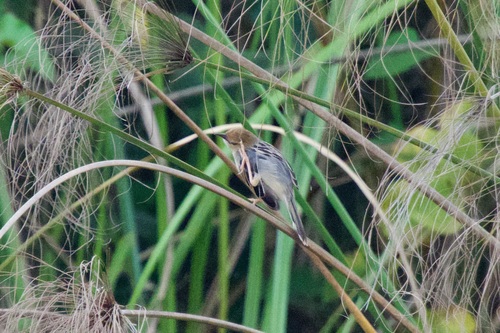 Winding Cisticola
In short
The most reliable way to separate Red-pate Cisticola from Winding Cisticola is by focusing on the head pattern: Red-pate Cisticola shows a distinct reddish crown (the 'red pate'), which is absent in Winding Cisticola. In the field, both species can occur in overlapping regions and similar habitats, but the Red-pate’s crown color is a strong visual cue, especially when seen from above or in good light. Juvenile and immature plumages are not described in detail for either species, so caution is needed with young birds. Structure and size are similar, so rely primarily on head and upperpart coloration. Habitat can help, but is not always diagnostic due to overlap.
Identification tips
- Red crown: The single most important field mark is the Red-pate Cisticola’s reddish crown (the 'pate'), which is present in adults and likely visible, though possibly duller, in immatures. Winding Cisticola never shows a red crown—its head is brownish or rufous, blending with the back.
- Crown contrast: Look for a sharp contrast between the reddish crown and the rest of the head/back in Red-pate Cisticola. Winding Cisticola’s crown and upperparts are more uniform.
- Head pattern in poor light: In dull or backlit conditions, the red crown may be hard to see, so do not rely on this mark alone if the light is poor or the bird is distant.
- Upperpart color: Both species are generally brownish above, but Red-pate often appears warmer or more rufous on the crown, while Winding is more uniformly brown or grayish.
- Juvenile/immature birds: No detailed information is available for age-specific wing or flight patterns in either species. Exercise caution with young birds, especially if the crown color is not obvious.
- Flight views: No distinctive upperwing or flight pattern differences are described, so focus on head and upperpart color even in flight.
- Structure: Both species are similar in size and structure—small, short-tailed, and compact. Do not use size or shape for separation.
- Tail: No tail pattern or shape differences are described; both have typical cisticola tails.
- Bill: Bill shape and color are not highlighted as distinguishing features in the sources.
- Habitat cues: If in dry savanna or open country, Red-pate may be more likely; in wetter grassland or marsh, Winding may be more likely. However, both can occur in mixed or transitional habitats, so use habitat as a secondary clue only.
- Range overlap: Both species can be found in West and Central Africa, so do not rule out either based on location alone.
- Voice: No vocal differences are described in the available sources, so do not use song or call for separation.
- Subspecies variation: Winding Cisticola shows some regional plumage variation, but none have a red crown. Do not be misled by subtle differences in brown or rufous tones.
- Pitfalls: The main pitfall is overlooking the red crown in poor light or on worn birds. Always try to get a clear view of the head in good light.
- Summary tip: If you see a cisticola with a distinctly reddish crown, it is a Red-pate; if the crown is not red and the bird is in suitable habitat, consider Winding, but check for other marks and context.
Size
Both Red-pate and Winding Cisticolas are small, similarly sized warblers in the Cisticolidae family. No distinguishing size or mass differences are documented between these two species in the available sources. In the field, neither bird appears noticeably larger or smaller than the other, so size is not a reliable separator.
Plumage
The key plumage difference is the Red-pate Cisticola’s bright reddish crown, visible in adults and likely present, though perhaps duller, in immatures. Winding Cisticola lacks this feature entirely, instead showing a more uniformly colored crown that blends with the rest of the upperparts. Detailed descriptions of juvenile or immature wing patterns are not provided for either species, so focus on crown and overall upperpart color. Both species have generally plain, streaked, or brownish upperparts typical of cisticolas, but only Red-pate has the distinctive red crown. Subspecific variation in Winding Cisticola can cause some regional differences in tone, but never produces a red crown.
Behaviour
Behavior is similar for both species: both are active, often skulking in grass or low vegetation, and may perch briefly on exposed stems. Flight is typically short and undulating. No behavioral trait is uniquely diagnostic between the two, so do not rely on jizz or foraging style for separation.
Habitat
Red-pate Cisticola is found in dry savanna and swamps across a broad swath of West and Central Africa, while Winding Cisticola has a scattered distribution south of the Sahara and north of 11°S, often in wetter grasslands, reedbeds, and marshy areas. There is significant range and habitat overlap, especially in regions like Nigeria, Uganda, and Kenya. While Red-pate can be more associated with drier savanna, and Winding with wetter grassland and marsh, both can occur in transitional habitats, so habitat alone is not always diagnostic.