

Red Knot vs Dunlin
Calidris canutus versus Calidris alpina
Play a quiz with Red Knot and Dunlin
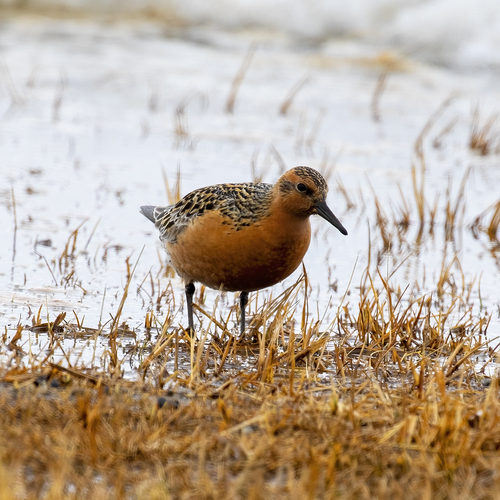 Red Knot
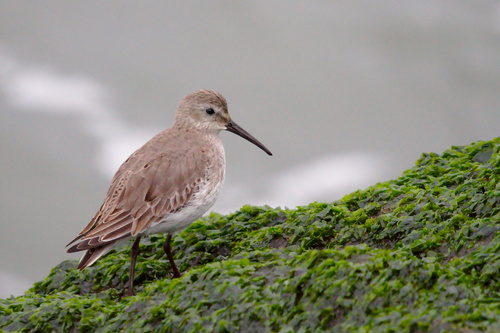 Dunlin
In short
The most reliable field mark to separate Red Knot from Dunlin is overall size and structure: Red Knot is much larger and bulkier, with a thicker body, shorter legs, and a straight, medium-length bill, while Dunlin is smaller, more delicate, and shows a noticeably longer, slightly decurved bill. In breeding plumage, Dunlin is unique among similar-sized waders in showing a bold black belly patch, which Red Knot never has. In flight, both show white wing bars, but Red Knot has a broader white wing bar and a pale grey rump and tail, while Dunlin's wing bar is narrower and the rump/tail are less contrasting. Juvenile plumages can be confusing, but Red Knot juveniles show submarginal lines and brown coverts, while Dunlin juveniles have weak whitish 'V's on the back. Winter birds are both grey above and white below, but Red Knot is much paler and bulkier. Bill shape, leg color, and feeding posture are also useful in the field.
Identification tips
- Size and structure: Red Knot is much larger and bulkier than Dunlin; this is the single most reliable field mark, especially in mixed flocks. Dunlin is noticeably smaller and slimmer.
- Bill shape: Red Knot has a straight, medium-length, dark bill about the length of its head. Dunlin's bill is longer (relative to head), slender, and distinctly decurved at the tip. This is visible at close range or in good binocular views.
- Leg color: Red Knot has short, dark green legs, which can appear dark in the field. Dunlin's legs are black and slightly longer in proportion to body size.
- Feeding posture: Red Knot often appears 'low-slung' due to its short legs and heavy body, while Dunlin stands higher and moves with a rapid, 'sewing machine' feeding action.
- Breeding plumage (spring/summer): Dunlin shows a bold black belly patch, unique among similar-sized waders; Red Knot never shows this. Red Knot in breeding plumage has a rich cinnamon-red face, throat, and breast, fading to a pale belly, with mottled grey above.
- Non-breeding (winter) plumage: Both are grey above and white below, but Red Knot is paler, more uniform, and bulkier. Dunlin is browner above and remains more delicate in build.
- Juvenile plumage: Red Knot juveniles show submarginal lines and brown coverts, giving a scaly look. Dunlin juveniles are brown above with weak whitish 'V' marks on the back, but these are not as bold as in some other Calidris.
- Flight pattern: Both species show a white wing bar, but Red Knot's is broader and more striking. Red Knot also shows a pale grey rump and tail in flight, while Dunlin's rump and tail are less contrasting.
- Flock behavior: Dunlin is highly gregarious, forming large, dense flocks that swirl in synchronized flight. Red Knot also forms flocks but tends to be less tightly packed and appears heavier in flight.
- Habitat in context: Both use coastal mudflats and beaches in migration and winter, but Red Knot is more likely at major stopover sites with abundant shellfish, while Dunlin is more widespread and common in a variety of muddy and sandy habitats.
- Voice: Dunlin's call is a sharp 'chreep', typical of small sandpipers. Red Knot's call is a lower 'knutt' or 'knuup-knuup', less sharp and more muffled.
- Sex differences: In Dunlin, females have longer bills than males, which can complicate identification if only bill length is used. In Red Knot, breeding males have a more even shade of red underparts, but this is subtle and not reliable in the field.
- Seasonal context: In late summer and autumn, juvenile plumages can be confusing; focus on size, bill shape, and flight pattern. In winter, both species are grey, so structure and bill remain the best clues.
- Pitfalls: Beware of lone birds or distant views, where size is hard to judge. Bill shape and feeding posture are then the most reliable marks. In mixed flocks, use size and structure first, then check for the black belly (Dunlin) or red underparts (Red Knot) in breeding season.
- When in doubt: If the bird is small, with a long, decurved bill and black belly (in breeding), it's a Dunlin. If it's larger, bulkier, with a straight bill and cinnamon underparts (in breeding), it's a Red Knot. In winter, rely on size, structure, and bill shape.
Size
Red Knot is substantially larger and heavier than Dunlin. Red Knot measures 23–26 cm in length with a wingspan of 47–53 cm and an average mass of 137 g [wikidata], making it the third or fourth largest Calidris. Dunlin is much smaller at 16–20 cm length, 38–43 cm wingspan, and a mass range of 34–77 g. In direct comparison, Red Knot appears stocky and robust, while Dunlin is more petite and slender. This size difference is usually obvious in mixed flocks or when seen side by side.
Plumage
Juvenile/first-year birds: Red Knot juveniles have distinctive submarginal lines and brown coverts, giving a scaly look to the upperparts. Dunlin juveniles are brown above with two weak whitish 'V' shapes on the back, but these are less obvious than in some other Calidris. Both species show white wing bars in flight, but Red Knot's is broader and more striking; Dunlin's is narrower. In flight, Red Knot shows a pale grey rump and tail, while Dunlin's rump and tail are less contrasting.
Breeding adults: Red Knot is mottled grey above with a rich cinnamon (red) face, throat, and breast, fading to a lighter rear belly. Dunlin in breeding plumage is brown above and white below, but uniquely shows a bold black belly patch, which is never present in Red Knot. Dunlin's upperparts may show some rufous, depending on subspecies, but the black belly is the key.
Non-breeding (winter) adults: Both species become grey above and white below, but Red Knot is paler and more uniform, with a bulkier look. Dunlin remains smaller and shows a slightly browner tone above. Bill and leg color: Red Knot has short, dark green legs and a medium, straight, dark bill. Dunlin has black legs and a longer, slender, slightly decurved black bill.
Behaviour
Red Knot often feeds with a 'low-slung' posture, due to its short legs and heavy body, and is more likely to probe deeply in mud for bivalves and hard-shelled prey. Dunlin typically feeds with a quick, 'sewing machine' action, methodically picking at the surface for small invertebrates. Dunlin is highly gregarious in winter, forming large, swirling flocks, while Red Knot can also be found in flocks but tends to appear more robust and less frenetic in movement. When foraging, Red Knot is often more solitary or in loose groups, while Dunlin is tightly packed.
Habitat
Both species frequent coastal mudflats and sandy beaches outside the breeding season, but Red Knot breeds in high Arctic tundra, while Dunlin breeds in a wider range of northern wetlands. In migration and winter, both can overlap, but Dunlin is generally more abundant and widespread, especially in Europe and North America. Red Knot is more likely to be found at major stopover sites with abundant shellfish, while Dunlin can be found in a broader range of muddy or sandy coastal habitats.
Voice
Red Knot calls are low and monosyllabic ('knutt') when flying in flocks, and a disyllabic 'knuup-knuup' on migration. Its display song is a fluty 'poor-me'. Dunlin gives a typical sandpiper 'chreep' call, and its display song is a harsh trill. In the field, Dunlin's calls are higher-pitched and more typical of small sandpipers, while Red Knot's are lower and less sharp.