

Red Knot vs Broad-billed Sandpiper
Calidris canutus versus Calidris falcinellus
Play a quiz with Red Knot and Broad-billed Sandpiper
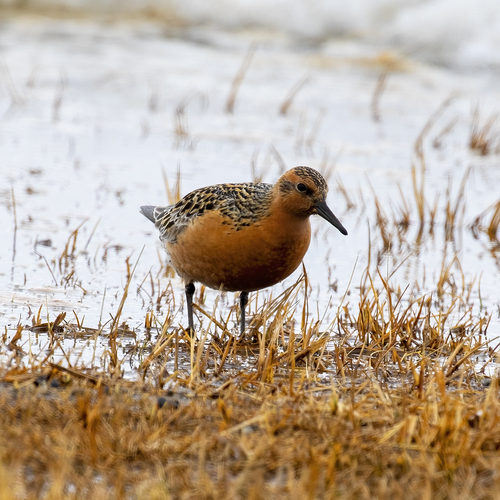 Red Knot
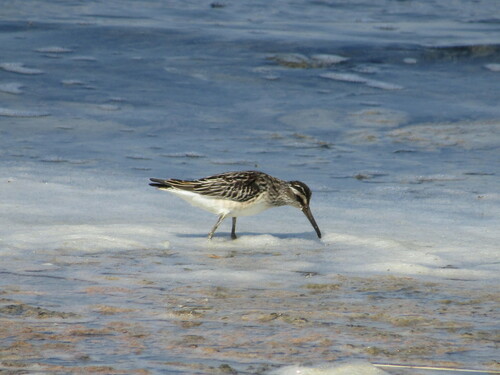 Broad-billed Sandpiper
In short
The most reliable field mark between Red Knot and Broad-billed Sandpiper is size: Red Knot is much larger and heavier, with a bulkier, 'low-slung' look, while Broad-billed Sandpiper is small and delicate. In flight, Red Knot shows a broad white wingbar and grey rump/tail, while Broad-billed Sandpiper lacks these bold contrasts. On the ground, Red Knot has a plain face and short, dark legs, whereas Broad-billed Sandpiper stands out with a split supercilium (double eyebrow) and a long, slightly downcurved bill. Juvenile Broad-billed Sandpipers show pale mantle tramlines, while juvenile Red Knots have brown coverts and submarginal lines. Bill shape and head pattern are key at close range, but size and structure are usually decisive.
Identification tips
- Size is the first check: Red Knot is much larger and heavier than Broad-billed Sandpiper. If you see a bird approaching the size of a pigeon among small waders, it's a Red Knot.
- Flight pattern: Red Knot of all ages shows a broad white wingbar and grey rump/tail in flight. Broad-billed Sandpiper lacks these bold contrasts and appears plainer above.
- Bill shape: Red Knot has a medium-length, straight, slightly tapering dark bill, never longer than the head. Broad-billed Sandpiper's bill is longer (for its size), straight at the base but distinctly downcurved at the tip, and appears finer and more delicate.
- Head pattern: Broad-billed Sandpiper has a split (double) supercilium and a pale crown stripe, giving a strongly patterned face. Red Knot has a plain face with only a faint eye-line in breeding plumage, and no split supercilium.
- Leg color and length: Red Knot has short, dark green legs, contributing to its 'low-slung' look. Broad-billed Sandpiper's legs are also short but not as dark; they do not give the same heavy impression.
- Juvenile upperparts: Juvenile Red Knot shows brown coverts with submarginal lines, creating a scaly effect. Juvenile Broad-billed Sandpiper has pale tramlines on the mantle and a brown-streaked breast with white flanks and belly.
- Breeding plumage: Red Knot is rich cinnamon below with a mottled grey back; Broad-billed Sandpiper is dark brown above with pale fringes and white below with blackish breast markings.
- Non-breeding plumage: Both are pale grey above and white below, but Red Knot is plainer and more uniform, while Broad-billed Sandpiper keeps its split supercilium and head stripes.
- Jizz on the ground: Red Knot appears robust, deep-chested, and heavy, with a short neck and legs. Broad-billed Sandpiper is dainty, active, and delicate.
- Feeding behavior: Red Knot probes methodically, often in tight groups or singly, while Broad-billed Sandpiper picks rapidly, often among mixed small wader flocks.
- Voice: Red Knot's calls are low and monosyllabic or disyllabic, rarely heard except in flight. Broad-billed Sandpiper gives a dry, whistling 'dree-it' and clicking 'dik dik.' Voice can help if heard clearly.
- Habitat context: Red Knot prefers large, open mudflats and estuaries; Broad-billed Sandpiper may be in muddier, smaller patches, often with other small Calidris.
- Sex and subspecies: Not reliably separable in the field for either species; focus on structural and plumage marks.
- Flock composition: Red Knot often associates with larger waders or forms dense flocks of its own kind; Broad-billed Sandpiper is more likely to be among Dunlin, Little Stint, or other small sandpipers.
- When in doubt: If the bird looks big and plain-faced, with a bold white wingbar in flight, it's a Red Knot. If it looks small, active, with a split supercilium and a fine, slightly downcurved bill, it's a Broad-billed Sandpiper.
Size
Red Knot is dramatically larger and heavier (body mass ~137g) compared to Broad-billed Sandpiper (~37g). Red Knot measures 23–26 cm in length with a 47–53 cm wingspan, making it the third or fourth largest Calidris. Broad-billed Sandpiper is only 16–18 cm long, smaller than a Dunlin. In the field, Red Knot appears robust, deep-chested, and 'low-slung' with a short neck and legs, while Broad-billed Sandpiper is dainty, with shorter legs and a more delicate build. Even at a distance or among mixed flocks, the size gap is obvious.
Plumage
Juvenile and first-year birds: Juvenile Red Knots have brown coverts and distinctive submarginal lines, giving a scaly look to the upperparts, while juvenile Broad-billed Sandpipers show pale 'tramlines' down the mantle and a brown-streaked breast with white flanks and belly. In flight, Red Knot (all ages) shows a bold white wingbar and grey rump/tail, which Broad-billed Sandpiper lacks.
Breeding adults: Red Knot is mottled grey above with a rich cinnamon face, throat, and breast, fading to a paler belly. Broad-billed Sandpiper breeding adults have dark brown upperparts with narrow pale fringes, white underparts with blackish breast markings, and a striking split supercilium and pale crown stripe.
Non-breeding (winter): Both species become pale grey above and white below, but Red Knot is plainer-faced and uniform, while Broad-billed Sandpiper retains its split supercilium and head pattern. Leg color is also helpful: Red Knot has short, dark green legs; Broad-billed Sandpiper's legs are short but not as dark.
Behaviour
Red Knot typically feeds with a steady, purposeful gait, often appearing 'low-slung' due to its short legs and heavy body. It probes for prey in mudflats, sometimes singly but often in tight flocks. Broad-billed Sandpiper is more active and gregarious, often mixing with other small waders and picking at food by sight rather than probing deeply. Its feeding is more delicate and rapid, matching its lighter build.
Habitat
Red Knot breeds in high Arctic tundra and migrates along coasts, favoring open mudflats and estuaries during migration and winter. Broad-billed Sandpiper breeds in wet taiga bogs of northern Scandinavia and Siberia, and winters from eastern Africa to Australasia, preferring soft mud in marshes and coastal areas. While both can occur on coastal mudflats in migration, Red Knot is more likely in larger, open habitats, while Broad-billed Sandpiper may be found in smaller, muddier patches, often with other small Calidris.
Voice
Red Knot calls infrequently when feeding but gives a low, monosyllabic 'knutt' in flight and a disyllabic 'knuup-knuup' on migration. Its display song is a fluty 'poor-me.' Broad-billed Sandpiper's contact call is a dry, whistling 'dree-it, dree-it' and a clicking 'dik dik,' somewhat reminiscent of Little Stint. Calls are not usually diagnostic unless heard well and in direct comparison.