

Motmot

Red Kite vs Long-legged Buzzard

Milvus milvus versus Buteo rufinus

Play a quiz with Red Kite and Long-legged Buzzard
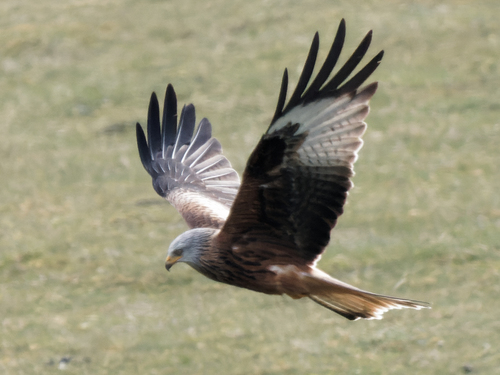
Red Kite (Milvus milvus) Red Kite
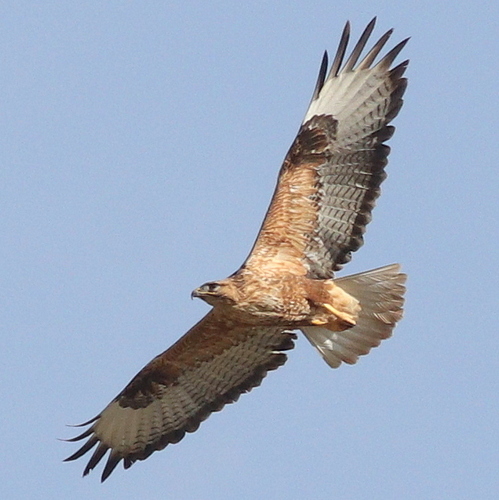
Long-legged Buzzard (Buteo rufinus) Long-legged Buzzard

Media

Loading…

In short

The most reliable field mark to separate Red Kite from Long-legged Buzzard is the tail shape in flight: Red Kite of all ages shows a distinctly long, deeply forked tail, while Long-legged Buzzard always has a broad, rounded tail. For juveniles, Red Kite displays a narrow pale line along the greater coverts on both upper- and underwings, forming a striking panel, while juvenile Long-legged Buzzard shows neater, paler edging above but lacks this continuous pale line. In adults, Red Kite is overall more rufous with white primaries and black wingtips, contrasting with the variable but generally less rufous, more sandy or brown-toned Long-legged Buzzard. Structurally, Red Kite is more elegant and slender with longer wings and tail, while Long-legged Buzzard is bulkier and broader-winged. These differences are visible both perched and in flight, but are most obvious when the birds are soaring.

Identification tips

  1. Tail shape in flight: Red Kite of all ages shows a long, deeply forked tail, often twisted in flight; Long-legged Buzzard always has a broad, rounded tail, never forked. This is the single most reliable mark.
  2. Juvenile wing panel: Juvenile Red Kite has a continuous, narrow pale line along the greater coverts on both upper- and underwings, forming a striking panel in flight. Juvenile Long-legged Buzzard may have paler covert edges but never a continuous pale line.
  3. Adult upperwing pattern: Adult Red Kite shows white primary panels contrasting with black wingtips and dark secondaries; Long-legged Buzzard (pale morph) shows more uniform sandy or rufous upperwings, lacking the sharp white/black contrast.
  4. Body color: Red Kite adults are overall more deeply rufous, with rufous body, upper tail, and wing coverts; Long-legged Buzzard is variable but generally paler, sandy, or ochre, sometimes with a pale head and darker body, never as richly rufous as Red Kite.
  5. Breast streaking: Adult Red Kite has black breast streaks; juveniles have pale breast streaks. Long-legged Buzzard (pale morph) has pencil-thin streaks on the lower breast, but the overall effect is less bold.
  6. Tail banding (juveniles): Juvenile Red Kite has a less deeply forked tail with a dark subterminal band; juvenile Long-legged Buzzard has a broad, rounded tail with irregular faint brown bars, sometimes a subterminal band, but never forked.
  7. Flight silhouette: Red Kite is elegant, long-winged, and slim, with wings held in a shallow V and a twisting tail. Long-legged Buzzard is bulkier, broad-winged, with a protruding head and a more eagle-like, robust profile.
  8. Perched posture: Red Kite perches less frequently and appears more slender and elongated; Long-legged Buzzard perches upright, often on prominent vantage points, and appears more compact and heavy-bodied.
  9. Leg length: Long-legged Buzzard has noticeably long legs and powerful feet, sometimes visible when perched or standing on the ground. Red Kite's legs are proportionally shorter and less obvious.
  10. Head pattern: Long-legged Buzzard (pale morph) has a plain pale or sandy head with a dark eye-stripe and sometimes a darker nape; Red Kite's head is paler than the body but not as plain or contrasting as in some buzzard morphs.
  11. Underwing pattern: Red Kite shows a pale panel (juveniles) or pale fringes to upperwing secondary coverts (adults); Long-legged Buzzard lacks this feature, instead showing variable underwing patterning depending on morph.
  12. Behavior on the ground: Long-legged Buzzard may be seen walking or standing on the ground, sometimes waddling; Red Kite is rarely seen on the ground except when feeding.
  13. Habitat context: In open, arid, or rocky areas, especially in southeastern Europe or Asia, Long-legged Buzzard is more likely; in temperate farmland or woodland edge in western Europe, Red Kite is more likely.
  14. Voice: Red Kite gives a thin, piping call, but this is not a strong separator from Long-legged Buzzard, which is generally quiet or gives different calls not described here.
  15. Sex and age: Both species show little sexual dimorphism in plumage; size difference is subtle in the field. Juvenile-specific marks (wing panel in Red Kite, covert edging in Long-legged Buzzard) are most useful for young birds.

Size

Red Kite is a large raptor with a body mass around 1122 g, and a wingspan of 175–195 cm, making it longer-winged and longer-tailed than Long-legged Buzzard. Long-legged Buzzard is also a large Buteo, but appears bulkier and more broad-bodied, with a relatively shorter, rounded tail and slightly shorter wings. In the field, Red Kite's size is accentuated by its long, deeply forked tail and slim build, while Long-legged Buzzard looks heavier and more compact, with a more eagle-like, robust silhouette.

Plumage

Juvenile Red Kite is best identified by a long, narrow pale line formed by pale tips to all greater coverts on both upper- and underwings, visible in flight; adults have pale fringes only to upperwing secondary coverts. Juvenile Red Kite also has a buff breast and belly, less deeply forked tail with a dark subterminal band, and pale breast streaks. Adult Red Kite is deeply rufous overall, with black breast streaks, white primary panels, and black wingtips. In contrast, Long-legged Buzzard is highly variable: pale morph adults have a plain pale head, sandy or creamy rufous tones, and a light rufous-orange or greyish tail (sometimes with a subterminal band); intermediate and rufous morphs are darker and more patterned, while dark morphs are nearly all blackish-brown. Juvenile Long-legged Buzzard resembles adults of its morph but shows paler, neater covert edges above, more streaky head and breast, and a tail that is pale at the base, darkening with irregular bars. The tail is always broad and rounded, never forked. In all ages, Long-legged Buzzard lacks the Red Kite's rufous body and distinctive forked tail, and never shows a continuous pale panel on both upper- and underwings.

Behaviour

Red Kite is graceful and buoyant in flight, often seen soaring with wings held in a shallow V (dihedral) and twisting its long, forked tail to steer. It rarely perches for long and is more aerial, frequently gliding and circling at moderate heights. Long-legged Buzzard is more sluggish and often perches upright on prominent rocks, crags, or utility poles, sometimes standing or walking on the ground with a waddling gait. In flight, it appears heavier, with broader wings and a more eagle-like silhouette, and typically soars with less tail movement.

Habitat

Red Kite is primarily a European species, favoring open countryside, farmland, and woodland edges, especially in milder western regions. Long-legged Buzzard is found in southeastern Europe, North Africa, and across to Central Asia, preferring open, arid, or semi-arid landscapes, steppe, and rocky areas. Overlap is possible in southeastern Europe and the eastern Mediterranean, but Red Kite is more associated with temperate, wooded, or agricultural areas, while Long-legged Buzzard prefers drier, more open terrain.

Voice

Red Kite gives a thin, piping call, less mewling than the Common Buzzard. No distinctive vocalization is described for Long-legged Buzzard in the provided notes, so voice is not a reliable separator between these two in the field.

Submit a better description

Use the same sections as the comparison. Your text is published immediately.

The most reliable field mark to separate Red Kite from Long-legged Buzzard is the tail shape in flight: Red Kite of all ages shows a distinctly long, deeply forked tail, while Long-legged Buzzard always has a broad, rounded tail. For juveniles, Red Kite displays a narrow pale line along the greater coverts on both upper- and underwings, forming a striking panel, while juvenile Long-legged Buzzard shows neater, paler edging above but lacks this continuous pale line. In adults, Red Kite is overall more rufous with white primaries and black wingtips, contrasting with the variable but generally less rufous, more sandy or brown-toned Long-legged Buzzard. Structurally, Red Kite is more elegant and slender with longer wings and tail, while Long-legged Buzzard is bulkier and broader-winged. These differences are visible both perched and in flight, but are most obvious when the birds are soaring.

  1. Tail shape in flight: Red Kite of all ages shows a long, deeply forked tail, often twisted in flight; Long-legged Buzzard always has a broad, rounded tail, never forked. This is the single most reliable mark.
  2. Juvenile wing panel: Juvenile Red Kite has a continuous, narrow pale line along the greater coverts on both upper- and underwings, forming a striking panel in flight. Juvenile Long-legged Buzzard may have paler covert edges but never a continuous pale line.
  3. Adult upperwing pattern: Adult Red Kite shows white primary panels contrasting with black wingtips and dark secondaries; Long-legged Buzzard (pale morph) shows more uniform sandy or rufous upperwings, lacking the sharp white/black contrast.
  4. Body color: Red Kite adults are overall more deeply rufous, with rufous body, upper tail, and wing coverts; Long-legged Buzzard is variable but generally paler, sandy, or ochre, sometimes with a pale head and darker body, never as richly rufous as Red Kite.
  5. Breast streaking: Adult Red Kite has black breast streaks; juveniles have pale breast streaks. Long-legged Buzzard (pale morph) has pencil-thin streaks on the lower breast, but the overall effect is less bold.
  6. Tail banding (juveniles): Juvenile Red Kite has a less deeply forked tail with a dark subterminal band; juvenile Long-legged Buzzard has a broad, rounded tail with irregular faint brown bars, sometimes a subterminal band, but never forked.
  7. Flight silhouette: Red Kite is elegant, long-winged, and slim, with wings held in a shallow V and a twisting tail. Long-legged Buzzard is bulkier, broad-winged, with a protruding head and a more eagle-like, robust profile.
  8. Perched posture: Red Kite perches less frequently and appears more slender and elongated; Long-legged Buzzard perches upright, often on prominent vantage points, and appears more compact and heavy-bodied.
  9. Leg length: Long-legged Buzzard has noticeably long legs and powerful feet, sometimes visible when perched or standing on the ground. Red Kite's legs are proportionally shorter and less obvious.
  10. Head pattern: Long-legged Buzzard (pale morph) has a plain pale or sandy head with a dark eye-stripe and sometimes a darker nape; Red Kite's head is paler than the body but not as plain or contrasting as in some buzzard morphs.
  11. Underwing pattern: Red Kite shows a pale panel (juveniles) or pale fringes to upperwing secondary coverts (adults); Long-legged Buzzard lacks this feature, instead showing variable underwing patterning depending on morph.
  12. Behavior on the ground: Long-legged Buzzard may be seen walking or standing on the ground, sometimes waddling; Red Kite is rarely seen on the ground except when feeding.
  13. Habitat context: In open, arid, or rocky areas, especially in southeastern Europe or Asia, Long-legged Buzzard is more likely; in temperate farmland or woodland edge in western Europe, Red Kite is more likely.
  14. Voice: Red Kite gives a thin, piping call, but this is not a strong separator from Long-legged Buzzard, which is generally quiet or gives different calls not described here.
  15. Sex and age: Both species show little sexual dimorphism in plumage; size difference is subtle in the field. Juvenile-specific marks (wing panel in Red Kite, covert edging in Long-legged Buzzard) are most useful for young birds.

Red Kite is a large raptor with a body mass around 1122 g, and a wingspan of 175–195 cm, making it longer-winged and longer-tailed than Long-legged Buzzard. Long-legged Buzzard is also a large Buteo, but appears bulkier and more broad-bodied, with a relatively shorter, rounded tail and slightly shorter wings. In the field, Red Kite's size is accentuated by its long, deeply forked tail and slim build, while Long-legged Buzzard looks heavier and more compact, with a more eagle-like, robust silhouette.

Juvenile Red Kite is best identified by a long, narrow pale line formed by pale tips to all greater coverts on both upper- and underwings, visible in flight; adults have pale fringes only to upperwing secondary coverts. Juvenile Red Kite also has a buff breast and belly, less deeply forked tail with a dark subterminal band, and pale breast streaks. Adult Red Kite is deeply rufous overall, with black breast streaks, white primary panels, and black wingtips. In contrast, Long-legged Buzzard is highly variable: pale morph adults have a plain pale head, sandy or creamy rufous tones, and a light rufous-orange or greyish tail (sometimes with a subterminal band); intermediate and rufous morphs are darker and more patterned, while dark morphs are nearly all blackish-brown. Juvenile Long-legged Buzzard resembles adults of its morph but shows paler, neater covert edges above, more streaky head and breast, and a tail that is pale at the base, darkening with irregular bars. The tail is always broad and rounded, never forked. In all ages, Long-legged Buzzard lacks the Red Kite's rufous body and distinctive forked tail, and never shows a continuous pale panel on both upper- and underwings.

Red Kite is graceful and buoyant in flight, often seen soaring with wings held in a shallow V (dihedral) and twisting its long, forked tail to steer. It rarely perches for long and is more aerial, frequently gliding and circling at moderate heights. Long-legged Buzzard is more sluggish and often perches upright on prominent rocks, crags, or utility poles, sometimes standing or walking on the ground with a waddling gait. In flight, it appears heavier, with broader wings and a more eagle-like silhouette, and typically soars with less tail movement.

Red Kite is primarily a European species, favoring open countryside, farmland, and woodland edges, especially in milder western regions. Long-legged Buzzard is found in southeastern Europe, North Africa, and across to Central Asia, preferring open, arid, or semi-arid landscapes, steppe, and rocky areas. Overlap is possible in southeastern Europe and the eastern Mediterranean, but Red Kite is more associated with temperate, wooded, or agricultural areas, while Long-legged Buzzard prefers drier, more open terrain.

Red Kite gives a thin, piping call, less mewling than the Common Buzzard. No distinctive vocalization is described for Long-legged Buzzard in the provided notes, so voice is not a reliable separator between these two in the field.

Discard your changes?

You have unsaved edits. If you leave now, those changes will be lost.

Red Kite · Long-legged Buzzard · My Tricky Birds