

Motmot

Red Junglefowl vs Red-legged Partridge

Gallus gallus versus Alectoris rufa

Play a quiz with Red Junglefowl and Red-legged Partridge
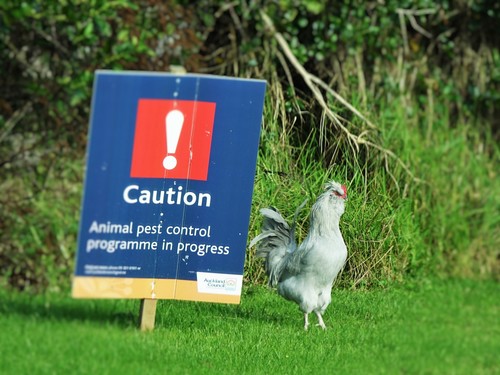
Red Junglefowl (Gallus gallus) Red Junglefowl
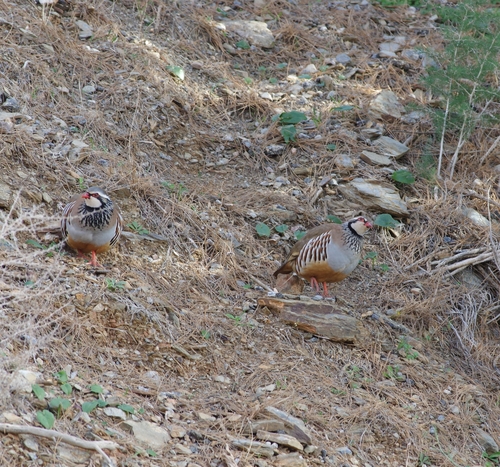
Red-legged Partridge (Alectoris rufa) Red-legged Partridge

Media

Loading…

In short

The most reliable field mark to separate Red Junglefowl from Red-legged Partridge is overall structure and tail: Red Junglefowl, especially males, are much larger, lankier, and have long, iridescent, often dramatically curved tail feathers, while Red-legged Partridge is compact, short-tailed, and round-bodied with no long plumes. In any age or sex, the partridge shows a striking face pattern with a black-and-white throat and bold rufous flank bars, never seen on junglefowl. Female junglefowl are plainer and brown, but still lack the partridge's facial and flank pattern. In flight, the junglefowl is strong and direct for short bursts, while the partridge has a whirring, low, fast flight. Use structure and face pattern first, then check for tail length and flank barring.

Identification tips

  1. Tail length and shape: Red Junglefowl, especially males, have long, curved, iridescent tail feathers, sometimes up to 28cm, which are never seen in Red-legged Partridge. Even females have a longer, more graduated tail than the partridge's stubby tail. This is diagnostic in all ages and sexes.
  2. Overall structure: Junglefowl are lanky, long-legged, and upright, with a stretched profile. Partridges are round, compact, and short-legged, with a low, squat stance.
  3. Face pattern: Red-legged Partridge always shows a bold black-and-white face and throat pattern, with a black gorget and red bill and eye-ring. Junglefowl, even males, have a plain face with a red comb and wattle (males) or plain brown (females), never with a black gorget or face stripes.
  4. Flank pattern: Partridges have prominent rufous and black bars on the flanks over a pale belly, visible in all ages. Junglefowl have plain flanks, with no barring.
  5. Bill and legs: Partridge has a bright red bill and pinkish-red legs. Junglefowl males have a yellowish or horn-colored bill and grayish legs, with males showing a spur on the back of the leg.
  6. Plumage color: Male junglefowl are brilliant, with golden hackles, red-orange body, and iridescent blue-green tail. Females are plain brown. Partridges are sandy-brown above, pale below, with a blue-grey breast and pinkish-buff belly, never as bright as male junglefowl.
  7. Comb and wattle: Male junglefowl have a large, fleshy red comb and wattle; partridges lack these features entirely.
  8. Flight style: Junglefowl fly in short, strong, direct bursts, usually to reach cover or roost. Partridges flush with a whirring, low, fast flight, often in a covey.
  9. Habitat: Junglefowl are found in forest or forest edge; partridges are in open farmland, grassland, or scrub.
  10. Vocalizations: Junglefowl males crow ('cock-a-doodle-doo'); partridges give a rapid, mechanical 'churr' or 'kerrr' call.
  11. Sexual dimorphism: Junglefowl show strong sexual dimorphism (males bright, females plain); partridges are similar in both sexes.
  12. Spurs: Male junglefowl have a sharp spur on the back of the leg; partridges do not.
  13. Roosting behavior: Junglefowl roost in trees; partridges roost on the ground.
  14. Group structure: Junglefowl flocks have one or a few males and several females; partridges are in pairs or coveys, often all similar in appearance.
  15. Seasonal plumage: Male junglefowl may show eclipse plumage (duller, with black back and scattered red-orange plumes) June–October, but still lack partridge face and flank pattern.

Size

Red Junglefowl is significantly larger and heavier than Red-legged Partridge. The average body mass for Red Junglefowl is 672g, with males reaching up to 1.5kg and females around 1kg [wikidata, wikipedia]. In contrast, Red-legged Partridge is a much smaller, more compact bird (no precise mass given, but always visibly smaller in the field). Junglefowl have a long, sometimes up to 28cm, iridescent tail, giving them a stretched, lanky look, while partridges are round-bodied with a short, stubby tail and a low-slung, squat appearance.

Plumage

No age-specific upperwing or flight pattern is described for either species, so rely on body and head plumage. Adult male Red Junglefowl are striking: golden hackle feathers on the neck, bright red, orange, and iridescent blue-green-black on the tail, and a large red comb and wattle. Females are plain brown and camouflaged, lacking any bold patterning, with no face or flank markings. Red-legged Partridge, in all ages and sexes, shows a bold black-and-white face and throat pattern, a black gorget, and prominent rufous and black bars on the flanks over a pale belly. The back is sandy-brown, and the bill and legs are bright red. Even juvenile partridges show some face and flank pattern, while junglefowl never have these marks. Male junglefowl in eclipse plumage (June–October) may be less bright but are still structurally distinct and lack the partridge's facial and flank patterns.

Behaviour

Red Junglefowl are shy, often found in small flocks with a few males and several females, and spend much of their time on the ground but roost in trees at night. Their flight is limited to short, direct bursts, usually to escape danger or reach a roost. Males may be seen alone, especially outside the breeding season. Red-legged Partridge is a ground-dweller, usually seen in pairs or small coveys, and when flushed, takes off with a rapid, whirring flight low over the ground. Junglefowl are more likely to be wary and retreat into cover, while partridges often burst up suddenly and fly away fast.

Habitat

Red Junglefowl is native to tropical forests and forest edges in South and Southeast Asia, rarely found in open country. Red-legged Partridge is associated with open farmland, grassland, and scrub in southwestern Europe and introduced populations in the UK and New Zealand. In the field, seeing a bird in dense forest or near forest edge points to junglefowl; in open fields, farmland, or grassy hills, partridge is much more likely.

Voice

Red Junglefowl males give a classic 'cock-a-doodle-doo' crow, loud and ringing, used to announce territory and attract mates. Red-legged Partridge has a rapid, repeated, mechanical 'churr-churr-churr' or 'kerrr-kerrr' call, very different from the junglefowl's crow. If you hear a rooster-like crow, it's junglefowl; if you hear a chattering, rolling call, it's partridge.

Submit a better description

Use the same sections as the comparison. Your text is published immediately.

The most reliable field mark to separate Red Junglefowl from Red-legged Partridge is overall structure and tail: Red Junglefowl, especially males, are much larger, lankier, and have long, iridescent, often dramatically curved tail feathers, while Red-legged Partridge is compact, short-tailed, and round-bodied with no long plumes. In any age or sex, the partridge shows a striking face pattern with a black-and-white throat and bold rufous flank bars, never seen on junglefowl. Female junglefowl are plainer and brown, but still lack the partridge's facial and flank pattern. In flight, the junglefowl is strong and direct for short bursts, while the partridge has a whirring, low, fast flight. Use structure and face pattern first, then check for tail length and flank barring.

  1. Tail length and shape: Red Junglefowl, especially males, have long, curved, iridescent tail feathers, sometimes up to 28cm, which are never seen in Red-legged Partridge. Even females have a longer, more graduated tail than the partridge's stubby tail. This is diagnostic in all ages and sexes.
  2. Overall structure: Junglefowl are lanky, long-legged, and upright, with a stretched profile. Partridges are round, compact, and short-legged, with a low, squat stance.
  3. Face pattern: Red-legged Partridge always shows a bold black-and-white face and throat pattern, with a black gorget and red bill and eye-ring. Junglefowl, even males, have a plain face with a red comb and wattle (males) or plain brown (females), never with a black gorget or face stripes.
  4. Flank pattern: Partridges have prominent rufous and black bars on the flanks over a pale belly, visible in all ages. Junglefowl have plain flanks, with no barring.
  5. Bill and legs: Partridge has a bright red bill and pinkish-red legs. Junglefowl males have a yellowish or horn-colored bill and grayish legs, with males showing a spur on the back of the leg.
  6. Plumage color: Male junglefowl are brilliant, with golden hackles, red-orange body, and iridescent blue-green tail. Females are plain brown. Partridges are sandy-brown above, pale below, with a blue-grey breast and pinkish-buff belly, never as bright as male junglefowl.
  7. Comb and wattle: Male junglefowl have a large, fleshy red comb and wattle; partridges lack these features entirely.
  8. Flight style: Junglefowl fly in short, strong, direct bursts, usually to reach cover or roost. Partridges flush with a whirring, low, fast flight, often in a covey.
  9. Habitat: Junglefowl are found in forest or forest edge; partridges are in open farmland, grassland, or scrub.
  10. Vocalizations: Junglefowl males crow ('cock-a-doodle-doo'); partridges give a rapid, mechanical 'churr' or 'kerrr' call.
  11. Sexual dimorphism: Junglefowl show strong sexual dimorphism (males bright, females plain); partridges are similar in both sexes.
  12. Spurs: Male junglefowl have a sharp spur on the back of the leg; partridges do not.
  13. Roosting behavior: Junglefowl roost in trees; partridges roost on the ground.
  14. Group structure: Junglefowl flocks have one or a few males and several females; partridges are in pairs or coveys, often all similar in appearance.
  15. Seasonal plumage: Male junglefowl may show eclipse plumage (duller, with black back and scattered red-orange plumes) June–October, but still lack partridge face and flank pattern.

Red Junglefowl is significantly larger and heavier than Red-legged Partridge. The average body mass for Red Junglefowl is 672g, with males reaching up to 1.5kg and females around 1kg [wikidata, wikipedia]. In contrast, Red-legged Partridge is a much smaller, more compact bird (no precise mass given, but always visibly smaller in the field). Junglefowl have a long, sometimes up to 28cm, iridescent tail, giving them a stretched, lanky look, while partridges are round-bodied with a short, stubby tail and a low-slung, squat appearance.

No age-specific upperwing or flight pattern is described for either species, so rely on body and head plumage. Adult male Red Junglefowl are striking: golden hackle feathers on the neck, bright red, orange, and iridescent blue-green-black on the tail, and a large red comb and wattle. Females are plain brown and camouflaged, lacking any bold patterning, with no face or flank markings. Red-legged Partridge, in all ages and sexes, shows a bold black-and-white face and throat pattern, a black gorget, and prominent rufous and black bars on the flanks over a pale belly. The back is sandy-brown, and the bill and legs are bright red. Even juvenile partridges show some face and flank pattern, while junglefowl never have these marks. Male junglefowl in eclipse plumage (June–October) may be less bright but are still structurally distinct and lack the partridge's facial and flank patterns.

Red Junglefowl are shy, often found in small flocks with a few males and several females, and spend much of their time on the ground but roost in trees at night. Their flight is limited to short, direct bursts, usually to escape danger or reach a roost. Males may be seen alone, especially outside the breeding season. Red-legged Partridge is a ground-dweller, usually seen in pairs or small coveys, and when flushed, takes off with a rapid, whirring flight low over the ground. Junglefowl are more likely to be wary and retreat into cover, while partridges often burst up suddenly and fly away fast.

Red Junglefowl is native to tropical forests and forest edges in South and Southeast Asia, rarely found in open country. Red-legged Partridge is associated with open farmland, grassland, and scrub in southwestern Europe and introduced populations in the UK and New Zealand. In the field, seeing a bird in dense forest or near forest edge points to junglefowl; in open fields, farmland, or grassy hills, partridge is much more likely.

Red Junglefowl males give a classic 'cock-a-doodle-doo' crow, loud and ringing, used to announce territory and attract mates. Red-legged Partridge has a rapid, repeated, mechanical 'churr-churr-churr' or 'kerrr-kerrr' call, very different from the junglefowl's crow. If you hear a rooster-like crow, it's junglefowl; if you hear a chattering, rolling call, it's partridge.

Discard your changes?

You have unsaved edits. If you leave now, those changes will be lost.

Red Junglefowl · Red-legged Partridge · My Tricky Birds