

Motmot

Red-footed Falcon vs Lanner Falcon

Falco vespertinus versus Falco biarmicus

Play a quiz with Red-footed Falcon and Lanner Falcon
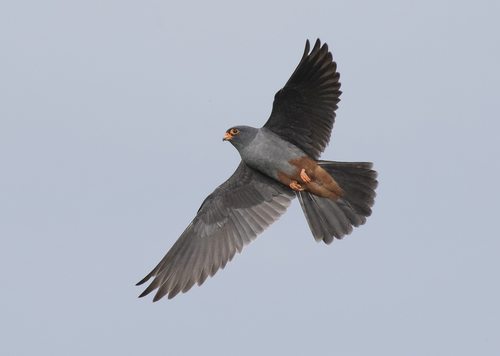
Red-footed Falcon (Falco vespertinus) Red-footed Falcon
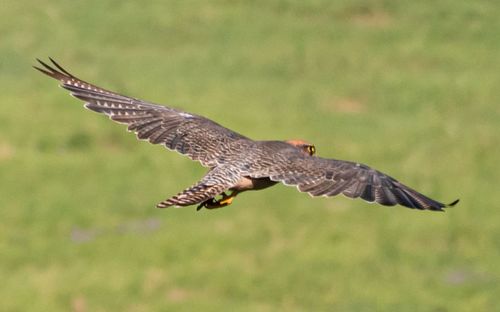
Lanner Falcon (Falco biarmicus) Lanner Falcon

Media

Loading…

In short

The most reliable field mark to separate Red-footed Falcon from Lanner Falcon is overall size and structure: Lanner is much larger and bulkier, with a broader wingspan and heavier build, while Red-footed Falcon is a compact, long-winged, and noticeably lighter bird. In flight, juvenile and female Red-footed Falcons show a uniform grey underwing (adults) or brown-and-buff streaked underparts (immatures), while Lanner Falcon juveniles are browner above with streaked breasts and a reddish nape. Adult male Red-footed Falcons are unique among the two for their all blue-grey plumage with red undertail and legs. When perched, note the Red-footed Falcon’s smaller, more delicate jizz and, in females and immatures, the strong facial pattern. Lanner Falcons always appear more robust, with a streaked breast and a reddish nape, and never show the red legs or undertail of Red-footed Falcon.

Identification tips

  1. Size and Structure: Lanner Falcon is much larger and heavier than Red-footed Falcon. If the bird looks big and powerful, with broad wings and a strong build, it is almost certainly a Lanner. Red-footed Falcon is compact and slender, with long, pointed wings.
  2. Wingspan: Lanner’s wingspan (95–105 cm) is about 30% greater than Red-footed Falcon’s (65–75 cm). This is especially apparent in flight or when perched birds are seen side by side.
  3. Adult Male Plumage: Only adult male Red-footed Falcon is all blue-grey with a red undertail and legs. Lanner Falcon never shows this combination.
  4. Female and Immature Face Pattern: Female and immature Red-footed Falcons have a striking white face with a black eye-stripe and moustaches, giving a bold, masked look. Lanner’s face is less contrasting, with a reddish nape and less defined markings.
  5. Breast Pattern: Lanner Falcons of all ages show a streaked breast, especially in northern birds. Red-footed Falcons (adults) have plain underparts; immatures are buff with dark streaks but never as heavily streaked as Lanner.
  6. Upperparts: Lanner is slate or brown-grey above (Eurasian birds), sometimes paler blue-grey (African subspecies), and always looks browner than Red-footed Falcon, which is blue-grey (adult male), grey (female), or brown (immature).
  7. Leg and Undertail Color: Red-footed Falcon (adult male) has red legs and undertail; Lanner never does. This is a clincher if seen well.
  8. Flight Jizz: Red-footed Falcon is agile, buoyant, and often hovers or hunts insects on the wing. Lanner is more powerful, with slower, deeper wingbeats and a heavier, more direct flight.
  9. Perched Posture: Lanner appears robust and upright, often on prominent perches. Red-footed Falcon is more delicate and less imposing.
  10. Juvenile Confusion: Juvenile Lanner is browner above, with a reddish nape and streaked breast, and lacks the bold face of young Red-footed Falcon. Juvenile Red-footed Falcon is buff and brown with a strong facial pattern.
  11. Habitat: In Europe, Red-footed Falcon is more likely in open steppe or grassland, often near colonies. Lanner prefers rocky, hilly, or open savannah habitats, and is much rarer in most of Europe.
  12. Behavior: Red-footed Falcons may be seen in groups or colonies, especially in breeding season, while Lanner is usually solitary or in pairs.
  13. Vocalization: Only Lanner has a distinctive harsh call; Red-footed Falcon is generally quieter or less distinctive vocally.
  14. Seasonality: Red-footed Falcon is migratory, so in winter in Europe, Lanner is more likely (though both are rare outside breeding season).
  15. Sex Differences: Lanner sexes are similar; Red-footed Falcon shows strong sexual dimorphism, especially in adults (male all blue-grey, female orange and grey with white face).

Size

Lanner Falcon is significantly larger than Red-footed Falcon in every dimension. Lanner measures 43–50 cm in length with a 95–105 cm wingspan, dwarfing the Red-footed Falcon’s 28–34 cm length and 65–75 cm wingspan. Red-footed Falcon is also much lighter (average mass 158.5 g) and more slender, while Lanner is a heavy, broad-winged falcon. This size difference is usually obvious in the field, especially when both species are seen in the same context.

Plumage

Juvenile and immature Red-footed Falcons are brown above and buff below with dark streaks, and have a female-like face pattern—look for a strong white face with black eye-stripe and moustaches. Their underwings are relatively uniform in color (grey in adults). Adult males are all blue-grey except for the red undertail and legs, which are unique among these two species. Females have a grey back and wings, orange head and underparts, and a white face with bold markings. Lanner Falcons, by contrast, are always larger and browner as juveniles, with slate or brown-grey upperparts and a streaked breast. Their head shows a reddish nape, and the facial pattern is less sharply defined than in Red-footed Falcon. Sexes are similar in Lanner, but young birds are even browner and resemble Saker Falcon more than Red-footed Falcon. Lanner never shows red legs or undertail, and the breast streaking is a key mark for all ages.

Behaviour

Red-footed Falcons are often seen in colonies or small groups, especially in breeding season, and may be more aerial and agile, sometimes hovering or hunting insects on the wing. Lanner Falcons are usually seen singly or in pairs, often perched prominently or soaring with slow, powerful wingbeats. Lanner preys mainly on birds and bats, using fast, direct pursuit, while Red-footed Falcon often takes insects and small vertebrates. Lanner’s behavior is more typical of a large, powerful falcon, while Red-footed Falcon is daintier and more buoyant in flight.

Habitat

Red-footed Falcon breeds in eastern Europe and Asia, favoring open grasslands and steppe with scattered trees, and often nests in old corvid nests or artificial boxes. Lanner Falcon is widespread in Africa and southeast Europe, preferring open habitats from savannah and grasslands to desert edges, but is less tied to steppe and more to rocky or hilly country. Lanner is mainly resident, while Red-footed Falcon is migratory. In Europe, Lanner is much rarer and more localized than Red-footed Falcon, which can be locally common in the right habitat.

Voice

Lanner Falcon’s call is a harsh "wray-e". No distinctive vocalization is noted for Red-footed Falcon in the sources provided, so voice is not a reliable separator in this context.

Submit a better description

Use the same sections as the comparison. Your text is published immediately.

The most reliable field mark to separate Red-footed Falcon from Lanner Falcon is overall size and structure: Lanner is much larger and bulkier, with a broader wingspan and heavier build, while Red-footed Falcon is a compact, long-winged, and noticeably lighter bird. In flight, juvenile and female Red-footed Falcons show a uniform grey underwing (adults) or brown-and-buff streaked underparts (immatures), while Lanner Falcon juveniles are browner above with streaked breasts and a reddish nape. Adult male Red-footed Falcons are unique among the two for their all blue-grey plumage with red undertail and legs. When perched, note the Red-footed Falcon’s smaller, more delicate jizz and, in females and immatures, the strong facial pattern. Lanner Falcons always appear more robust, with a streaked breast and a reddish nape, and never show the red legs or undertail of Red-footed Falcon.

  1. Size and Structure: Lanner Falcon is much larger and heavier than Red-footed Falcon. If the bird looks big and powerful, with broad wings and a strong build, it is almost certainly a Lanner. Red-footed Falcon is compact and slender, with long, pointed wings.
  2. Wingspan: Lanner’s wingspan (95–105 cm) is about 30% greater than Red-footed Falcon’s (65–75 cm). This is especially apparent in flight or when perched birds are seen side by side.
  3. Adult Male Plumage: Only adult male Red-footed Falcon is all blue-grey with a red undertail and legs. Lanner Falcon never shows this combination.
  4. Female and Immature Face Pattern: Female and immature Red-footed Falcons have a striking white face with a black eye-stripe and moustaches, giving a bold, masked look. Lanner’s face is less contrasting, with a reddish nape and less defined markings.
  5. Breast Pattern: Lanner Falcons of all ages show a streaked breast, especially in northern birds. Red-footed Falcons (adults) have plain underparts; immatures are buff with dark streaks but never as heavily streaked as Lanner.
  6. Upperparts: Lanner is slate or brown-grey above (Eurasian birds), sometimes paler blue-grey (African subspecies), and always looks browner than Red-footed Falcon, which is blue-grey (adult male), grey (female), or brown (immature).
  7. Leg and Undertail Color: Red-footed Falcon (adult male) has red legs and undertail; Lanner never does. This is a clincher if seen well.
  8. Flight Jizz: Red-footed Falcon is agile, buoyant, and often hovers or hunts insects on the wing. Lanner is more powerful, with slower, deeper wingbeats and a heavier, more direct flight.
  9. Perched Posture: Lanner appears robust and upright, often on prominent perches. Red-footed Falcon is more delicate and less imposing.
  10. Juvenile Confusion: Juvenile Lanner is browner above, with a reddish nape and streaked breast, and lacks the bold face of young Red-footed Falcon. Juvenile Red-footed Falcon is buff and brown with a strong facial pattern.
  11. Habitat: In Europe, Red-footed Falcon is more likely in open steppe or grassland, often near colonies. Lanner prefers rocky, hilly, or open savannah habitats, and is much rarer in most of Europe.
  12. Behavior: Red-footed Falcons may be seen in groups or colonies, especially in breeding season, while Lanner is usually solitary or in pairs.
  13. Vocalization: Only Lanner has a distinctive harsh call; Red-footed Falcon is generally quieter or less distinctive vocally.
  14. Seasonality: Red-footed Falcon is migratory, so in winter in Europe, Lanner is more likely (though both are rare outside breeding season).
  15. Sex Differences: Lanner sexes are similar; Red-footed Falcon shows strong sexual dimorphism, especially in adults (male all blue-grey, female orange and grey with white face).

Lanner Falcon is significantly larger than Red-footed Falcon in every dimension. Lanner measures 43–50 cm in length with a 95–105 cm wingspan, dwarfing the Red-footed Falcon’s 28–34 cm length and 65–75 cm wingspan. Red-footed Falcon is also much lighter (average mass 158.5 g) and more slender, while Lanner is a heavy, broad-winged falcon. This size difference is usually obvious in the field, especially when both species are seen in the same context.

Juvenile and immature Red-footed Falcons are brown above and buff below with dark streaks, and have a female-like face pattern—look for a strong white face with black eye-stripe and moustaches. Their underwings are relatively uniform in color (grey in adults). Adult males are all blue-grey except for the red undertail and legs, which are unique among these two species. Females have a grey back and wings, orange head and underparts, and a white face with bold markings. Lanner Falcons, by contrast, are always larger and browner as juveniles, with slate or brown-grey upperparts and a streaked breast. Their head shows a reddish nape, and the facial pattern is less sharply defined than in Red-footed Falcon. Sexes are similar in Lanner, but young birds are even browner and resemble Saker Falcon more than Red-footed Falcon. Lanner never shows red legs or undertail, and the breast streaking is a key mark for all ages.

Red-footed Falcons are often seen in colonies or small groups, especially in breeding season, and may be more aerial and agile, sometimes hovering or hunting insects on the wing. Lanner Falcons are usually seen singly or in pairs, often perched prominently or soaring with slow, powerful wingbeats. Lanner preys mainly on birds and bats, using fast, direct pursuit, while Red-footed Falcon often takes insects and small vertebrates. Lanner’s behavior is more typical of a large, powerful falcon, while Red-footed Falcon is daintier and more buoyant in flight.

Red-footed Falcon breeds in eastern Europe and Asia, favoring open grasslands and steppe with scattered trees, and often nests in old corvid nests or artificial boxes. Lanner Falcon is widespread in Africa and southeast Europe, preferring open habitats from savannah and grasslands to desert edges, but is less tied to steppe and more to rocky or hilly country. Lanner is mainly resident, while Red-footed Falcon is migratory. In Europe, Lanner is much rarer and more localized than Red-footed Falcon, which can be locally common in the right habitat.

Lanner Falcon’s call is a harsh "wray-e". No distinctive vocalization is noted for Red-footed Falcon in the sources provided, so voice is not a reliable separator in this context.

Discard your changes?

You have unsaved edits. If you leave now, those changes will be lost.

Red-footed Falcon · Lanner Falcon · My Tricky Birds