

Motmot

Plain Chachalaca vs West Mexican Chachalaca

Ortalis vetula versus Ortalis poliocephala

Play a quiz with Plain Chachalaca and West Mexican Chachalaca
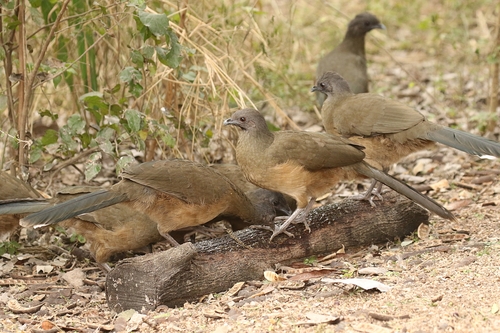
Plain Chachalaca (Ortalis vetula) Plain Chachalaca
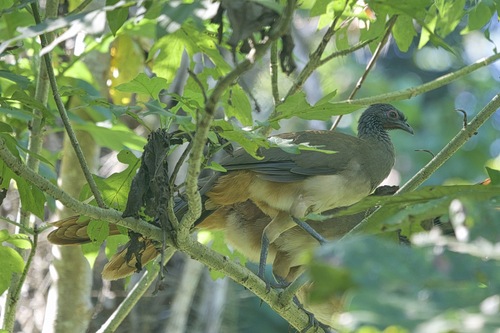
West Mexican Chachalaca (Ortalis poliocephala) West Mexican Chachalaca

Media

Loading…

In short

The most reliable field mark between Plain Chachalaca and West Mexican Chachalaca is the tail tip: Plain Chachalaca has a blackish tail with a green gloss and a distinct buffy-white tip, while West Mexican Chachalaca’s tail is grayer and the feathers have broad buff tips. Both are long-necked, brownish cracids, but West Mexican Chachalaca is larger and shows a paler, buff-washed belly and a more extensive bare carmine skin around the eye. Subtle differences in head and underpart coloration, as well as range and habitat, can help separate them where their ranges approach. Immature and flight marks are not described in detail for either, so focus on adult tail and facial features.

Identification tips

  1. Tail tip color and pattern: Plain Chachalaca shows a blackish tail with green gloss and a distinct buffy-white tip; West Mexican Chachalaca’s tail is grayer with broad buff tips to the feathers. This is often the best mark in perched or fanned-tail views.
  2. Facial skin color: West Mexican Chachalaca has bare carmine (reddish) skin around the eye, while Plain Chachalaca’s orbital skin is dull grey. This can be subtle at a distance but is diagnostic up close.
  3. Head and neck coloration: Plain Chachalaca has a greyish head and neck, contrasting with the dull olive-brown body. West Mexican Chachalaca’s crown and nape are dull brownish gray, blending more smoothly into the upperparts.
  4. Underpart color: West Mexican Chachalaca has a whitish belly with a buff wash, noticeably paler than the pale to ochraceous underbelly of Plain Chachalaca. Look for this in side views or when birds are preening.
  5. Upperparts: Plain Chachalaca is dull olive-brown above, while West Mexican is pale brownish olive, sometimes appearing paler overall.
  6. Tail gloss: The green gloss on Plain Chachalaca’s tail is absent or much less pronounced in West Mexican Chachalaca, which has a grayer tail overall.
  7. Eye color: West Mexican Chachalaca has a hazel eye, while Plain Chachalaca’s iris is brown. This is subtle and rarely diagnostic in the field.
  8. Size: West Mexican Chachalaca is longer and can appear bulkier, but size overlaps and is not always reliable unless you have direct comparison or experience.
  9. Range: If you are in western Mexico (west of the Sierra Madre Occidental), expect West Mexican Chachalaca; elsewhere, especially in Texas, Yucatán, Belize, or northern Central America, it is Plain Chachalaca. Range is the easiest separation in most of North America.
  10. Habitat: Both species use a range of wooded and scrubby habitats, but Plain Chachalaca is more adaptable to disturbed and suburban areas, especially in its northern range.
  11. Bare throat patch: Both species have a bare throat patch that becomes deep red in breeding season, so this is not useful for separation.
  12. Sex and age: No reliable sex or age differences are described for field separation; both sexes and all ages are similar within each species.
  13. Behavior: Both species behave similarly and are not separable by jizz, flocking, or foraging style.
  14. Vocalizations: No comparative vocal differences are described in the sources; do not rely on voice for separation.
  15. Pitfalls: Immature birds are not described as differing in wing or flight pattern, so focus on tail tip, facial skin, and underpart color regardless of age.

Size

West Mexican Chachalaca is noticeably larger, measuring 58.5–68.5 cm in length, compared to Plain Chachalaca’s 48–58 cm. A weighed West Mexican Chachalaca male reached 760 g, while Plain Chachalaca males range from 468–794 g and females 439–707 g. There is overlap in mass, but the West Mexican is longer on average. Both are similar in build, but the West Mexican may appear bulkier and longer-tailed in the field. Size alone is not always reliable due to overlap and lack of direct comparison, but can support other field marks.

Plumage

No age-specific flight or wing pattern differences are described for either species, so focus on adult plumage. Plain Chachalaca adults have a greyish head and neck, dull olive-brown body and wings, and a blackish tail with green gloss and a buffy-white tip. The underbelly is pale to ochraceous. In contrast, West Mexican Chachalaca has a dull brownish gray crown and nape, pale brownish olive upperparts, and a tail that is slightly grayer with broad buff tips to the feathers. Its breast is grayish olive and the belly is whitish with a buff wash, noticeably paler than Plain Chachalaca. The bare skin around the eye is carmine in West Mexican, while Plain Chachalaca has dull grey orbital skin. These differences are most apparent in good light and close views.

Behaviour

Both species are diurnal, social, and often seen in pairs or small groups, roosting communally in trees. Their behavior in the field is very similar: they are most active in the cool mornings and evenings, and are often found foraging for fruit and buds. There are no described behavioral differences that are diagnostic in the field.

Habitat

Plain Chachalaca is found from southern Texas through eastern Mexico, Belize, northern Guatemala, northern Honduras, and just into Nicaragua, with a disjunct population in northern Costa Rica. It occupies a wide range of habitats including primary and secondary forests, forest edge, riverine forest, thorny bush-scrub, shrubland, orchards, suburban parks, gardens, and croplands, and is adaptable to scrubby, disturbed areas. West Mexican Chachalaca is endemic to western Mexico and is not found east of the Sierra Madre Occidental. If you are outside western Mexico, you are almost certainly seeing Plain Chachalaca. In overlap zones, habitat is less diagnostic, but West Mexican is more restricted to the west.

Submit a better description

Use the same sections as the comparison. Your text is published immediately.

The most reliable field mark between Plain Chachalaca and West Mexican Chachalaca is the tail tip: Plain Chachalaca has a blackish tail with a green gloss and a distinct buffy-white tip, while West Mexican Chachalaca’s tail is grayer and the feathers have broad buff tips. Both are long-necked, brownish cracids, but West Mexican Chachalaca is larger and shows a paler, buff-washed belly and a more extensive bare carmine skin around the eye. Subtle differences in head and underpart coloration, as well as range and habitat, can help separate them where their ranges approach. Immature and flight marks are not described in detail for either, so focus on adult tail and facial features.

  1. Tail tip color and pattern: Plain Chachalaca shows a blackish tail with green gloss and a distinct buffy-white tip; West Mexican Chachalaca’s tail is grayer with broad buff tips to the feathers. This is often the best mark in perched or fanned-tail views.
  2. Facial skin color: West Mexican Chachalaca has bare carmine (reddish) skin around the eye, while Plain Chachalaca’s orbital skin is dull grey. This can be subtle at a distance but is diagnostic up close.
  3. Head and neck coloration: Plain Chachalaca has a greyish head and neck, contrasting with the dull olive-brown body. West Mexican Chachalaca’s crown and nape are dull brownish gray, blending more smoothly into the upperparts.
  4. Underpart color: West Mexican Chachalaca has a whitish belly with a buff wash, noticeably paler than the pale to ochraceous underbelly of Plain Chachalaca. Look for this in side views or when birds are preening.
  5. Upperparts: Plain Chachalaca is dull olive-brown above, while West Mexican is pale brownish olive, sometimes appearing paler overall.
  6. Tail gloss: The green gloss on Plain Chachalaca’s tail is absent or much less pronounced in West Mexican Chachalaca, which has a grayer tail overall.
  7. Eye color: West Mexican Chachalaca has a hazel eye, while Plain Chachalaca’s iris is brown. This is subtle and rarely diagnostic in the field.
  8. Size: West Mexican Chachalaca is longer and can appear bulkier, but size overlaps and is not always reliable unless you have direct comparison or experience.
  9. Range: If you are in western Mexico (west of the Sierra Madre Occidental), expect West Mexican Chachalaca; elsewhere, especially in Texas, Yucatán, Belize, or northern Central America, it is Plain Chachalaca. Range is the easiest separation in most of North America.
  10. Habitat: Both species use a range of wooded and scrubby habitats, but Plain Chachalaca is more adaptable to disturbed and suburban areas, especially in its northern range.
  11. Bare throat patch: Both species have a bare throat patch that becomes deep red in breeding season, so this is not useful for separation.
  12. Sex and age: No reliable sex or age differences are described for field separation; both sexes and all ages are similar within each species.
  13. Behavior: Both species behave similarly and are not separable by jizz, flocking, or foraging style.
  14. Vocalizations: No comparative vocal differences are described in the sources; do not rely on voice for separation.
  15. Pitfalls: Immature birds are not described as differing in wing or flight pattern, so focus on tail tip, facial skin, and underpart color regardless of age.

West Mexican Chachalaca is noticeably larger, measuring 58.5–68.5 cm in length, compared to Plain Chachalaca’s 48–58 cm. A weighed West Mexican Chachalaca male reached 760 g, while Plain Chachalaca males range from 468–794 g and females 439–707 g. There is overlap in mass, but the West Mexican is longer on average. Both are similar in build, but the West Mexican may appear bulkier and longer-tailed in the field. Size alone is not always reliable due to overlap and lack of direct comparison, but can support other field marks.

No age-specific flight or wing pattern differences are described for either species, so focus on adult plumage. Plain Chachalaca adults have a greyish head and neck, dull olive-brown body and wings, and a blackish tail with green gloss and a buffy-white tip. The underbelly is pale to ochraceous. In contrast, West Mexican Chachalaca has a dull brownish gray crown and nape, pale brownish olive upperparts, and a tail that is slightly grayer with broad buff tips to the feathers. Its breast is grayish olive and the belly is whitish with a buff wash, noticeably paler than Plain Chachalaca. The bare skin around the eye is carmine in West Mexican, while Plain Chachalaca has dull grey orbital skin. These differences are most apparent in good light and close views.

Both species are diurnal, social, and often seen in pairs or small groups, roosting communally in trees. Their behavior in the field is very similar: they are most active in the cool mornings and evenings, and are often found foraging for fruit and buds. There are no described behavioral differences that are diagnostic in the field.

Plain Chachalaca is found from southern Texas through eastern Mexico, Belize, northern Guatemala, northern Honduras, and just into Nicaragua, with a disjunct population in northern Costa Rica. It occupies a wide range of habitats including primary and secondary forests, forest edge, riverine forest, thorny bush-scrub, shrubland, orchards, suburban parks, gardens, and croplands, and is adaptable to scrubby, disturbed areas. West Mexican Chachalaca is endemic to western Mexico and is not found east of the Sierra Madre Occidental. If you are outside western Mexico, you are almost certainly seeing Plain Chachalaca. In overlap zones, habitat is less diagnostic, but West Mexican is more restricted to the west.

Discard your changes?

You have unsaved edits. If you leave now, those changes will be lost.

Plain Chachalaca · West Mexican Chachalaca · My Tricky Birds