

Pink-backed Pelican vs Dalmatian Pelican
Pelecanus rufescens versus Pelecanus crispus
Play a quiz with Pink-backed Pelican and Dalmatian Pelican
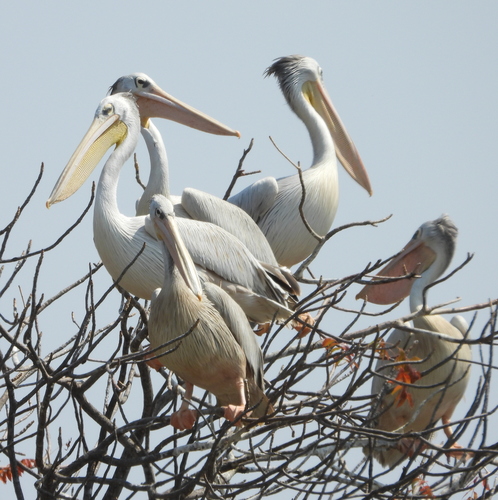 Pink-backed Pelican
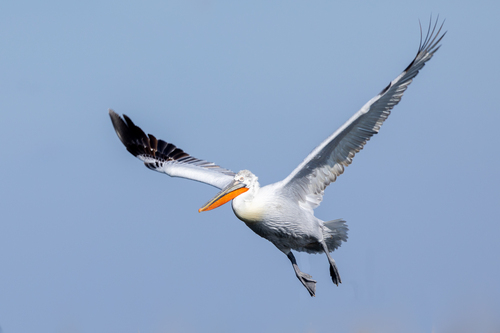 Dalmatian Pelican
In short
The most reliable way to separate Pink-backed Pelican from Dalmatian Pelican is by size and overall coloration: Dalmatian is much larger, with a massive bill and silvery-white to greyish plumage, while Pink-backed is smaller, with a greyer overall tone and a subtle pinkish wash on the back. In flight, Dalmatian shows broad, pale wings with black primary tips, and a distinctive shaggy crest on the nape, while Pink-backed is more uniformly greyish with less contrast and lacks the curly nape feathers. Bill and pouch color also differ, especially in breeding season: Dalmatian's pouch turns vivid orange-red, while Pink-backed's remains greyish. These differences are visible in both perched and flying birds, but are most obvious when the two are seen together or with a sense of scale.
Identification tips
- Size is the most immediate clue: Dalmatian Pelican is much larger and bulkier than Pink-backed, with a wingspan and body length that dwarf the latter. Use nearby birds or objects for scale if possible.
- Bill length and shape: Dalmatian's bill is extremely long and robust (37–45 cm), with a noticeably larger pouch. Pink-backed's bill is shorter and more slender (30–38 cm).
- Plumage color: Dalmatian adults are silvery-white to creamy-grey, sometimes appearing almost white, while Pink-backed is always greyer with a subtle pinkish wash on the back. The pink is never as strong as a flamingo and can be faint in the field.
- Nape crest: Dalmatian has a shaggy, curly crest on the nape and back of the head, giving a messy look. Pink-backed lacks this feature, with a smoother head profile.
- Wing pattern in flight: Dalmatian shows broad, pale wings with black-tipped primaries, especially obvious in adults. Pink-backed's wings are more uniformly greyish, lacking strong black contrasts.
- Pouch color (breeding season): Dalmatian's pouch turns vivid orange-red in breeding adults; Pink-backed's pouch remains greyish year-round.
- Leg color: Dalmatian has dark grey legs, which can help separate it from other pelicans but is less useful against Pink-backed, which also has dull legs.
- Juvenile plumage: Dalmatian juveniles are overall greyer and duller than adults, with a less distinctive crest. Pink-backed juveniles are not described in detail, but are expected to be similar to adults, lacking strong contrast.
- Flight style: Dalmatian soars with slow, powerful wingbeats and often glides in synchronized flocks. Pink-backed is less likely to soar high and tends to fly lower and less dramatically.
- Takeoff: Dalmatian requires a long, energetic run on water to take off, looking heavy and labored. Pink-backed is lighter and takes off more easily.
- Roosting and nesting: Pink-backed often roosts and nests in trees or mangroves, sometimes high above ground. Dalmatian is more likely to be seen on open water or reedbeds.
- Habitat context: Dalmatian is found in large Eurasian wetlands and lakes, while Pink-backed is restricted to Africa and southern Arabia, favoring quieter, tree-lined waters.
- Group behavior: Dalmatian often travels in synchronized flocks, especially outside the breeding season. Pink-backed is more likely to be seen in smaller groups or singly.
- Voice: If heard, Dalmatian may give deep, guttural grunts or hisses in the breeding season; Pink-backed is generally silent.
- When in doubt: If the bird appears intermediate in size or color, look for the nape crest (present in Dalmatian, absent in Pink-backed) and the presence or absence of black in the wing tips (present in Dalmatian, absent in Pink-backed).
Size
Dalmatian Pelican is dramatically larger in every dimension: body length 1.6–1.8 m, wingspan 2.7–3.2 m, and average mass around 9.5 kg. Pink-backed Pelican is much smaller, with length 1.25–1.55 m, wingspan 2.15–2.9 m, and mass averaging 5.4 kg. The bill of Dalmatian is also notably longer (37–45 cm) compared to Pink-backed (30–38 cm). Even at a distance, Dalmatian's bulk and huge bill are striking, while Pink-backed appears more compact and less imposing.
Plumage
Juvenile and immature plumages are not described in detail for Pink-backed, but Dalmatian juveniles are overall greyer and duller than adults, with less pronounced nape crests. Adult Dalmatian Pelicans show silvery-white to creamy-grey plumage with a shaggy, curly nape crest and black-tipped primaries in flight. Pink-backed Pelican adults are grey and white, with a pinkish wash on the back (never deep pink), and lack the curly crest. The Pink-backed's plumage is generally duller and more uniform, with no strong black in the wings. In breeding season, Dalmatian's pouch becomes vivid orange-red, while Pink-backed's remains greyish. Both species have yellowish tones on the upper bill, but Dalmatian's is longer and more robust.
Behaviour
Dalmatian Pelican often soars with slow, powerful wingbeats and flies in synchronized flocks, neck pulled back in a pronounced 'S' shape. Takeoff is labored and energetic, especially when carrying fish. Pink-backed Pelican is less massive in flight, with more moderate wingbeats and a less dramatic takeoff. Both species may fish in groups, but Dalmatian is more likely to be seen gliding high above wetlands, while Pink-backed tends to stay closer to water surfaces and roosts in trees or on islands.
Habitat
Pink-backed Pelican prefers quiet, shallow freshwater habitats—lakes, swamps, slow rivers, and flooded areas—often roosting and nesting in trees (including mangroves), and rarely ventures to open seashore. Dalmatian Pelican is associated with large lakes and wetlands, often in Eurasia, and forages close to breeding sites during the season. Both can be found in similar wetland environments, but Pink-backed is more arboreal in its roosting and nesting habits, while Dalmatian is more likely to be seen on open water or large reedbeds.
Voice
Dalmatian Pelican is generally quiet, but may give deep, guttural grunts, hisses, or barking sounds in the breeding season. No distinctive vocalization is described for Pink-backed Pelican, and neither species is particularly vocal in the field.