

Pied Crow vs Common Raven
Corvus albus versus Corvus corax
Play a quiz with Pied Crow and Common Raven
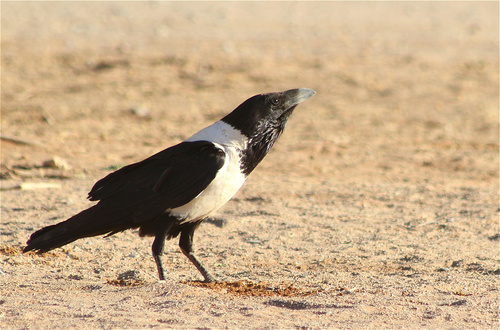 Pied Crow
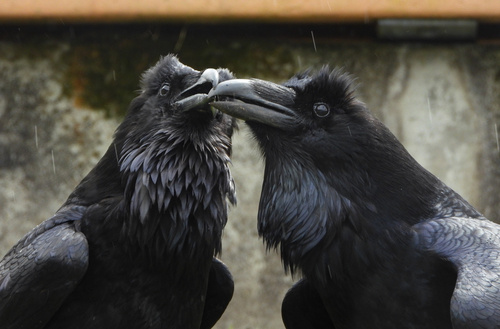 Common Raven
In short
The most reliable way to separate Pied Crow from Common Raven is the bold white patch on the crow’s breast and neck—Pied Crow is the only one of the two with any white in its plumage, while Common Raven is entirely black. If seen in flight, look for the raven’s much larger size, heavier bill, and distinctive wedge-shaped tail, compared to the crow’s more moderate proportions and squared tail. Juvenile Pied Crows may show some black mixed into the white, but never appear all-black like a raven. Structure and flight style also differ: ravens are bulkier, soar more steadily, and have a deeper croaking call, while Pied Crows are slimmer and behave more like typical crows.
Identification tips
- White breast and neck (Pied Crow only): If you see any white on the breast or neck, it is a Pied Crow. Common Raven is always all-black.
- All-black plumage (Common Raven): If the bird is entirely black, check other features, but Pied Crow never lacks white on the underparts or neck.
- Tail shape in flight: Ravens have a long, wedge-shaped tail, especially obvious when fanned. Pied Crow’s tail is shorter and more squared-off.
- Bill size and shape: Common Raven’s bill is much heavier, deeper, and more curved. Pied Crow’s bill is proportionately large for a crow but still slimmer and less imposing than the raven’s.
- Throat feathers: Adult ravens have shaggy, pointed throat feathers ("beard"), visible at close range. Pied Crow’s throat is smooth.
- Flight style: Ravens soar with steady, gliding flight and minimal wingbeats, often circling high. Pied Crows flap more, with a more direct, crow-like flight.
- Size impression: Ravens are much larger and bulkier, with longer wings and tail. Even at a distance, a raven will look more imposing than a Pied Crow.
- Juvenile plumage: Young Pied Crows may have black mixed into the white, but always show some pale on the breast/neck. Juvenile ravens are duller black, with blue-grey iris and pinkish gape, but never show white.
- Eye color: Both have dark brown eyes as adults; juvenile ravens have blue-grey irises, but this is rarely visible in the field.
- Leg length: Pied Crow has relatively long legs, but this is subtle and not usually diagnostic at a distance.
- Vocalizations: Listen for the deep croak of the raven versus the higher-pitched, typical crow calls of the Pied Crow.
- Habitat and range: Pied Crow is African and often near people; Common Raven is found across the Northern Hemisphere, usually in wilder habitats.
- Social behavior: Pied Crows are more likely to be seen in groups or mobbing raptors; ravens are more solitary or in pairs, except for subadults at roosts.
- Bill color: Both have black bills; color is not a separator, but the raven’s is much more massive.
- Confusion with other species: If you are in Africa and see a black-and-white corvid, it is almost certainly a Pied Crow. If you are in Eurasia or North America and see a massive all-black corvid with a wedge tail, it is a Common Raven.
Size
Common Raven is significantly larger and heavier than Pied Crow. Raven averages about 66 cm in length and nearly 950 g in mass, making it one of the largest passerines. Pied Crow is smaller, about 46–52 cm long and 520 g in weight. In the field, ravens appear much bulkier, with a more massive bill, longer tail, and larger wingspan. Even the largest Pied Crow will look noticeably slighter and more agile than a raven.
Plumage
Plumage is the clearest separator at all ages. Pied Crow, adult and immature, shows a large white area from the shoulders down to the lower breast, sharply contrasting with its glossy black head, neck, wings, and tail. Immature Pied Crows may have some black mixed into the white, but never lose the pale patch. Common Raven is entirely black at all ages, with a slightly duller look in juveniles and a blue-grey iris and pinkish gape when very young. Adult ravens have shaggy throat feathers and a subtle brownish-grey base to neck feathers, but these are only visible at close range. In flight, the raven’s tail is long and wedge-shaped, while the crow’s is shorter and more squared. No age or season brings white into the raven’s plumage.
Behaviour
Pied Crow behaves much like Eurasian crows, often seen in pairs or small groups, sometimes gathering in larger numbers at food sources. They are active, social, and may mob raptors. Common Raven is more solitary or found in pairs, especially adults, though subadults may roost together. Ravens are powerful fliers, often soaring with little wing-flapping, and display more stable, gliding flight than the more flappy, direct-flying Pied Crow. Ravens are also noted for their intelligence and complex social behaviors, such as communicating about food sources.
Habitat
Pied Crow is widespread in Africa, often found near human settlements, open country, and savannas. It adapts well to disturbed habitats. Common Raven is found across the Northern Hemisphere in a wide range of habitats, from tundra and forests to mountains and deserts, but is generally less associated with dense human habitation than Pied Crow. Range overlap is minimal, so location can be a strong clue.
Voice
Common Raven has a deep, resonant croak, much more sonorous and lower-pitched than any crow. Pied Crow’s calls are more typical of crows—higher-pitched, less resonant, and lacking the deep quality of the raven’s voice. In areas where other raven species occur, calls may be more similar, but between these two, the difference is usually clear.