
Pied-billed Grebe vs American Moorhen
Podilymbus podiceps versus Gallinula galeata
Play a quiz with Pied-billed Grebe and American Moorhen
 Pied-billed Grebe
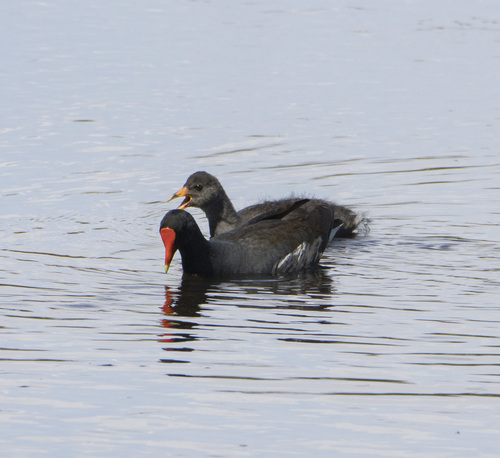 American Moorhen
In short
The most reliable field mark to separate Pied-billed Grebe from American Moorhen is bill shape and coloration: Pied-billed Grebe has a short, thick, chicken-like bill with a pale base and a bold black band in summer, while American Moorhen shows a bright red bill with a yellow tip and a prominent red frontal shield (adults). In flight, Pied-billed Grebe lacks any white on the upperwing, whereas American Moorhen shows white undertail coverts and flashes white along the flanks and underwing. Structure is also distinctive: Pied-billed Grebe is compact, short-necked, and rides low in the water, while American Moorhen is lankier, longer-legged, and often seen walking or swimming with head bobbing. Juveniles differ as well: young grebes are striped, while young moorhens are browner and lack the red shield. Both species may be found in similar wetland habitats, but their behavior and shape are quite different.
Identification tips
- Bill shape and color (all ages): Pied-billed Grebe has a short, thick, chicken-like bill that is pale with a black band in summer; American Moorhen has a slender, pointed bill that is bright red with a yellow tip and a red frontal shield (adults).
- Upperwing pattern in flight (all ages): Pied-billed Grebe shows no white on the upperwing, appearing uniformly brown; American Moorhen flashes white along the flanks and underwing, with white undertail coverts visible in flight and when swimming.
- Juvenile plumage: Juvenile grebes are boldly striped black-and-white on the face and neck; juvenile moorhens are plain brownish and lack the red shield and bill.
- Body structure: Grebe is compact, short-necked, and sits low in the water; moorhen is lankier, longer-legged, with a more upright posture and often seen walking or standing on vegetation.
- Feet and walking: Grebe has lobed toes and cannot walk on land; moorhen has long, unwebbed toes and is often seen walking, hopping, or running on land or floating plants.
- Swimming posture: Grebe rides low, often with only the head and neck visible, especially when alarmed; moorhen sits higher and is more buoyant.
- Throat and face (breeding adults): Grebe shows a black throat patch in summer; moorhen has a plain dark throat but a bright red shield above the bill.
- Undertail: Both species have white undertail coverts, but moorhen's are more prominent and often fluffed, especially when flicking the tail.
- Leg color: Moorhen has yellow legs; grebe's legs are not usually visible.
- Flight behavior: Grebe rarely flies and appears awkward, with feet trailing behind; moorhen takes off more readily, with legs dangling and strong wingbeats.
- Head pattern: Grebe has a dark crown and plain face; moorhen has a plain dark face in adults, but the shield is diagnostic.
- Behavior when disturbed: Grebe dives and may surface far from danger; moorhen often runs or flies short distances, sometimes with young clinging to the adult.
- Habitat use: If seen walking on land or on floating plants, it's almost certainly a moorhen, not a grebe.
- Seasonal changes: Grebe loses the black throat and bill band in winter but remains plain; moorhen's bill and shield become duller but structure and white flanks remain.
- Potential confusion: Inexperienced observers may mistake grebes for ducks due to their habits, but bill shape and lack of walking behavior are key distinctions.
Size
Pied-billed Grebe and American Moorhen are similar in length (Grebe: 31–38 cm; Moorhen: 32–35 cm), but the Moorhen is slightly heavier on average (Grebe mass: 440 g; Moorhen: 310–456 g). Moorhen has a longer wingspan (54–62 cm vs. Grebe's 45–62 cm) and appears lankier and longer-legged, while the grebe is more compact and sits lower in the water. The grebe's body is stockier and shorter-necked, with feet set far back, making it awkward on land, while the moorhen is more upright and agile on both land and floating vegetation.
Plumage
- Juvenile/immature birds: Pied-billed Grebe juveniles are boldly striped black-and-white on the face and neck, resembling a smaller, paler version of the adult but with clear striping. American Moorhen juveniles are browner overall, lack the red shield and bill, and do not show striping.
- Adults in flight: Pied-billed Grebe lacks any white on the upperwing, appearing uniformly brown above; American Moorhen shows white undertail coverts and flashes white along the flanks and underwing when flying or flapping.
- Adult breeding plumage: Pied-billed Grebe is plain brown with a black throat patch and a thick, pale bill with a black band. American Moorhen is dark overall but with a bright red bill, yellow tip, and red shield, plus yellow legs and white undertail.
- Nonbreeding/winter: Grebe loses the black throat and bill band becomes less distinct, but remains plain brown. Moorhen retains the white undertail and flanks, but the bill and shield are duller.
Behaviour
Pied-billed Grebe is almost always seen swimming or diving, rarely coming onto land, and often sinks low in the water or dives when disturbed. Its feet are set far back, making it unable to walk on land. American Moorhen is often seen swimming, but also walks and forages on floating vegetation or mud, using its long toes to balance. Moorhen is more likely to be seen walking, hopping on lily pads, or even running across open ground. In flight, grebes appear awkward and rarely fly, usually only when flushed; moorhens fly more readily and can show bursts of rapid flapping with dangling legs.
Habitat
Both species occur in freshwater wetlands, ponds, and marshes with emergent vegetation. Pied-billed Grebe prefers still water and is more strictly aquatic, rarely venturing onto land or dense vegetation. American Moorhen uses similar habitats but is more likely to be seen walking along the water's edge, on floating plants, or even in canals and ditches. Both may be found together, but the moorhen's terrestrial habits can be a clue.