

Paradise Jacamar vs Great Jacamar
Galbula dea versus Jacamerops aureus
Play a quiz with Paradise Jacamar and Great Jacamar
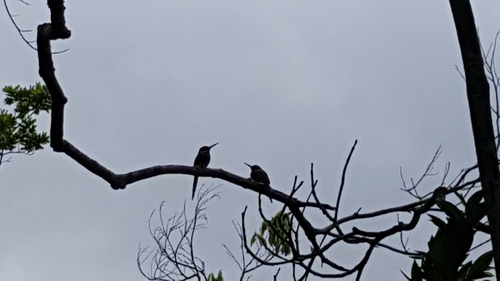 Paradise Jacamar
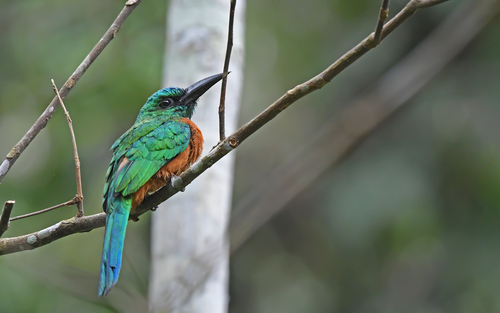 Great Jacamar
In short
The most reliable field mark to separate Paradise Jacamar from Great Jacamar is overall size and bulk: Great Jacamar is much heavier and more robust, with a noticeably stouter appearance even at a distance. Paradise Jacamar is slimmer, more elongated, and has a proportionally longer tail. In plumage, Paradise Jacamar shows a striking white throat and upper breast contrasting with glossy black upperparts, while Great Jacamar males have a metallic green head and upperparts with a deep rufous belly and a smaller white throat patch (females lack the white throat). Both species can appear similar when perched, but their size, structure, and throat/belly coloration are key in the field. No age-specific wing or flight pattern marks are described for either species, so focus on structure and plumage contrasts.
Identification tips
- Size and Bulk: Great Jacamar is much heavier and bulkier (63 g vs 27 g). Even when perched at a distance, it looks thickset and robust, while Paradise Jacamar is slim and elongated. Size difference is often obvious if both are seen in the same area.
- Tail Proportion: Paradise Jacamar has a proportionally longer, narrower tail, which accentuates its slender look. Great Jacamar's tail is shorter relative to its body and appears broader.
- Bill Structure: Great Jacamar has a heavier, stouter bill, matching its robust head and body. Paradise Jacamar's bill is finer and more delicate.
- White Throat Patch: Paradise Jacamar always shows a large, crisp white throat and upper breast, contrasting with dark upperparts. Great Jacamar male has only a small white throat patch (often hard to see), and the female lacks it entirely (throat metallic green).
- Underparts Color: Paradise Jacamar's underparts below the white throat are blackish. Great Jacamar's underparts are deep rufous from the lower throat down, a strong contrast to the white or green throat.
- Upperparts Color: Paradise Jacamar is glossy black above (with some subspecific bronzy or greenish sheen), while Great Jacamar is metallic green with gold and blueish tints, especially on the head, back, and tail.
- Sex Differences: Only Great Jacamar shows sexual dimorphism in throat color: females lack the white throat spot, making their throat entirely metallic green. Paradise Jacamar sexes are similar.
- Tail Color: Paradise Jacamar's tail is glossy black; Great Jacamar's is blue-black.
- Perched Posture: Paradise Jacamar often looks more upright and slender when perched, while Great Jacamar appears heavier and more horizontal.
- Flight Impression: No age-specific flight or wing pattern differences are described, so rely on structure and plumage in flight as well as perched.
- Habitat Context: Both species overlap in range and habitat, but Great Jacamar may be more tied to dense, shaded forest interiors and edges, especially near riverbanks.
- Voice: No vocal differences are described in the provided notes; do not rely on voice for separation here.
- Juvenile/Immature Marks: No distinctive juvenile or immature wing or flight marks are noted for either species; all main field marks apply to adults and immatures alike.
- Subspecies Variation: Some Paradise Jacamar subspecies have a lighter crown or bronzy sheen, but all retain the white throat and blackish underparts, so confusion with the rufous-bellied Great Jacamar is unlikely.
- Common Pitfalls: The main confusion arises when viewing a lone perched bird in poor light, where size and throat/belly color are best clues. If the throat is entirely white and the bird is slim, it's Paradise Jacamar; if the bird is bulky with a rufous belly and only a small or absent white throat patch, it's Great Jacamar.
Size
Great Jacamar is significantly larger and heavier, weighing about 63 g compared to Paradise Jacamar's 27 g. Both species are similar in length (Paradise Jacamar 25.5–34 cm, Great Jacamar 25–30 cm), but Great Jacamar is much bulkier and more powerfully built. In the field, Great Jacamar appears thickset with a heavy bill and broad body, while Paradise Jacamar is slender, with a long, narrow tail and a more delicate silhouette.
Plumage
No distinctive juvenile or immature upperwing or flight pattern marks are described for either species, so separation relies on adult plumage. Paradise Jacamar of all ages and sexes (nominate) has a dark brown crown, glossy black upperparts, and a crisp white throat and upper breast, with the rest of the underparts blackish. Some subspecies show a lighter crown or bronzy sheen, but all retain the white throat. Great Jacamar adult male is metallic green above with gold and blueish tints, a small white throat patch, and a rich rufous belly; the female lacks the white throat spot, so her throat is entirely metallic green. The tail of Great Jacamar is blue-black, while Paradise Jacamar's is glossy black. In summary: Paradise Jacamar is black-and-white (with a white throat and blackish underparts), while Great Jacamar is green above and rufous below (with a small or absent white throat patch).
Behaviour
Both species perch in the mid to upper canopy, often sallying for insects. Great Jacamar is described as sitting in the canopy and hunting by following prey, then beating it on a branch before eating. Both species use similar perching and hunting strategies, but Great Jacamar may appear more sluggish and deliberate due to its size. Paradise Jacamar, being lighter and slimmer, may look more agile and active when sallying for insects.
Habitat
Both species overlap in range (Amazon basin and adjacent regions) and inhabit lowland tropical forests. Great Jacamar is noted for preferring the middle levels of the canopy and shaded forest edges, especially near riverbanks, up to 500 m elevation. Paradise Jacamar is also found in similar habitats across a broad Amazonian range. Habitat alone is not diagnostic, but Great Jacamar may be more associated with dense, shaded forest interiors and edges.