

Pallid Harrier vs Eurasian Sparrowhawk
Circus macrourus versus Accipiter nisus
Play a quiz with Pallid Harrier and Eurasian Sparrowhawk
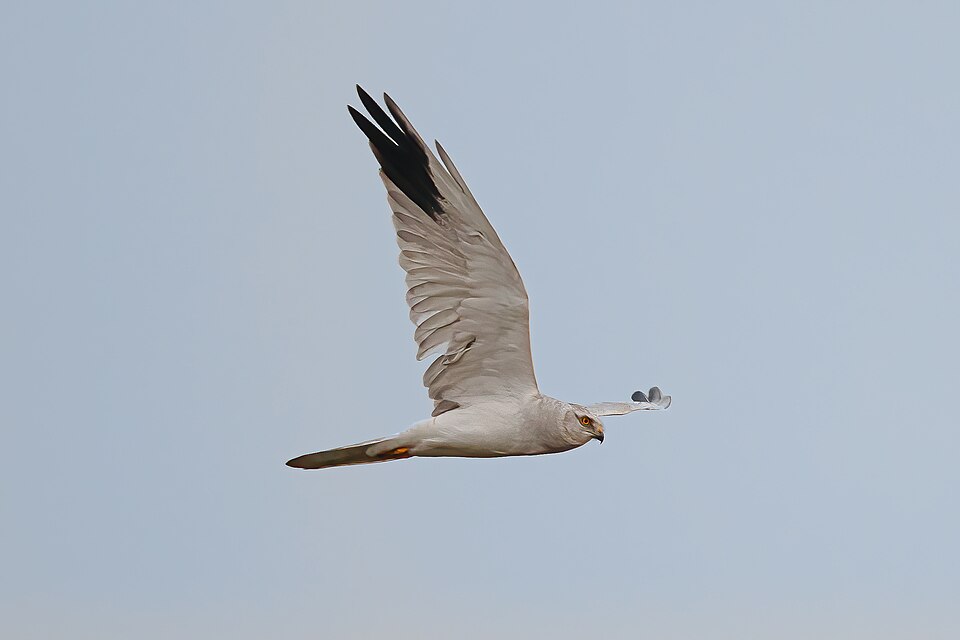 Pallid Harrier
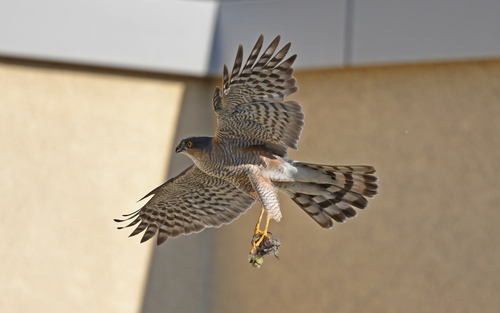 Eurasian Sparrowhawk
In short
The most reliable field mark to separate Pallid Harrier from Eurasian Sparrowhawk is the harrier’s long, narrow wings held in a shallow V during low flight, versus the sparrowhawk’s short, broad wings and rapid, flap-flap-glide flight. Juvenile and female Pallid Harriers ('ringtails') can be confused with female or juvenile Sparrowhawks at a distance, especially when perched, but in flight, the harrier’s slimmer, more buoyant profile and distinctive wing shape are key. Plumage differences are subtle in immatures, but Pallid Harrier shows a paler belly and a more defined facial pattern than the streakier, browner Sparrowhawk. Size is also a strong clue: Pallid Harrier is notably larger and more rangy, while Sparrowhawk is compact and built for woodland agility.
Identification tips
- Wing shape in flight: Pallid Harrier (all ages) shows long, narrow wings held in a shallow V, with a buoyant, gliding flight. Sparrowhawk has short, broad wings and a more direct, rapid flap-flap-glide flight. This is the most reliable separation at a distance.
- Size and jizz: Pallid Harrier is much larger and rangier, with a longer tail and wings. Sparrowhawk is compact, with a short neck and a square-ended tail. Even large female Sparrowhawks are smaller and bulkier compared to harriers.
- Facial pattern (juvenile/female): Pallid Harrier 'ringtails' (females/juveniles) show a well-defined pale collar and facial pattern, often with a contrasting pale area around the eye. Sparrowhawk juveniles/females lack this, appearing more uniformly brown-faced.
- Underparts (juvenile/female): Pallid Harrier has a paler, buffier belly with less extensive streaking. Sparrowhawk is more heavily and coarsely streaked or barred below, especially on the breast and belly.
- Upperparts (juvenile/female): Both are brown above, but Sparrowhawk juveniles have rusty fringes to upperparts and a streaked throat (no midline stripe), while Pallid Harrier is plainer above and shows a more uniform brown.
- Adult male plumage: Male Pallid Harrier is strikingly pale grey above and white below with narrow black wingtips—never matched by Sparrowhawk. Male Sparrowhawk is blue-grey above and orange-barred below.
- Tail shape: Pallid Harrier’s tail is long and rounded; Sparrowhawk’s is long but square-ended. In flight, the harrier’s tail often appears slightly wedge-shaped.
- Perched posture: Harrier appears elongated and slender when perched, often on the ground or low posts. Sparrowhawk is upright and compact, usually perched in trees or on fences.
- Flight style: Harrier glides and quarters low over open ground, rarely flapping rapidly. Sparrowhawk uses rapid, stiff wingbeats interspersed with short glides, especially when dashing through trees.
- Habitat context: Harrier is almost always in open country; Sparrowhawk is most often in or near woodland, but can occur in gardens and urban areas.
- Sexual dimorphism: Sparrowhawk shows extreme size difference between sexes; female can be nearly twice the mass of male, but both are smaller than harrier.
- Bill and legs: Sparrowhawk has a small bill and long, thin toes for catching birds; harrier’s bill and legs are less specialized for perching or gripping prey.
- Confusion risk: Juvenile/female harriers are most likely to be confused with female/juvenile Sparrowhawks, especially at a distance or when perched. Always prioritize wing shape and flight style for separation.
- Seasonality: Pallid Harrier is a rare vagrant in western Europe, so context and abundance may help; Sparrowhawk is common and widespread.
- Voice: Not diagnostic for separation in the field; both are generally silent when hunting.
Size
Pallid Harrier is substantially larger and longer-winged than Eurasian Sparrowhawk. Adult harriers average about 383.5 g (body mass), with a length of 40–48 cm and a wingspan of 95–120 cm. In contrast, adult Sparrowhawks average 220 g, with males 29–34 cm long (wingspan 59–64 cm) and females 35–41 cm (wingspan 67–80 cm). Even the largest female Sparrowhawk is smaller and much shorter-winged than a Pallid Harrier. In the field, the harrier’s size and long, slim wings stand out, especially in flight.
Plumage
- Juveniles and Females: Both species’ juveniles and females are brown above and streaked below, but Pallid Harrier juveniles/females ('ringtails') have a paler, buffier belly and a more sharply defined facial pattern (often a pale collar and contrasting face). Sparrowhawks are more uniformly brown above and have coarser, darker barring or streaking below, with less facial contrast.
- Adults: Adult male Pallid Harrier is pale grey above and white below with narrow black wingtips—never matched by Sparrowhawk. Adult male Sparrowhawk is blue-grey above with orange-barred underparts, and never shows the harrier’s pale, black-tipped wing pattern. Female Sparrowhawks are brown or greyish-brown above with brown-barred underparts, lacking the harrier’s pale belly and facial pattern.
- Wing pattern in flight: Pallid Harrier (all ages) shows long, narrow wings with black tips and a shallow V shape. Sparrowhawk has short, broad, rounded wings, with no black tip panel, and a square-ended tail. Juvenile Sparrowhawks have rusty fringes above and a streaked throat without a midline stripe.
Behaviour
Pallid Harrier hunts by gliding low over open fields and moors, wings held in a shallow V, often quartering back and forth with buoyant, unhurried flight. Eurasian Sparrowhawk is a woodland specialist, flying with rapid, bursty flap-flap-glide sequences, using short, broad wings and a long tail to maneuver through trees. When perched, Sparrowhawk is compact and upright, while harrier appears rangier and more elongated. Harriers rarely perch in trees, preferring ground or low posts, while Sparrowhawks often perch in woodland edges or gardens.
Habitat
Pallid Harrier is a bird of open country: fields, moors, steppes, and grasslands, rarely venturing into dense woodland. Eurasian Sparrowhawk is adapted to woodland and forest edges, but also hunts in gardens and parks, especially in more urbanized areas. If seen quartering low over open fields, Pallid Harrier is more likely; if darting through trees or seen in a garden, Sparrowhawk is the default.