

Ovambo Sparrowhawk vs Rufous-breasted Sparrowhawk
Accipiter ovampensis versus Accipiter rufiventris
Play a quiz with Ovambo Sparrowhawk and Rufous-breasted Sparrowhawk
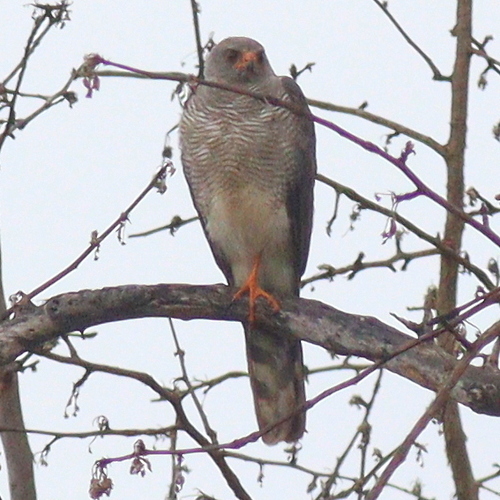 Ovambo Sparrowhawk
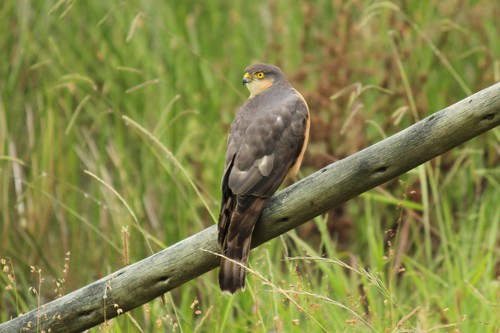 Rufous-breasted Sparrowhawk
In short
The most reliable field mark to separate Ovambo Sparrowhawk from Rufous-breasted Sparrowhawk is the color and pattern of the underparts: adult Rufous-breasted shows rich rufous underparts, while Ovambo is white below with fine grey barring and a plain white vent. In flight, both species show barred tails, but Rufous-breasted has bolder wing and tail bars. Eye and leg color also differ: Ovambo has dark red eyes and orange legs, while Rufous-breasted has yellow eyes at all ages. Juvenile plumages can overlap in pattern, but Rufous-breasted juveniles always show dark shaft streaks below, while Ovambo juveniles may be whiter or rufous but lack the same shaft streaking. Both are small Accipiters with similar size and overall shape, so careful attention to underpart color and soft part coloration is key.
Identification tips
- Underpart color (adult): Rufous-breasted Sparrowhawk always shows rich rufous underparts in adult plumage, visible both perched and in flight. Ovambo Sparrowhawk is white below with fine grey barring and a plain white vent. This is the single best field mark for adults.
- Juvenile underpart pattern: Juvenile Rufous-breasted Sparrowhawks have dark shaft streaks on the underparts, even when the background is pale. Juvenile Ovambo may be white or rufous below but lack the same consistent shaft streaking. Use this for immatures.
- Upperpart color: Both are grey above as adults, but Rufous-breasted is described as darker slate-brown, while Ovambo is plain grey. This is subtle and not always reliable.
- Tail pattern: Both show barred tails in flight, but Rufous-breasted has bolder, more obvious bars. Ovambo's tail has three dark bars and a broad, dark subterminal band.
- Wing pattern in flight: Rufous-breasted shows bold bars on both wings and tail. Ovambo's upperwing pattern is less distinctive, but the underwing of the melanistic morph is white-barred.
- Eye color: Ovambo Sparrowhawk has dark red eyes in adults, while Rufous-breasted has yellow eyes at all ages. This is a strong mark if seen well.
- Leg color: Ovambo has orange legs; Rufous-breasted has yellow legs. Useful when seen perched or in good light.
- Cere color: Ovambo's cere is red, contrasting with the black bill. Rufous-breasted's cere is not specified but is not noted as red.
- Melanistic morph: Only Ovambo Sparrowhawk has a melanistic (all-black) form. If you see a black Accipiter with white-barred underwings, it's Ovambo.
- Facial pattern: Rufous-breasted lacks a dark patch behind the eye or a white eyebrow, which may be present in Ovambo. This is subtle and not always visible.
- Sexual dimorphism: Both species show females larger than males, but size overlap is too great to use this reliably in the field.
- Perched jizz: Both are typical Accipiters, but look for the color and pattern clues above rather than relying on posture or structure.
- Flight jizz: Both are agile, broad-winged, and long-tailed. Focus on underpart color and wing/tail barring in flight.
- Habitat and range: Both can occur in similar habitats and ranges in southern Africa. Do not rely on location alone for identification.
- Voice: No distinctive vocal differences are noted in the sources; do not use voice for separation.
Size
Both species are nearly identical in size and structure, with body mass around 192–195 g and a length of about 30 cm. Wingspans are similar, though Rufous-breasted may average slightly broader (Ovambo: ~67 cm, Rufous-breasted: ~72 cm), but this is not a reliable field mark. Females are larger than males in both species, but the overlap is substantial and not useful for separation in the field.
Plumage
Juvenile and immature birds are the main confusion point. Juvenile Rufous-breasted Sparrowhawks always show dark shaft streaks on the underparts, regardless of how much rufous or white is present; this is a key mark in all ages before adult plumage. Juvenile Ovambo Sparrowhawks can be white below and on the head, or have a brown head and rufous underparts, but do not show the same consistent shaft streaking. Adults are easier: Rufous-breasted is dark slate-grey above and rich rufous below, with bold bars on wings and tail visible in flight. Ovambo adults are plain grey above, finely barred grey and white below, with a plain white vent, and three dark tail bars with a broad subterminal band. Ovambo also has a melanistic form (all black except for white-barred underwings), which is not found in Rufous-breasted. Eye and leg color differ: Ovambo has dark red eyes and orange legs, while Rufous-breasted has yellow eyes and legs at all ages.
Behaviour
Both species hunt small birds, often from flight, but Rufous-breasted is noted for striking from a perch as well and may take insects, small mammals, and reptiles. Ovambo's hunting behavior is less detailed in the sources, but both are typical Accipiters in jizz: broad-winged, long-tailed, agile in flight. No major behavioral differences are noted that aid identification.
Habitat
Both species occur in sub-Saharan Africa and can overlap in range. Rufous-breasted is found in a wider range of countries, including much of southern and eastern Africa. Ovambo is named for Ovamboland in northern Namibia but is also widespread. Habitat is not a reliable separator in the field where ranges overlap.
Ovambo Sparrowhawk · Rufous-breasted Sparrowhawk · My Tricky Birds