
Orange River Francolin vs Common Quail
Scleroptila gutturalis versus Coturnix coturnix
Play a quiz with Orange River Francolin and Common Quail
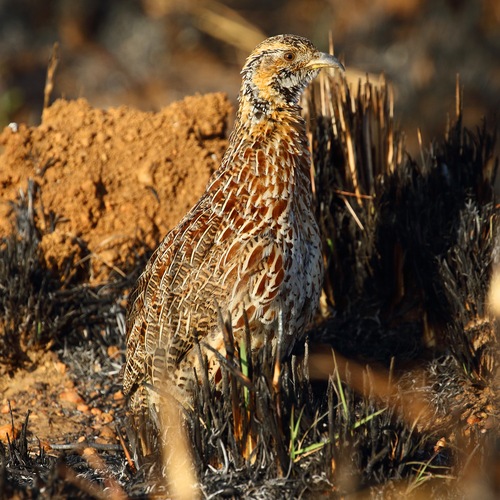 Orange River Francolin
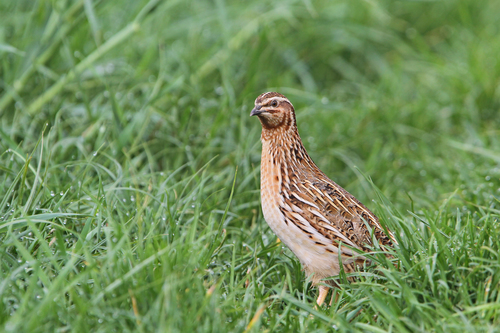 Common Quail
In short
The most reliable field mark to separate Orange River Francolin from Common Quail is overall structure and size: the francolin is much larger, bulkier, and longer-necked, while Common Quail is small, compact, and short-tailed. In plumage, Common Quail shows a distinctive white eyestripe and, in males, a white chin, whereas Orange River Francolin lacks these features and instead shows a neck-line (which varies in extent by region) and a buff or whitish belly. In flight, Common Quail’s long, pointed wings contrast with the francolin’s more rounded, gamebird-like wings. Habitat and behavior also help: francolins prefer open grassland and woodland, while quail are often in cultivated or grassy fields and are more likely to flush at close range. Voice is rarely helpful in direct comparison, as Common Quail’s call is distinctive but the francolin’s is less well described in these sources.
Identification tips
- Size and Structure: Orange River Francolin is much larger and bulkier than Common Quail. Look for a longer neck, longer legs, and a more upright, chicken-like stance in the francolin. Quail are small, round, and squat.
- Head Pattern: Common Quail shows a bold white eyestripe and, in males, a white chin. Orange River Francolin lacks both; instead, look for a neck-line (dark line on the neck) that may reach the eye (southern birds) or stop short (northern birds).
- Belly Color: In Orange River Francolin, the belly is buff in southern populations and whitish in northern ones. Common Quail’s underparts are streaked but not distinctly buff or white-bellied.
- Wing Shape in Flight: Common Quail has long, pointed wings for migration, giving a swift, direct flight. Francolin wings are shorter and more rounded, with a slower, heavier flight typical of gamebirds.
- Tail: Quail have very short tails, often barely visible in flight or on the ground. Francolins have a more obvious, though still short, tail.
- Behavior on the Ground: Francolins are more likely to walk in the open, sometimes in small groups, and appear upright. Quail are secretive, crouch low, and are rarely seen except when flushed.
- Flush Behavior: Quail flush suddenly and fly rapidly away, often dropping back into cover. Francolins may run before flushing and fly less explosively.
- Voice: If you hear a repeated three-note "wet-my-lips" call, it is Common Quail. Francolin calls are not described here, so absence of this call is not diagnostic.
- Habitat: In southern Africa, francolins are resident in grassland and woodland. Quail are more likely in cultivated fields or disturbed grassland, especially during migration or winter.
- Regional Variation: If you are in northern East Africa, check for a neck-line that does not reach the eye (francolin) and a whitish belly; in southern Africa, the neck-line reaches the eye and the belly is buff.
- Sex Differences: Male Common Quail have a white chin; females do not, but both sexes have the white eyestripe. Francolin sexes are similar.
- Plumage Pitfalls: Both species are brown and streaked, but only quail have the bold eyestripe and white chin. Francolin’s head is plainer except for the neck-line.
- Migration Context: If seen in Europe or North Africa outside the francolin’s range, it is Common Quail. In southern Africa, check for size and head pattern.
- Group Size: Francolins may be in pairs or small groups; quail are usually solitary or in loose, small parties.
- Captive Birds: If seen in captivity, check for call and head pattern, as Common Quail are sometimes kept as poultry.
Size
Common Quail is a small, compact bird, measuring 16–18 cm in length with a wingspan of 32–35 cm and weighing 70–140 g [wikipedia]. Orange River Francolin is considerably larger and bulkier, typical of francolins, though precise measurements are not given in the sources. The francolin’s longer neck and legs, as well as its heavier build, are obvious in the field, especially when the two are seen in similar contexts. Quail appear squat and round, with short tails and a low profile, while francolins are upright and chicken-like.
Plumage
Juvenile and immature plumages are not described in detail for either species in the sources, but key contrasts are visible in adults and likely hold for most ages. Common Quail is streaked brown overall with a clear white eyestripe and, in males, a white chin. Its wings are long and pointed, suited to migration, and show no bold upperwing panels or contrasting patterns in flight. Orange River Francolin lacks a white eyestripe and white chin, instead showing a neck-line (a dark line on the neck) that varies by region: in southern populations it reaches the eye and the belly is buff, while in northern birds the neck-line does not reach the eye and the belly is whitish. The francolin’s plumage is generally more uniform and less boldly marked on the head. In flight, the francolin’s wings are shorter and rounder, typical of non-migratory gamebirds.
Behaviour
Common Quail is secretive, often only detected by voice, and flushes at close range with rapid, direct flight. Its migratory nature means it is sometimes seen in open fields during migration, but it quickly drops back into cover. Orange River Francolin is more likely to be seen walking in open grassland or woodland, often in pairs or small groups, and is less likely to flush unless closely approached. Its movements are more deliberate and upright, resembling a small chicken more than a quail.
Habitat
Orange River Francolin inhabits grassland and woodland in southern and eastern Africa, with regional variation in plumage. Common Quail breeds in the Palearctic and winters in Africa and southern India, favoring cultivated fields, meadows, and grassy areas. While both can occur in grassland, francolins are more associated with natural open habitats, and quail with agricultural or disturbed grassland. In southern Africa, francolins are resident, while quail are present mainly as migrants or winter visitors.
Voice
Common Quail has a distinctive call of three repeated chirps, often described as "wet-my-lips" and repeated in quick succession. This call is frequently heard at dawn and dusk and is a key detection method for the species. The Orange River Francolin’s call is not described in the provided sources, so voice is not a reliable separation feature unless the quail’s call is clearly heard.