

Orange-bellied Flowerpecker vs Scarlet-backed Flowerpecker
Dicaeum trigonostigma versus Dicaeum cruentatum
Play a quiz with Orange-bellied Flowerpecker and Scarlet-backed Flowerpecker
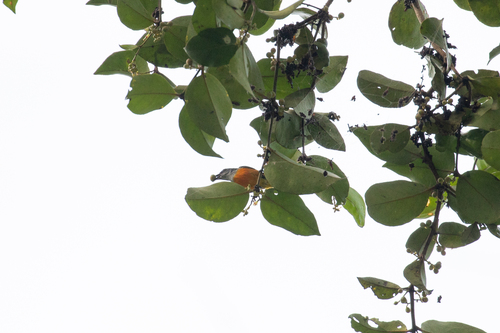 Orange-bellied Flowerpecker
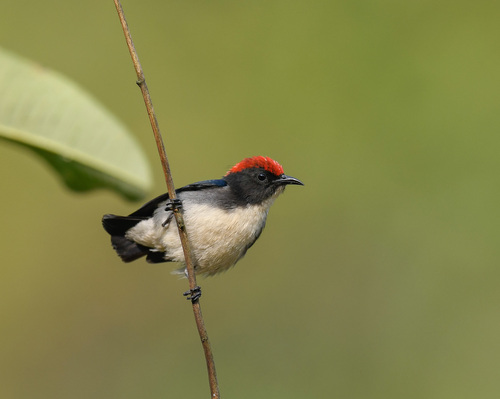 Scarlet-backed Flowerpecker
In short
The most reliable way to separate Orange-bellied and Scarlet-backed Flowerpecker is by the color and pattern of the upperparts and underparts, especially in males: Orange-bellied males show a slaty-blue back with a large orange mantle patch and fiery orange to yellow underparts, while Scarlet-backed males have a navy blue back with a striking, continuous bright red stripe from crown to tail coverts and clean white underparts. Females and immatures are trickier, but Orange-bellied females are drab olive-brown with a pale orange rump and yellow belly, whereas Scarlet-backed females and juveniles are olive-green above with a black tail, scarlet rump and upper tail coverts, and creamy white underparts. Bill shape and subtle differences in jizz can help in poor views. Both species overlap widely in range and habitat, so careful attention to these plumage details is essential.
Identification tips
- Male upperparts: Look for the bright red stripe running from crown to tail coverts in Scarlet-backed males; Orange-bellied males never show this, instead having slaty-blue upperparts with a large orange mantle patch.
- Male underparts: Orange-bellied males have a gradient of fiery orange to yellow below, while Scarlet-backed males have clean creamy white underparts.
- Female upperparts: Orange-bellied females are drab olive-brown with a pale orange rump, lacking any red or scarlet on the back or rump. Scarlet-backed females are olive-green above, with a black tail and scarlet rump and upper tail coverts.
- Female underparts: Orange-bellied females have a yellow belly, while Scarlet-backed females have creamy white underparts.
- Juvenile Scarlet-backed: Juveniles resemble females but have an orange bill and lack the bright red rump; underparts remain white. If you see a small olive-green bird with white underparts and an orange bill, it's likely a juvenile Scarlet-backed.
- Bill shape: Orange-bellied has a fairly thin, short bill that is slightly curved downwards at the tip; Scarlet-backed's bill is dark grey and arched, but this is subtle and best used in good views.
- Tail color: Scarlet-backed females and juveniles have a black tail, which contrasts with the olive-green upperparts and scarlet rump; Orange-bellied females are more uniformly drab.
- Mantle patch: Only Orange-bellied males show a large triangular orange patch on the mantle; Scarlet-backed never does.
- Red on back: Any continuous red stripe from crown to tail coverts is diagnostic for male Scarlet-backed; Orange-bellied never shows this pattern.
- Underpart color in all ages: Orange/yellow below points to Orange-bellied; white below points to Scarlet-backed.
- Rump color in females: Pale orange rump in Orange-bellied female vs. scarlet rump and upper tail coverts in Scarlet-backed female.
- Context: Both species can occur together in the same habitat, so do not rely on location or habitat alone for ID.
- No flight pattern clues: Neither species shows a distinctive upperwing or flight pattern for field separation.
- No reliable size difference: Both are similar in size and mass; do not use this for ID.
- Be cautious with immatures: Juvenile Scarlet-backed lacks the bright red rump but has white underparts and an orange bill; Orange-bellied juveniles are likely duller and more yellowish below, but this is less well described.
Size
Both species are very similar in size and mass, with Orange-bellied Flowerpecker averaging 7.0 g and Scarlet-backed Flowerpecker ranging from 7–8 g. Scarlet-backed is slightly longer at about 9 cm, but this is not a reliable field mark. Both are compact, short-tailed flowerpeckers and size alone is not helpful for separation.
Plumage
No distinctive age-specific upperwing or flight pattern is described for either species, so focus is on perched views and overall coloration.
- Adult males: Orange-bellied shows slaty-blue upperparts with a large triangular orange patch on the mantle, and a gradient of fiery orange to yellow on the underparts. Scarlet-backed males have navy blue upperparts with a broad, continuous bright red stripe from crown to upper tail coverts, and clean creamy white underparts.
- Females: Orange-bellied females are drab olive-brown overall, with a pale orange rump and yellow belly. Scarlet-backed females are olive-green above, with a black tail, scarlet rump and upper tail coverts, and creamy white underparts.
- Juveniles: Scarlet-backed juveniles resemble females but have an orange bill and lack the bright red rump; their underparts remain creamy white. Orange-bellied juvenile plumage is not specifically described but is likely similar to the female.
- Key contrast: Underparts color is a strong separator—Orange-bellied (especially males) show orange/yellow below, while Scarlet-backed (all ages/sexes) have white underparts. The presence or absence of a continuous red stripe on the back is diagnostic in males.
Behaviour
No distinctive behavioral differences are described in the sources for field separation. Both species are typical active, restless flowerpeckers, often seen moving quickly through foliage or visiting flowers and fruit. Behavior is not a reliable separator.
Habitat
Both species overlap widely in range and habitat, occurring in Bangladesh, Brunei, Indonesia, Malaysia, Myanmar, the Philippines, Singapore, and Thailand. Scarlet-backed is noted for using gardens as well as lowland forests, while Orange-bellied is also widespread in similar habitats. Habitat alone is not a reliable separator in areas of overlap.
Orange-bellied Flowerpecker · Scarlet-backed Flowerpecker · My Tricky Birds