

Northern Shoveler vs Great-tailed Grackle
Spatula clypeata versus Quiscalus mexicanus
Play a quiz with Northern Shoveler and Great-tailed Grackle
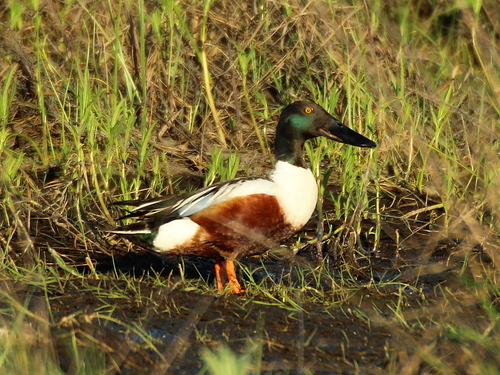 Northern Shoveler
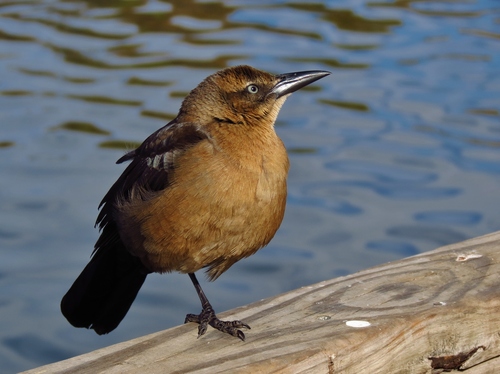 Great-tailed Grackle
In short
The most reliable way to separate Northern Shoveler from Great-tailed Grackle is by bill shape: shovelers have a huge, flat, spatula-like bill, while grackles have a slender, pointed bill. In flight or at rest, shovelers (of all ages) show a broad, pale blue forewing panel and a white-bordered green speculum, while grackles never show such wing patterning and instead have uniform dark wings. Adult male shovelers are striking with their white, chestnut, and green plumage, but females and eclipse males are mottled brown—still, their bill remains diagnostic. Grackles are long-tailed, iridescent black (males) or brown (females), and often seen in noisy, social groups. Even at a distance or in poor light, the shoveler's bill and the grackle's tail and posture are strong clues.
Identification tips
- Bill shape is the single most reliable mark: Northern Shoveler has a huge, flat, spatulate bill (grey to black in males, grey with orange edges in females); Great-tailed Grackle has a long, slender, pointed bill. This holds for all ages and sexes.
- Wing pattern in flight: Shovelers (all ages except juveniles) show a broad, pale blue forewing panel and a green speculum bordered by white; grackles have plain, dark wings with no contrasting panels or speculum. This is especially useful for distant or flying birds.
- Tail shape and length: Grackles have a very long, keel-shaped tail, often fanned or folded vertically; shovelers have a short, rounded duck tail. In flight, the grackle's tail is obvious and distinctive.
- Adult male plumage: Breeding male shoveler is boldly patterned (dark green head, white breast, chestnut flanks); male grackle is glossy black with purple-blue sheen. No confusion at close range, but distant or poor-light views may obscure color.
- Female/immature confusion: Female shovelers are mottled brown, similar to female mallards, but always with the oversized bill and, in flight, the blue forewing. Female and juvenile grackles are brown, but slimmer, with a long tail and yellow (adult) or brown (juvenile) eyes.
- Leg color: Shovelers have bright orange-red legs; grackles have dark legs. This is visible when birds are walking or perched.
- Eye color: Adult grackles have bright yellow eyes (both sexes); shovelers have dark eyes. Juvenile grackles have brown eyes.
- Feeding behavior: Shovelers are always dabbling or swimming, rarely seen walking far from water; grackles walk or run on the ground, forage in open areas, and perch in trees or on wires.
- Social behavior: Grackles are highly social, often in noisy flocks; shovelers are less gregarious, usually in small groups.
- Habitat context: Shovelers are found in wetlands and marshes; grackles are common in urban, agricultural, and open habitats, often far from water.
- Flight style: Shovelers fly with steady, direct wingbeats; grackles have a more undulating, sometimes floppy flight, with obvious tail movement.
- Size and shape: Shovelers are bulkier, heavier-bodied ducks; grackles are slimmer, with a more elongated profile and long tail.
- Vocalization: If you hear a harsh, varied, or squeaky call, it's a grackle; shovelers are generally quiet.
- Seasonal confusion: In eclipse (nonbreeding) plumage, male shovelers resemble females but still show the blue forewing and spatulate bill. Grackles do not have a comparable plumage change.
- Pitfalls: At great distance or in poor light, a female shoveler might be mistaken for a brown grackle, but the bill and wing pattern (in flight) will always separate them. Grackles never have a blue forewing or spatulate bill.
Size
Northern Shoveler is a medium-sized duck, noticeably heavier and bulkier than a Great-tailed Grackle. Shovelers are 44–52 cm long with a wingspan of 70–84 cm and a mass of 500–800 g (much heavier than the grackle). Great-tailed Grackles are slimmer, 38–46 cm long, with a wingspan of 48–58 cm and a mass around 169 g (males up to 265 g, females as light as 115 g). In the field, shovelers look stocky and broad-chested, while grackles appear sleeker and more elongated, especially with their long tails.
Plumage
- Juvenile/immature and female shovelers are mottled brown with a grey forewing and a broad, pale blue panel visible in flight (all ages/sexes except juveniles may show this), plus a green speculum bordered by white. The bill is always large and spatulate, even in young birds.
- Adult male shovelers (breeding) have a dark green head, white breast, chestnut flanks, and black bill; in eclipse plumage, they resemble females but keep the blue forewing.
- Great-tailed Grackles: Adult males are glossy black with a purple-blue sheen, females and juveniles are brown with darker wings and tail. No pale wing panels or speculum. Both sexes have bright yellow eyes as adults (juveniles have brown eyes). The tail is long and keel-shaped, often fanned or folded vertically.
- In flight: Shovelers show strong wing pattern contrast; grackles show uniform dark wings and a very long tail.
Behaviour
Northern Shovelers are dabbling ducks, often seen swimming and feeding by swinging their bills side-to-side on the water surface, straining food with their specialized lamellae. They are less gregarious than some ducks, usually in small flocks. Grackles are highly social passerines, often in noisy, conspicuous flocks, walking on the ground, perching in trees, or foraging in open areas and urban settings. In flight, shovelers are direct and steady, while grackles have a more undulating, sometimes floppy flight with obvious tail movements.
Habitat
Northern Shovelers prefer marshes, wetlands, and shallow lakes with muddy bottoms rich in invertebrates. They are rarely found far from water. Great-tailed Grackles are highly adaptable, found in open country, urban areas, parking lots, agricultural fields, and near water, but not restricted to wetlands. If you see a bird in a city parking lot or urban park, it's far more likely to be a grackle than a shoveler.
Voice
No direct comparison available. Grackles are extremely vocal, with a wide variety of harsh, squeaky, and musical calls, often heard in flocks. Shovelers are relatively quiet; males may give soft calls in display, but are not conspicuous by voice.