
Motmot

Narina Trogon vs Purple Roller

Apaloderma narina versus Coracias naevius

Play a quiz with Narina Trogon and Purple Roller
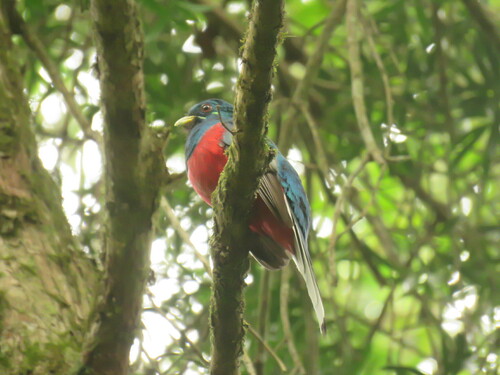
Narina Trogon (Apaloderma narina) Narina Trogon
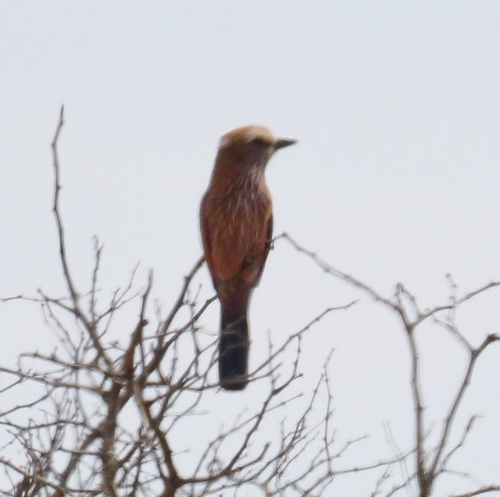
Purple Roller (Coracias naevius) Purple Roller

Media

Loading…

In short

The most reliable field mark to separate Narina Trogon from Purple Roller is overall color: Narina Trogon is a vivid green and red bird with a white-fringed undertail, while Purple Roller is a duller brownish bird with purplish-pink streaked underparts and a white eyebrow. Immature Narina Trogons show white-tipped tertials, a feature absent in rollers. In flight or perched, the trogon’s metallic green upperparts and bright red belly contrast sharply with the roller’s streaked, muted tones and square-cut tail. Structure and behavior also differ: trogons perch quietly in forest shade, while rollers are bulkier, sit atop exposed perches, and display a rocking flight.

Identification tips

  1. Juvenile/immature wing pattern: Immature Narina Trogons have distinct white tips to the tertials (inner wing feathers), visible when perched or in flight—Purple Roller never shows this feature at any age.
  2. Undertail pattern: Narina Trogon of all ages and sexes shows white-tipped and fringed outer tail feathers, giving a white appearance to the undertail when perched; Purple Roller’s tail is dark and square-cut, lacking white.
  3. Overall color: Narina Trogon is vivid green above (metallic gloss in males), bright red below (especially males), while Purple Roller is brownish overall with purplish-pink, white-streaked underparts and a white eyebrow.
  4. Facial pattern: Purple Roller shows a strong white supercilium (eyebrow) and a white nape patch; Narina Trogon lacks these, with a plain green or brown face (female/immature) and green or blue-green bare skin around the eye and gape.
  5. Tail shape: Narina Trogon’s tail is long and graduated with a metallic gloss; Purple Roller’s tail is square-cut and dark, with no gloss.
  6. Crown color: Purple Roller’s crown varies (rufous in north, olive-green in south), but always contrasts with the white eyebrow; Narina Trogon’s crown is green (male/female) or brownish (female/immature), blending with the rest of the upperparts.
  7. Wing structure: Purple Roller has long, rounded wings suited for strong, direct flight; Narina Trogon’s wings are shorter and more rounded, adapted for maneuvering in dense forest.
  8. Bill shape: Narina Trogon has a short, broad bill with a green gape (male) or blue skin (female); Purple Roller’s bill is longer, more robust, and lacks colorful bare skin.
  9. Perching behavior: Narina Trogon perches quietly in shaded forest, often remaining still and hidden; Purple Roller perches conspicuously atop trees or poles in open country.
  10. Flight style: Purple Roller rocks side-to-side and performs rolling dives in display, often calling; Narina Trogon flies quietly and directly between perches, rarely displaying.
  11. Vocalization: Listen for the difference: trogon’s call is a low, repeated hoot from cover, while the roller’s is a loud, harsh "ka" or "gaa" from an exposed perch or in flight.
  12. Habitat context: If seen in dense forest or woodland, especially in shade, it is likely Narina Trogon; if in open, dry thornveld or woodland, especially perched high, it is likely Purple Roller.
  13. Sex differences: Only Narina Trogon is sexually dimorphic—males are brighter, females duller with blue skin around the eye; Purple Roller sexes are similar.
  14. Size impression: Purple Roller is much larger and heavier than Narina Trogon, appearing bulkier and more robust.
  15. Pitfalls: Dull light or distance can make Narina Trogon appear less colorful and more similar to Purple Roller, but the undertail and tertial tips (immature) remain diagnostic.

Size

Purple Roller is significantly larger and heavier than Narina Trogon. Purple Roller measures 35–40 cm in length and averages 168 g in mass, making it the largest African roller. Narina Trogon is medium-sized for a trogon at 32–34 cm and much lighter at 61 g. The roller appears bulkier and more robust, while the trogon is more slender and delicate in build.

Plumage

Juvenile and immature Narina Trogons have distinct white tips to the tertials (inner wing feathers), a feature not seen in Purple Roller of any age. Adult male Narina Trogons are strikingly green above with a metallic blue-green gloss on the tail, bright red below, and a green gape and eye flanges. Females are duller, with a brown face and chest and blue skin around the eyes, but still show green upperparts and reddish underparts. In all ages, the undertail of Narina Trogon is marked by white-tipped and fringed outer tail feathers, making the undertail appear white from below. Purple Roller, by contrast, is overall dull brownish from a distance, with a white eyebrow, white nape patch, and a dark, square-cut tail. Its underparts are purplish-pink with white streaks. The roller’s wings are long and rounded, lacking any white tertial tips or metallic gloss. Crown color varies geographically: rufous in the north, olive-green in the south.

Behaviour

Narina Trogon is typically quiet and unobtrusive, perching motionless in shaded forest or woodland, often remaining hidden. It may fluff breast feathers in display but rarely perches openly. Purple Roller is conspicuous, often sitting at the top of thorn trees or on poles in open country, scanning for prey. Its display flight is distinctive: rocking side-to-side, calling raucously, and performing a rolling dive from above the treetops. Rollers are territorial and aggressive towards intruders, including other rollers and even small raptors.

Habitat

Narina Trogon is a forest and woodland specialist, found in a wide range of wooded habitats from lowland to highland forests across sub-Saharan Africa, but always associated with dense cover. Purple Roller prefers dry thornveld and open woodland, avoiding dense forest. It is usually seen in open country, especially where it can perch high and watch for prey. Thus, habitat context is a strong clue: trogon in shaded forest, roller in open, arid areas.

Voice

Narina Trogon’s call is a low, grating, repeated hoot, given only by males, usually from within cover. Purple Roller’s voice is a harsh, grating "ka" or "gaa" repeated rapidly and evenly, often delivered during display flights and much more raucous and obvious than the trogon’s call. The roller’s calls are more likely to be heard in open country and during display.

Submit a better description

Use the same sections as the comparison. Your text is published immediately.

The most reliable field mark to separate Narina Trogon from Purple Roller is overall color: Narina Trogon is a vivid green and red bird with a white-fringed undertail, while Purple Roller is a duller brownish bird with purplish-pink streaked underparts and a white eyebrow. Immature Narina Trogons show white-tipped tertials, a feature absent in rollers. In flight or perched, the trogon’s metallic green upperparts and bright red belly contrast sharply with the roller’s streaked, muted tones and square-cut tail. Structure and behavior also differ: trogons perch quietly in forest shade, while rollers are bulkier, sit atop exposed perches, and display a rocking flight.

  1. Juvenile/immature wing pattern: Immature Narina Trogons have distinct white tips to the tertials (inner wing feathers), visible when perched or in flight—Purple Roller never shows this feature at any age.
  2. Undertail pattern: Narina Trogon of all ages and sexes shows white-tipped and fringed outer tail feathers, giving a white appearance to the undertail when perched; Purple Roller’s tail is dark and square-cut, lacking white.
  3. Overall color: Narina Trogon is vivid green above (metallic gloss in males), bright red below (especially males), while Purple Roller is brownish overall with purplish-pink, white-streaked underparts and a white eyebrow.
  4. Facial pattern: Purple Roller shows a strong white supercilium (eyebrow) and a white nape patch; Narina Trogon lacks these, with a plain green or brown face (female/immature) and green or blue-green bare skin around the eye and gape.
  5. Tail shape: Narina Trogon’s tail is long and graduated with a metallic gloss; Purple Roller’s tail is square-cut and dark, with no gloss.
  6. Crown color: Purple Roller’s crown varies (rufous in north, olive-green in south), but always contrasts with the white eyebrow; Narina Trogon’s crown is green (male/female) or brownish (female/immature), blending with the rest of the upperparts.
  7. Wing structure: Purple Roller has long, rounded wings suited for strong, direct flight; Narina Trogon’s wings are shorter and more rounded, adapted for maneuvering in dense forest.
  8. Bill shape: Narina Trogon has a short, broad bill with a green gape (male) or blue skin (female); Purple Roller’s bill is longer, more robust, and lacks colorful bare skin.
  9. Perching behavior: Narina Trogon perches quietly in shaded forest, often remaining still and hidden; Purple Roller perches conspicuously atop trees or poles in open country.
  10. Flight style: Purple Roller rocks side-to-side and performs rolling dives in display, often calling; Narina Trogon flies quietly and directly between perches, rarely displaying.
  11. Vocalization: Listen for the difference: trogon’s call is a low, repeated hoot from cover, while the roller’s is a loud, harsh "ka" or "gaa" from an exposed perch or in flight.
  12. Habitat context: If seen in dense forest or woodland, especially in shade, it is likely Narina Trogon; if in open, dry thornveld or woodland, especially perched high, it is likely Purple Roller.
  13. Sex differences: Only Narina Trogon is sexually dimorphic—males are brighter, females duller with blue skin around the eye; Purple Roller sexes are similar.
  14. Size impression: Purple Roller is much larger and heavier than Narina Trogon, appearing bulkier and more robust.
  15. Pitfalls: Dull light or distance can make Narina Trogon appear less colorful and more similar to Purple Roller, but the undertail and tertial tips (immature) remain diagnostic.

Purple Roller is significantly larger and heavier than Narina Trogon. Purple Roller measures 35–40 cm in length and averages 168 g in mass, making it the largest African roller. Narina Trogon is medium-sized for a trogon at 32–34 cm and much lighter at 61 g. The roller appears bulkier and more robust, while the trogon is more slender and delicate in build.

Juvenile and immature Narina Trogons have distinct white tips to the tertials (inner wing feathers), a feature not seen in Purple Roller of any age. Adult male Narina Trogons are strikingly green above with a metallic blue-green gloss on the tail, bright red below, and a green gape and eye flanges. Females are duller, with a brown face and chest and blue skin around the eyes, but still show green upperparts and reddish underparts. In all ages, the undertail of Narina Trogon is marked by white-tipped and fringed outer tail feathers, making the undertail appear white from below. Purple Roller, by contrast, is overall dull brownish from a distance, with a white eyebrow, white nape patch, and a dark, square-cut tail. Its underparts are purplish-pink with white streaks. The roller’s wings are long and rounded, lacking any white tertial tips or metallic gloss. Crown color varies geographically: rufous in the north, olive-green in the south.

Narina Trogon is typically quiet and unobtrusive, perching motionless in shaded forest or woodland, often remaining hidden. It may fluff breast feathers in display but rarely perches openly. Purple Roller is conspicuous, often sitting at the top of thorn trees or on poles in open country, scanning for prey. Its display flight is distinctive: rocking side-to-side, calling raucously, and performing a rolling dive from above the treetops. Rollers are territorial and aggressive towards intruders, including other rollers and even small raptors.

Narina Trogon is a forest and woodland specialist, found in a wide range of wooded habitats from lowland to highland forests across sub-Saharan Africa, but always associated with dense cover. Purple Roller prefers dry thornveld and open woodland, avoiding dense forest. It is usually seen in open country, especially where it can perch high and watch for prey. Thus, habitat context is a strong clue: trogon in shaded forest, roller in open, arid areas.

Narina Trogon’s call is a low, grating, repeated hoot, given only by males, usually from within cover. Purple Roller’s voice is a harsh, grating "ka" or "gaa" repeated rapidly and evenly, often delivered during display flights and much more raucous and obvious than the trogon’s call. The roller’s calls are more likely to be heard in open country and during display.

Discard your changes?

You have unsaved edits. If you leave now, those changes will be lost.

Narina Trogon · Purple Roller · My Tricky Birds