
Moustached Warbler vs Sedge Warbler
Acrocephalus melanopogon versus Acrocephalus schoenobaenus
Play a quiz with Moustached Warbler and Sedge Warbler
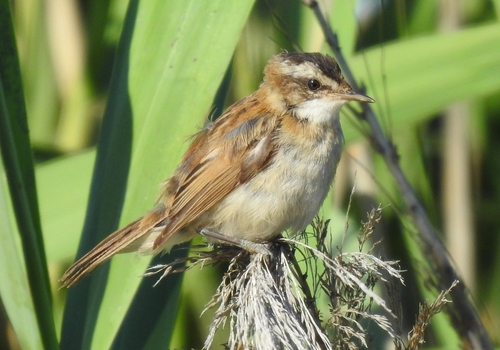 Moustached Warbler
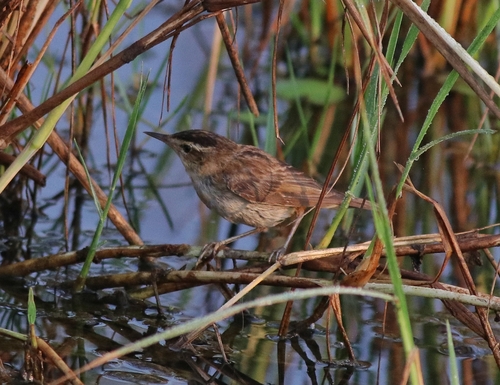 Sedge Warbler
In short
The most reliable field mark between Moustached Warbler and Sedge Warbler is the pattern and extent of streaking on the upperparts and breast, especially in juveniles: juvenile Sedge Warblers show dark spots on the breast, while young Moustached Warblers have heavier streaking and breast markings. Adults of both species have a prominent whitish supercilium and streaked brown backs, but Moustached Warbler tends to look cleaner below and slightly smaller overall. Sedge Warbler is more likely to be seen singing in flight, while Moustached Warbler sings only from cover or a perch. Careful attention to head pattern, underpart streaking, and behavior is key, especially in autumn and among juveniles.
Identification tips
- Juvenile breast pattern: Juvenile Sedge Warblers have dark spots on the breast, while juvenile Moustached Warblers show heavier streaking and more extensive breast markings. This is the best mark in late summer and autumn.
- Adult underparts: Adult Moustached Warbler has clean white underparts with little or no streaking, while Sedge Warbler is pale but may show a warmer tone and less contrast.
- Back streaking: Both are streaked brown above, but Moustached Warbler's streaking is finer; Sedge Warbler's is bolder and extends onto the wings.
- Rump color: Sedge Warbler has a warm brown, unstreaked rump, which can contrast with the duller wings; this is subtle but can help in good light.
- Supercilium: Both have a prominent whitish supercilium, but Sedge Warbler's is often broader and more contrasting, especially in fresh plumage. Moustached Warbler's may look narrower and more finely defined.
- Crown pattern: Sedge Warbler can show a pale central crown stripe bordered by darker edges, especially in juveniles and fresh adults; Moustached Warbler's crown is less distinctly marked.
- Ear coverts: Moustached Warbler has grey ear coverts, which can give a slightly different head pattern compared to Sedge Warbler.
- Song behavior: Sedge Warbler often sings in flight, rising and parachuting down with wings raised; Moustached Warbler never sings in flight and is more secretive.
- Song quality: Moustached Warbler's song is softer, more melodious, and includes nightingale-like phrases; Sedge Warbler's is a fast, chattering mix with mimicry but less musical.
- Bill and forehead: Both have strong, pointed bills and flattened foreheads; these are not useful for separation.
- Leg color: Sedge Warbler has greyish legs, but this is not a strong field mark compared to plumage and behavior.
- Habitat overlap: Both occur in reedbeds and marshes; do not rely on habitat alone for separation in overlapping areas.
- Seasonal context: In southern Europe and temperate Asia, Moustached Warbler is more likely; in northern and central Europe, Sedge Warbler predominates.
- Sex differences: Both are sexually monomorphic in the field; sex cannot be determined visually.
- Flight views: In flight, look for the overall impression: Sedge Warbler may appear slightly larger and more contrasting above, especially with the warm rump, but this is subtle and best used in combination with other marks.
Size
Both species are very close in size, but Moustached Warbler is slightly smaller at 12–13 cm in length, compared to Sedge Warbler's 11.5–13 cm. In practice, this size difference is minimal and rarely diagnostic in the field. Both have similar proportions, with strong, pointed bills and flattened foreheads. Weight is not a useful field mark here.
Plumage
- Juveniles: Sedge Warbler juveniles show dark spots on the breast, and can appear especially streaky above, sometimes with a pale central crown stripe. Moustached Warbler juveniles are more heavily streaked overall, with more pronounced breast markings than adults, but less spotty than Sedge Warbler juveniles.
- Adults: Both species have a streaked brown back and prominent pale supercilium. Moustached Warbler adults have a finely streaked brown back and white underparts, with grey ear coverts, while Sedge Warbler adults have a streaked brown back and wings, pale underparts, and a warm brown, unstreaked rump. The crown of Sedge Warbler is streaked with black, sometimes giving a pale central stripe effect, which is less marked in Moustached Warbler. Both have a strong, pointed bill and flattened forehead. The supercilium is prominent and whitish in both, but Sedge Warbler's can look broader and more contrasting, especially in fresh plumage.
Behaviour
Sedge Warbler is notable for its song-flights: males often sing while rising from a perch, circling, and parachuting down with wings in a 'V'. Moustached Warbler does not sing in flight, instead delivering its song from cover or a perch. Both are active in reedbeds and dense vegetation, but Sedge Warbler may be more conspicuous due to its song-flights and more frequent movement into open view.
Habitat
Both species breed in reedbeds and marshy areas, but their ranges differ: Moustached Warbler breeds mainly in southern Europe, southern temperate Asia, and northwest Africa, while Sedge Warbler breeds widely across Europe and Asia and winters in Africa. In overlapping areas, both can be found in similar wetland habitats, so habitat alone is not a reliable separator, though Sedge Warbler is more widespread and likely in northern and central Europe.
Voice
Both species have complex, fast songs with mimicry and acrocephaline whistles. Moustached Warbler's song is softer, more melodious, and includes nightingale-like phrases, always delivered from cover or a perch. Sedge Warbler's song is a random, chattering mix, often given during song-flights. Sedge Warbler also gives rattling alarm calls ('chirr' or 'kerr'). If you see a bird singing in flight, it is almost certainly a Sedge Warbler.