

Mourning Collared Dove vs Laughing Dove
Streptopelia decipiens versus Spilopelia senegalensis
Play a quiz with Mourning Collared Dove and Laughing Dove
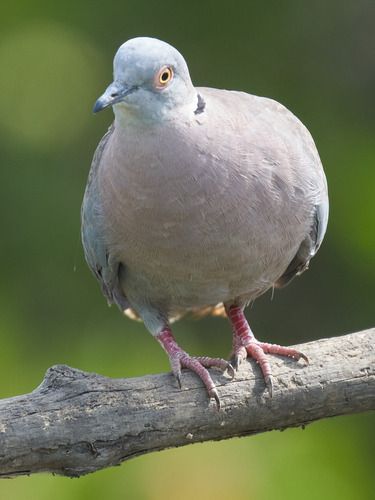 Mourning Collared Dove
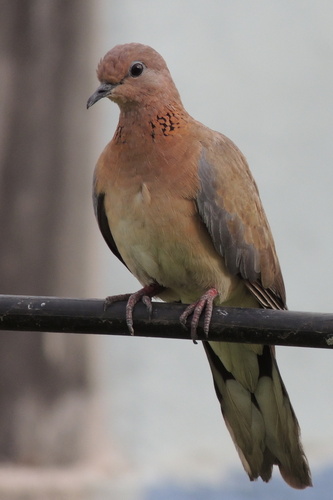 Laughing Dove
In short
The most reliable field mark to separate Mourning Collared Dove from Laughing Dove is the presence of a bold black-and-white half-collar on the neck of Mourning Collared Dove, versus the chequered rufous-and-grey patch on the neck of adult Laughing Dove. In flight, Mourning Collared Dove shows extensive white in the tail, while Laughing Dove's tail is long, graduated, and only the outer feathers are tipped white. Juvenile Laughing Doves lack the chequered neck patch, making them duller and potentially confusing, but Mourning Collared Dove immatures are also duller, with body feather scalloping. Mourning Collared Dove is stockier and larger, with a pale grey head and pinkish-grey body, while Laughing Dove is slimmer, longer-tailed, and has a pinkish-brown underside with a lilac-tinged head. Habitat and behavior can help: Mourning Collared Dove is common near water, while Laughing Dove prefers dry scrub and semi-desert.
Identification tips
- Neck Markings (Adults): Mourning Collared Dove shows a bold black half-collar edged in white on the back and sides of the neck. Laughing Dove has a chequered rufous-and-grey patch on the neck, not a solid collar. This is the single most reliable mark for adults.
- Juvenile/Immature Neck: Juvenile Laughing Doves lack the chequered neck patch and appear plain-necked, which can cause confusion. Immature Mourning Collared Doves are duller than adults and show scalloping on the body feathers, but retain a faint collar. Check for any hint of a collar versus a plain or patchy neck.
- Tail Pattern in Flight: Mourning Collared Dove has extensive white in the tail, visible as broad white flashes when flying. Laughing Dove's tail is long, graduated, and only the outer feathers are tipped white, so the white is less obvious and more limited.
- Overall Structure: Mourning Collared Dove is stocky and robust, with a thick neck and shorter tail. Laughing Dove is slim, with a noticeably long, graduated tail and more delicate build. This difference is most apparent when both species are seen together.
- Head and Body Color: Mourning Collared Dove has a pale grey head and pinkish-grey body. Laughing Dove has a lilac-tinged head and neck, with pinkish underparts and buff lower belly. The difference is subtle, but the lilac tone is unique to Laughing Dove.
- Wing Pattern: Both species have brownish upperwings, but Laughing Dove may show a bluish-grey band along the wing (especially in African populations), while Mourning Collared Dove's wings are pale brown with darker flight feathers. This is a minor mark and can be variable.
- Leg and Eye Color: Both have red legs. Mourning Collared Dove has a pale yellow to brownish iris and a red eye-ring, while Laughing Dove's eye color is not distinctive for separation.
- Flight Style: Mourning Collared Dove's flight is quick with regular beats and sharp flicks, typical of pigeons. Laughing Dove may display with wing-clapping and gliding during courtship, but in normal flight, the difference is subtle.
- Habitat Preference: If seen near water, especially in abundance, Mourning Collared Dove is more likely. In dry scrub or semi-desert, especially away from water, Laughing Dove is the default.
- Vocalization: Mourning Collared Dove's call is a deep, flat hoot (kuk-koooo-kuk), while Laughing Dove's is a rolling, musical croo-doo-doo-doo-doo. Use this only if the bird is calling.
- Sexes: Both species are sexually monomorphic in the field; do not rely on sex for separation.
- Seasonal Variation: Both species are resident and do not show strong seasonal plumage changes, but juveniles can be confusing. Always check for neck markings and tail pattern in flight.
- Pitfalls: Juvenile Laughing Doves lacking neck patches can be mistaken for Mourning Collared Dove, especially if the collar is faint or the bird is in poor light. Always look for the combination of collar/neck patch and tail pattern in flight.
- Contextual Clues: Mourning Collared Dove often mingles peacefully with other doves near water, while Laughing Dove is more often seen in pairs or small groups in open, dry habitats.
- Abundance: In areas where both occur, Mourning Collared Dove is more likely near water, Laughing Dove in drier areas. Use local eBird data to check which is more common at your site.
Size
Mourning Collared Dove is noticeably larger and stockier, with a body mass of about 171 g and a length of 28–30 cm. Laughing Dove is smaller and slimmer, typically around 25 cm in length, with a more delicate build and a distinctly longer, graduated tail. This size difference is often apparent when both species are seen together, but can be subtle at a distance or with lone birds.
Plumage
For adults, Mourning Collared Dove has a broad black half-collar on the back and sides of the neck, finely edged in white, and a pale grey head with pinkish-grey body. Its wings are pale brown with darker flight feathers, and in flight, it shows dark flight feathers and extensive white in the tail. Laughing Dove adults have a chequered rufous-and-grey patch on the neck (not a solid collar), a lilac-tinged head and neck, pinkish underparts, and a long, graduated tail with only the outer feathers tipped white. Juvenile Laughing Doves lack the chequered neck patch and are generally duller, while immature Mourning Collared Doves are also duller and have scalloped body feathers. The upperwing pattern in flight is not strongly marked in either species, but Mourning Collared Dove's white tail flashes are more prominent. Both have red legs, but Mourning Collared Dove has a pale yellow to brownish iris and a red eye-ring, while Laughing Dove's eye color is not distinctive for separation.
Behaviour
Mourning Collared Dove is often seen near water and can be quite tame, mingling with other doves. Its flight is quick, with regular wingbeats and occasional sharp flicks. Laughing Dove is more often found feeding on the ground in pairs in dry, open habitats. During courtship, Laughing Dove males display by head-bobbing, wing-clapping, and gliding in a gentle arc. Both species may be seen in flocks, but Laughing Dove is more likely to be found in arid, open country, while Mourning Collared Dove prefers wetter areas.
Habitat
Mourning Collared Dove is strongly associated with water sources and is common or abundant near rivers, lakes, and wetlands throughout sub-Saharan Africa. Laughing Dove favors dry scrub, semi-desert, and open country, often far from water, and is widespread across Africa, the Middle East, South Asia, and introduced populations in Australia. If the habitat is dry and far from water, Laughing Dove is more likely; if near water, Mourning Collared Dove is the better bet.
Voice
Mourning Collared Dove gives a deep, nasal kuk-koooo-kuk, a flat, hooting call. Laughing Dove's call is a low, rolling croo-doo-doo-doo-doo with rising and falling amplitude, described as more musical and effervescent than most doves. The difference in tone and rhythm can be useful if the bird is calling, but both are soft and may be missed in noisy environments.