

Montagu's Harrier vs Common Buzzard
Circus pygargus versus Buteo buteo
Play a quiz with Montagu's Harrier and Common Buzzard
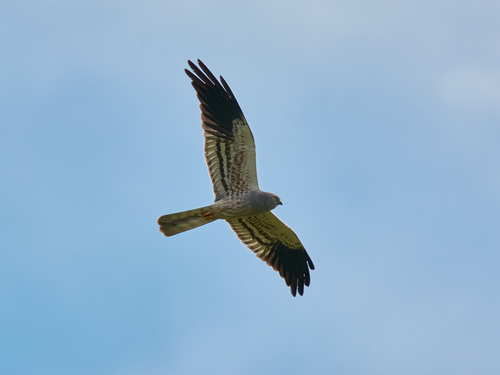 Montagu's Harrier
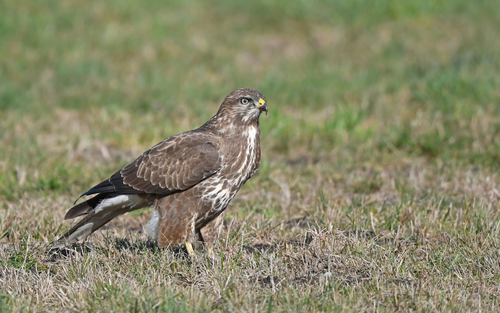 Common Buzzard
In short
The most reliable field mark to separate Montagu's Harrier from Common Buzzard is overall structure and flight style: Montagu's Harrier is much slimmer, with long, narrow, pointed wings and a long tail, giving it a buoyant, elastic flight, while Common Buzzard is broad-winged, stocky, and soars on broad, rounded wings with a short tail. Immature Montagu's Harriers lack the pale neck collar of Pallid Harrier, but compared to Common Buzzard, all ages show a more slender, graceful silhouette and different wing shape in flight. Plumage is variable in both, but Montagu's Harrier males are pale grey with black wingtips and bands, while Common Buzzard is brown with much individual variation. Size is also a strong clue: Common Buzzard is nearly three times heavier. Perched birds can be tricky, but the harrier's slim build and long tail are still distinctive.
Identification tips
- Structure in flight: Montagu's Harrier is slim, with long, narrow, pointed wings and a long tail; Common Buzzard is broad-winged, short-tailed, and bulky. This is the most reliable separation at a distance or in flight.
- Flight style: Harrier's flight is buoyant, elastic, and tern-like, often with flexible, shallow dihedral wingbeats. Buzzard soars on flat, broad wings, with slower, deeper wingbeats and less agility.
- Underwing pattern (all ages): Montagu's Harrier shows black bands along the secondaries and black wingtips, especially in males and immatures. Buzzard has a pale underwing with a dark carpal patch, but lacks the clean bands and pointed hand of the harrier.
- Juvenile underparts: Juvenile Montagu's Harrier is rufous below, unspotted, while juvenile Buzzard is brown with streaks or mottling and often a pale breast band.
- Adult male plumage: Male Montagu's Harrier is pale grey with black wingtips and bands; Buzzard is always brown, never grey.
- Adult female/juvenile confusion: Female and immature Montagu's Harrier are brown above, pale below with streaks, and have a white rump. Buzzard is brown above and below, with variable pale markings but no white rump.
- Melanistic birds: Both can be very dark, but structure and flight style remain diagnostic. Melanistic Montagu's Harrier males have a black head and grey underparts; Buzzard dark morphs are uniformly dark brown.
- Perched birds: Montagu's Harrier is slim, long-tailed, and small-headed; Buzzard is thickset, short-tailed, and heavy-billed.
- Habitat context: Harrier prefers open country and is absent from wooded areas; Buzzard is common in woods, on fenceposts, and in mixed habitats.
- Season: Montagu's Harrier is a summer visitor to Europe; Buzzard is present year-round.
- Size impression: Buzzard is much heavier and bulkier; harrier is light and slim.
- White rump: Montagu's Harrier shows a white rump in all plumages; Buzzard does not.
- Tail shape: Harrier's tail is long and straight-edged; Buzzard's is shorter and more rounded.
- Wing shape: Harrier's wings are long and pointed; Buzzard's are broad and rounded.
- Behavior: Harrier quarters low over fields; Buzzard often perches or soars high.
Size
Common Buzzard is substantially larger and heavier than Montagu's Harrier: average body mass is about 878 g for Buzzard versus 315.5 g for Harrier. Buzzard is bulkier, with a broad chest and thick legs, while Montagu's Harrier is slim and lightweight. In the field, Buzzard appears robust and compact, with a short neck and tail, while Montagu's Harrier is noticeably slender, with a long tail and relatively small head. Wingspan also differs: Harrier's is 97–115 cm, but Buzzard's is typically broader and more rounded. Even at a distance, Buzzard's heavyset proportions contrast with the harrier's elegant, elongated look.
Plumage
-
Juveniles and immatures: Montagu's Harrier juveniles are uniformly rufous below, lacking the pale neck collar of Pallid Harrier, and do not show the heavy streaking or variable underparts of Common Buzzard. Buzzard juveniles are highly variable but generally brown above and below, sometimes with a pale breast band or mottling, and never show the clean, unspotted rufous underparts of young Montagu's. In flight, Buzzard's underwing is usually pale with dark carpal patches, while Montagu's Harrier shows black bands along the secondaries and more pointed wing tips.
-
Adult males: Montagu's Harrier adult males are pale grey with black wingtips and distinct black bands on the secondaries; these bands are visible both above and below the wing. Buzzard males (and females) are brown, sometimes with a paler breast or underwing, but lack the clean grey and black pattern of the harrier.
-
Adult females: Female Montagu's Harrier is brown above, pale yellow-brown below with streaks and spots, and shows a white rump. Buzzard females are similar to males: brown above, variable below, often with a pale band across the breast, and lack the harrier's white rump and long, narrow wings.
-
Melanistic forms: Both species can show dark morphs, but melanistic Montagu's Harrier males are very dark with a black head and grey underparts, while melanistic females are chocolate brown with grey flight feathers. Buzzard dark morphs are uniformly dark brown, but structure and flight style remain distinct.
Behaviour
Montagu's Harrier hunts by flying low over open country with buoyant, elastic wingbeats, often holding its wings in a shallow V (dihedral) and gliding with a tern-like grace. It is highly aerial, rarely perching for long except on posts or the ground. Common Buzzard, in contrast, soars on broad, rounded wings, often circling high on thermals or perching for long periods on trees, poles, or fenceposts. Its flight is slower, with deeper wingbeats, and it rarely quarters low over fields like a harrier. Buzzard's hunting is more often from a perch or by soaring and dropping onto prey.
Habitat
Montagu's Harrier breeds in large, open areas—farmland, grassland, heath, or marsh—avoiding wooded or heavily built-up landscapes. It is a long-distance migrant, absent from Europe in winter. Common Buzzard is highly adaptable, found in a wide range of habitats including woodland, farmland, moorland, and even near settlements. It is resident or only locally migratory in most of its range, and is much more likely to be seen in wooded or mixed habitats, or perched in trees.