

Mississippi Kite vs Black-faced Hawk
Ictinia mississippiensis versus Leucopternis melanops
Play a quiz with Mississippi Kite and Black-faced Hawk
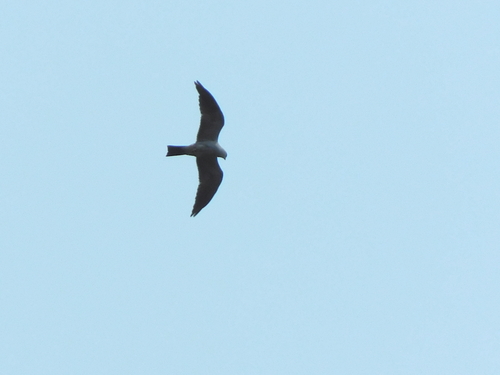 Mississippi Kite
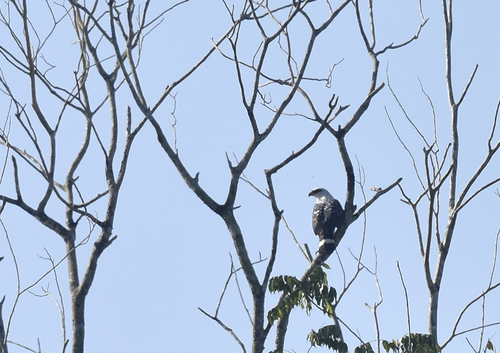 Black-faced Hawk
In short
The most reliable field mark to separate Mississippi Kite from Black-faced Hawk is the presence of a distinct black facial mask and white tail banding in the hawk, versus the kite’s uniform grayish-blue plumage and lack of strong facial pattern. Juvenile Black-faced Hawks show two white tail bands and a streaked head, while Mississippi Kite immatures lack such tail patterning and facial contrast. In flight, Mississippi Kites appear more buoyant and slender-winged, often soaring gracefully in groups, whereas Black-faced Hawks are heavier-bodied and typically solitary. Both species have pale underparts, but the kite’s plumage is much plainer overall.
Identification tips
- Facial Pattern: Black-faced Hawk (all ages) has a bold black mask across the face, contrasting with a white head; Mississippi Kite lacks any facial mask, showing a smooth pale gray head instead.
- Tail Banding: Juvenile Black-faced Hawks show two white tail bands, adults one; Mississippi Kite has a plain tail with no banding at any age.
- Head Streaking: Juvenile Black-faced Hawk has thin black streaks on the white head, while Mississippi Kite juveniles have a plainer, pale gray head.
- Back Color: Black-faced Hawk has a dark back with white mottling; Mississippi Kite is uniformly grayish-blue above, lacking strong contrast or mottling.
- Underparts: Both species have pale underparts, but the kite’s are a smooth, uniform pale gray, while the hawk’s are white and may contrast more with the dark back.
- Wing Shape in Flight: Mississippi Kite has long, narrow, pointed wings (almost falcon-like), giving a slender, elegant look; Black-faced Hawk has broader, more rounded wings, appearing bulkier and less streamlined.
- Flight Style: Kites are buoyant, often floating or gliding in groups; hawks are heavier, more direct, and almost always solitary or in pairs.
- Eye Color: Adult Mississippi Kite has striking bright red eyes, visible at close range; Black-faced Hawk’s eye color is not noted as distinctive.
- Bill and Cere: Black-faced Hawk has a dark orange cere and black-tipped bill, which may be visible at close range; kite’s bill is less colorful and less contrasting.
- Group Behavior: If you see several raptors circling together, Mississippi Kite is far more likely; Black-faced Hawk is rarely seen in groups.
- Habitat Context: In open country, shelterbelts, or grasslands in the US, expect Mississippi Kite; in dense Amazonian forest, especially north of the Amazon River, expect Black-faced Hawk.
- Range: Mississippi Kite is a North American migrant; Black-faced Hawk is resident in the Amazon Basin and never occurs in North America.
- Plumage Confusion: Juvenile Black-faced Hawk can resemble juvenile White-browed Hawk, but always check for the number of tail bands (two in juvenile Black-faced, one in adult Black-faced, two in juvenile White-browed).
- Size and Structure: Mississippi Kite is lighter and more slender, with a longer wingspan relative to body size; Black-faced Hawk is heavier and more compact.
- Perched Posture: Kites often perch in exposed spots or soar high; hawks are more secretive, perching quietly in forest canopy or subcanopy.
Size
Black-faced Hawk is noticeably heavier (355g vs 278g) and slightly bulkier than Mississippi Kite, though both are small raptors. The kite is more slender and falcon-like, with longer, narrower, and more pointed wings, while the hawk is compact and broad-winged. Both are under 40 cm in length, but the kite’s lighter build and longer wingspan (about 90 cm) give it a more elegant, buoyant appearance in flight, compared to the hawk’s denser silhouette.
Plumage
- Juvenile/Immature: Juvenile Black-faced Hawks have a white head with thin black streaks, a bold black mask, and two white tail bands, plus brown feather tips. Juvenile Mississippi Kites lack a bold facial mask and tail bands; their plumage is more uniformly grayish, with a pale head and underbelly, and no strong contrast on the face or tail.
- Adult: Adult Black-faced Hawks retain the black mask and a single white tail band, with a white head streaked with black and a dark back with white mottling. Adult Mississippi Kites are smooth grayish-blue overall, with a very pale gray head, pale underparts, and no facial mask or tail bands. The kite’s eyes are bright red, a feature not noted in the hawk.
- In flight: Mississippi Kite shows long, pointed wings and a plain, lightly marked tail, while Black-faced Hawk shows broader wings and a tail with a conspicuous white band (or two in juveniles), plus a contrasting dark back.
Behaviour
Mississippi Kites are highly social in flight, often seen circling in groups and displaying buoyant, floating flight. Black-faced Hawks are typically solitary or in pairs, rarely seen in groups, and their flight is more direct and less buoyant. Kites often soar high and glide for long periods, while hawks are more likely to perch quietly in forested areas or make short flights between trees.
Habitat
Mississippi Kite breeds in open woodlands, shelterbelts, and grasslands of the southern and central US, often near water, and migrates in large groups to South America. Black-faced Hawk is a low-density, forest-dwelling species of the Amazon Basin, mainly north of the Amazon River, favoring dense lowland rainforest. The kite is much more likely in open or semi-open habitats, while the hawk is restricted to humid forest interiors.