
Motmot

Meadow Pipit vs Buff-bellied Pipit

Anthus pratensis versus Anthus rubescens

Play a quiz with Meadow Pipit and Buff-bellied Pipit
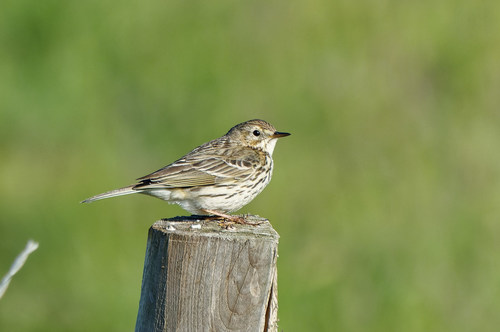
Meadow Pipit (Anthus pratensis) Meadow Pipit
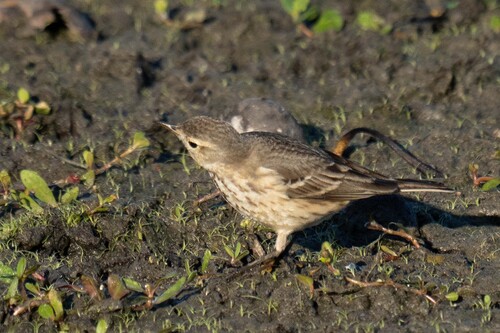
Buff-bellied Pipit (Anthus rubescens) Buff-bellied Pipit

Media

Loading…

In short

The most reliable field mark to separate Meadow Pipit from Buff-bellied Pipit is the combination of leg color and underpart streaking: Meadow Pipit shows pale pinkish-yellow legs and more extensive, sharper streaking below, while Buff-bellied Pipit has dark legs and more diffuse, limited streaking on a buff breast and flanks, with a whiter belly. Both are small, slim pipits with similar jizz, but Meadow Pipit’s rear claw is notably longer and its upperparts are generally browner. In flight or on the ground, look closely at leg color and the pattern and extent of streaking on the underparts. Voice and habitat may help, but plumage and structure are most useful for field separation.

Identification tips

  1. Leg color: Meadow Pipit has pale pinkish-yellow legs; Buff-bellied Pipit’s legs are dark. This is often the quickest field check if the legs are visible.
  2. Underpart streaking: Meadow Pipit shows sharper, more extensive streaking on the breast, flanks, and belly; Buff-bellied Pipit has more diffuse streaking, mainly on the breast and flanks, with a whiter, cleaner belly. This is visible in both perched and walking birds.
  3. Rear claw: Meadow Pipit’s hind claw is notably long, longer than the other rear toes, and can sometimes be seen in good views; Buff-bellied Pipit’s is shorter and less conspicuous. This is best seen on perched birds or in photos.
  4. Upperparts color: Meadow Pipit is generally browner above; Buff-bellied Pipit is greyer-brown. This can be subtle and variable with light, but may help in direct comparison.
  5. Facial pattern: Meadow Pipit may show slightly stronger facial markings, but this is not a strong separator between these two species.
  6. Bill color: Meadow Pipit’s bill is thinner and paler; Buff-bellied Pipit’s is darker. This is a supporting mark, not primary.
  7. Tail pattern: Both species have brown tails with white outer edges, but this is not a strong separator.
  8. Voice: Meadow Pipit’s call is a faint 'tsi-tsi'; Buff-bellied Pipit’s is a squeaky 'sip.' With experience, these calls are distinctive, but can be hard to separate for beginners.
  9. Song flight: Meadow Pipit often performs short, repetitive song flights, especially in the breeding season; Buff-bellied Pipit is less likely to be seen singing in flight in Europe.
  10. Habitat and range: In Europe, Meadow Pipit is common and widespread; Buff-bellied Pipit is a rare vagrant. In North America, the reverse is true. Always consider location and season.
  11. Behavior: Both species walk or run on the ground, but Meadow Pipit may be more likely to flush with a song flight.
  12. Juvenile/immature plumage: No distinctive upperwing or flight pattern differences are described for these ages in the sources; focus on leg color and underpart streaking for all ages.
  13. Pitfalls: Overlapping structure and general coloration can lead to confusion, especially in worn or poorly seen birds. Always try to get a clear view of the legs and underparts.
  14. Seasonal variation: Plumage differences are subtle between seasons; rely on structural and underpart marks year-round.
  15. Flock composition: Outside the breeding season, both species may join mixed pipit flocks, but in Europe, Meadow Pipit will vastly outnumber Buff-bellied Pipit.

Size

Both species are small pipits of similar proportions. Meadow Pipit measures 14.5–15 cm in length and weighs 15–22 g [wikipedia]. Buff-bellied Pipit is also a small pipit, with no significant size difference noted in the sources; expect them to appear very similar in the field. Size alone is not a reliable separator.

Plumage

Juvenile and immature plumages are not described in detail for either species in the sources, so focus on adult and general field marks. Meadow Pipit is brown above and buff below, with dark barring (streaks) on most of its plumage, especially the underparts. Its tail is brown with narrow white outer edges. Buff-bellied Pipit (American Pipit) is grey-brown above, with lighter, more diffuse streaking on the buff breast and flanks, and a distinctly whitish belly. Meadow Pipit’s underpart streaking is sharper and more extensive, while Buff-bellied Pipit’s is softer and more restricted to the breast and flanks. Leg color is a key difference: Meadow Pipit has pale pinkish-yellow legs, Buff-bellied Pipit has dark legs. Bill color is also paler in Meadow Pipit. The rear claw is conspicuously long in Meadow Pipit, longer than the other rear toes, while Buff-bellied Pipit’s is not as prominent. No distinctive upperwing or flight pattern differences are described for immature birds in these sources.

Behaviour

Both species are ground-dwelling, often seen running or walking on open ground. Meadow Pipit frequently performs short song flights, especially in the breeding season, with a repetitive song. Buff-bellied Pipit is also terrestrial, often seen in flocks outside the breeding season, and is described as running around on the ground. Both species are migratory, but Buff-bellied Pipit is a rare vagrant in Europe and more likely to be seen in North America, while Meadow Pipit is widespread in the Palearctic.

Habitat

Meadow Pipit breeds in open country across much of the Palearctic, favoring meadows, moorland, and grassland. It winters in southern Europe, North Africa, and southwest Asia, but is resident in parts of western Europe. Buff-bellied Pipit breeds in tundra and alpine meadows in North America and winters in open, lightly vegetated areas, including coastal flats and agricultural land. In Europe, Buff-bellied Pipit is a rare vagrant, so context and location can help: a pipit in open European grassland is far more likely to be Meadow Pipit.

Voice

Meadow Pipit gives a faint 'tsi-tsi' call and a simple, repetitive song that accelerates towards the end. Buff-bellied Pipit’s call is a squeaky 'sip.' Song is not a strong separator, but call notes may help with experience: Meadow Pipit’s call is softer and higher-pitched, Buff-bellied Pipit’s is sharper and more squeaky.

Submit a better description

Use the same sections as the comparison. Your text is published immediately.

The most reliable field mark to separate Meadow Pipit from Buff-bellied Pipit is the combination of leg color and underpart streaking: Meadow Pipit shows pale pinkish-yellow legs and more extensive, sharper streaking below, while Buff-bellied Pipit has dark legs and more diffuse, limited streaking on a buff breast and flanks, with a whiter belly. Both are small, slim pipits with similar jizz, but Meadow Pipit’s rear claw is notably longer and its upperparts are generally browner. In flight or on the ground, look closely at leg color and the pattern and extent of streaking on the underparts. Voice and habitat may help, but plumage and structure are most useful for field separation.

  1. Leg color: Meadow Pipit has pale pinkish-yellow legs; Buff-bellied Pipit’s legs are dark. This is often the quickest field check if the legs are visible.
  2. Underpart streaking: Meadow Pipit shows sharper, more extensive streaking on the breast, flanks, and belly; Buff-bellied Pipit has more diffuse streaking, mainly on the breast and flanks, with a whiter, cleaner belly. This is visible in both perched and walking birds.
  3. Rear claw: Meadow Pipit’s hind claw is notably long, longer than the other rear toes, and can sometimes be seen in good views; Buff-bellied Pipit’s is shorter and less conspicuous. This is best seen on perched birds or in photos.
  4. Upperparts color: Meadow Pipit is generally browner above; Buff-bellied Pipit is greyer-brown. This can be subtle and variable with light, but may help in direct comparison.
  5. Facial pattern: Meadow Pipit may show slightly stronger facial markings, but this is not a strong separator between these two species.
  6. Bill color: Meadow Pipit’s bill is thinner and paler; Buff-bellied Pipit’s is darker. This is a supporting mark, not primary.
  7. Tail pattern: Both species have brown tails with white outer edges, but this is not a strong separator.
  8. Voice: Meadow Pipit’s call is a faint 'tsi-tsi'; Buff-bellied Pipit’s is a squeaky 'sip.' With experience, these calls are distinctive, but can be hard to separate for beginners.
  9. Song flight: Meadow Pipit often performs short, repetitive song flights, especially in the breeding season; Buff-bellied Pipit is less likely to be seen singing in flight in Europe.
  10. Habitat and range: In Europe, Meadow Pipit is common and widespread; Buff-bellied Pipit is a rare vagrant. In North America, the reverse is true. Always consider location and season.
  11. Behavior: Both species walk or run on the ground, but Meadow Pipit may be more likely to flush with a song flight.
  12. Juvenile/immature plumage: No distinctive upperwing or flight pattern differences are described for these ages in the sources; focus on leg color and underpart streaking for all ages.
  13. Pitfalls: Overlapping structure and general coloration can lead to confusion, especially in worn or poorly seen birds. Always try to get a clear view of the legs and underparts.
  14. Seasonal variation: Plumage differences are subtle between seasons; rely on structural and underpart marks year-round.
  15. Flock composition: Outside the breeding season, both species may join mixed pipit flocks, but in Europe, Meadow Pipit will vastly outnumber Buff-bellied Pipit.

Both species are small pipits of similar proportions. Meadow Pipit measures 14.5–15 cm in length and weighs 15–22 g [wikipedia]. Buff-bellied Pipit is also a small pipit, with no significant size difference noted in the sources; expect them to appear very similar in the field. Size alone is not a reliable separator.

Juvenile and immature plumages are not described in detail for either species in the sources, so focus on adult and general field marks. Meadow Pipit is brown above and buff below, with dark barring (streaks) on most of its plumage, especially the underparts. Its tail is brown with narrow white outer edges. Buff-bellied Pipit (American Pipit) is grey-brown above, with lighter, more diffuse streaking on the buff breast and flanks, and a distinctly whitish belly. Meadow Pipit’s underpart streaking is sharper and more extensive, while Buff-bellied Pipit’s is softer and more restricted to the breast and flanks. Leg color is a key difference: Meadow Pipit has pale pinkish-yellow legs, Buff-bellied Pipit has dark legs. Bill color is also paler in Meadow Pipit. The rear claw is conspicuously long in Meadow Pipit, longer than the other rear toes, while Buff-bellied Pipit’s is not as prominent. No distinctive upperwing or flight pattern differences are described for immature birds in these sources.

Both species are ground-dwelling, often seen running or walking on open ground. Meadow Pipit frequently performs short song flights, especially in the breeding season, with a repetitive song. Buff-bellied Pipit is also terrestrial, often seen in flocks outside the breeding season, and is described as running around on the ground. Both species are migratory, but Buff-bellied Pipit is a rare vagrant in Europe and more likely to be seen in North America, while Meadow Pipit is widespread in the Palearctic.

Meadow Pipit breeds in open country across much of the Palearctic, favoring meadows, moorland, and grassland. It winters in southern Europe, North Africa, and southwest Asia, but is resident in parts of western Europe. Buff-bellied Pipit breeds in tundra and alpine meadows in North America and winters in open, lightly vegetated areas, including coastal flats and agricultural land. In Europe, Buff-bellied Pipit is a rare vagrant, so context and location can help: a pipit in open European grassland is far more likely to be Meadow Pipit.

Meadow Pipit gives a faint 'tsi-tsi' call and a simple, repetitive song that accelerates towards the end. Buff-bellied Pipit’s call is a squeaky 'sip.' Song is not a strong separator, but call notes may help with experience: Meadow Pipit’s call is softer and higher-pitched, Buff-bellied Pipit’s is sharper and more squeaky.

Discard your changes?

You have unsaved edits. If you leave now, those changes will be lost.

Meadow Pipit · Buff-bellied Pipit · My Tricky Birds