
Mallard vs Marbled Duck
Anas platyrhynchos versus Marmaronetta angustirostris
Play a quiz with Mallard and Marbled Duck
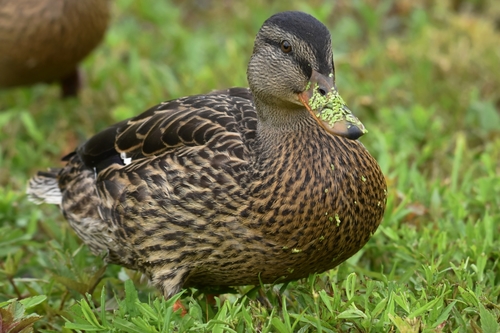 Mallard
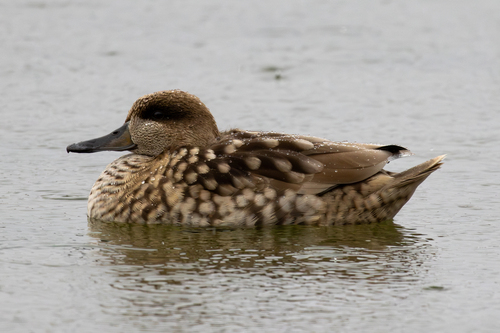 Marbled Duck
In short
The most reliable field mark between Mallard and Marbled Duck is the wing pattern in flight: Mallards of all ages show a bold, iridescent blue speculum bordered with white, while Marbled Ducks have uniformly pale wings with no speculum or strong pattern. On the water, adult male Mallards are unmistakable, but confusion arises with female and juvenile Mallards, which can resemble the pale, diffusely blotched Marbled Duck. Structure and size also help: Mallards are heavier and bulkier, with a larger bill and more robust jizz, while Marbled Ducks are smaller and slimmer. Careful attention to wing pattern, bill color, and overall tone will separate even tricky immatures.
Identification tips
- In flight, look for the speculum: Mallards of all ages and sexes show a bright, iridescent blue speculum bordered with white on the secondaries. Marbled Ducks never show a speculum; their wings are pale and unmarked in flight. This is the single most reliable field mark, especially for juveniles or distant birds.
- Overall size and structure: Mallards are much larger and heavier-bodied than Marbled Ducks. In mixed flocks, Mallards look longer-necked, broader across the chest, and have a more robust bill.
- Bill color and shape: Adult male Mallards have a yellow bill; females have a dark to orange-mottled bill. Marbled Ducks have a narrower, plain bill, lacking the strong color contrasts of Mallard.
- Face pattern: Female and juvenile Mallards have a buffy face with a clear dark eye-stripe and crown, giving a more patterned look. Marbled Ducks have a pale face with a dark eye-patch but lack the crisp eye-stripe and crown contrast.
- Body plumage: Mallards (females and juveniles) are mottled brown with sharp feather edges and a generally warmer tone. Marbled Ducks are pale sandy-brown with diffuse, blurry off-white blotches and a more uniform, washed-out appearance.
- Tail features: Male Mallards have a curled central tail feather (drake feather), which is never present in Marbled Duck. Female Mallards and Marbled Ducks both have straight tail feathers.
- Head shape: Marbled Ducks have a slightly shaggy, peaked rear crown, giving a subtly crested look. Mallards have a smoothly rounded head profile.
- Sexual dimorphism: Mallards are strongly sexually dimorphic in breeding plumage; males are bright and unmistakable. Marbled Ducks are monomorphic; both sexes look alike, so any bird with a green head or chestnut breast is a Mallard.
- Juvenile confusion: Juvenile Mallards resemble adult females but always show the speculum and face pattern. Juvenile Marbled Ducks are even paler and more diffusely blotched than adults, with no speculum or face contrast.
- Habitat context: If seen in a city park, urban pond, or far north of the Mediterranean, a pale dabbling duck is almost certainly a Mallard. Marbled Duck is restricted to shallow, vegetated wetlands in southern Europe, North Africa, and western/central Asia.
- Group size and behavior: Mallards are often in large, noisy flocks; Marbled Ducks are more likely to be in small, quiet groups or pairs.
- Bill size: Mallards have a heavier, broader bill, especially obvious in males. Marbled Duck's bill is narrower and more delicate.
- Plumage anomalies: Rarely, female Mallards can show male-like plumage due to hormonal changes, but will still show the speculum and Mallard structure.
- Voice: Not diagnostic from the provided notes, but Mallards are generally more vocal and quack frequently; Marbled Ducks are quieter.
- When in doubt: Always try to see the upperwing in flight or when stretching—presence or absence of the speculum is the clincher for all ages and sexes.
Size
Mallard is significantly larger and heavier than Marbled Duck. Mallards reach 50–65 cm in length with a wingspan of 81–98 cm and weigh 0.7–1.6 kg, making them medium-large dabbling ducks. In contrast, Marbled Duck is smaller at 39–42 cm in length and an average body mass of 527 g. In mixed flocks, Mallards will appear bulkier and longer-necked, while Marbled Ducks look more delicate and compact.
Plumage
The most diagnostic difference is in the wing pattern seen in flight. Mallards (all ages and sexes) show a prominent, iridescent blue speculum bordered by white bars on the secondaries, easily visible when the bird is flying or stretching its wings. Marbled Ducks, regardless of age, lack any speculum: their wings are uniformly pale and show no strong pattern or color contrast in flight. On the ground, adult male Mallards are instantly told by their glossy green head, white neck ring, and chestnut breast. Female and juvenile Mallards are mottled brown but always with a distinct face pattern (buff cheeks, dark eye-stripe) and a contrasting speculum. Marbled Ducks of all ages are pale sandy-brown with diffuse off-white blotches, a dark eye-patch, and a shaggy head; their plumage is more uniform and lacks the crisp feather edges and face contrast of Mallard. Juvenile Marbled Ducks are even more diffusely blotched off-white than adults, but never show a speculum or strong face pattern. Bill color is also useful: female Mallards have a dark to orange-mottled bill, while Marbled Ducks have a narrower, plain bill. Male Mallards have a yellow bill and curled central tail feather, both absent in Marbled Duck.
Behaviour
Both species are dabbling ducks and may be seen feeding by up-ending or dabbling in shallow water. Mallards are highly social and often gather in large, noisy flocks, especially outside the breeding season. Marbled Ducks are less conspicuous and tend to be quieter and more secretive, often found in smaller groups. In flight, Mallards appear broad-winged and strong, while Marbled Ducks look lighter and more buoyant.
Habitat
Mallards are extremely adaptable and can be found in almost any wetland, from city parks and ponds to lakes, rivers, and marshes across a vast range. Marbled Ducks are much more habitat-specific, favoring shallow, vegetated wetlands in southern Europe, North Africa, and western/central Asia. In regions where both occur (mainly southern Europe and North Africa), Marbled Duck is much scarcer and more local than the ubiquitous Mallard.