

Long-tailed Honey-buzzard vs Black-faced Hawk
Henicopernis longicauda versus Leucopternis melanops
Play a quiz with Long-tailed Honey-buzzard and Black-faced Hawk
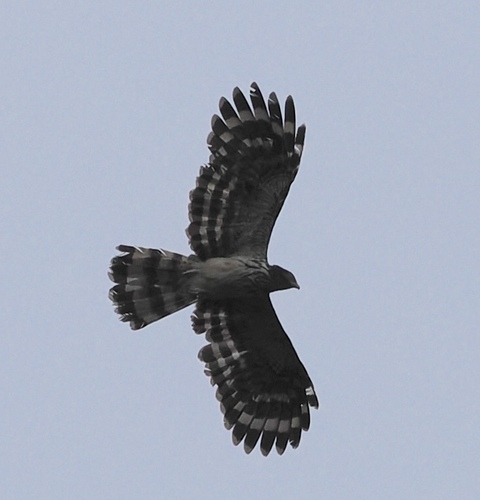 Long-tailed Honey-buzzard
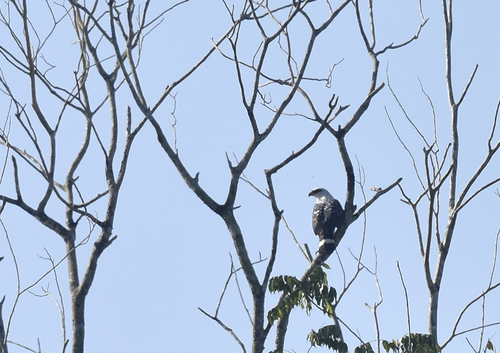 Black-faced Hawk
In short
The most reliable field mark to separate Long-tailed Honey-buzzard from Black-faced Hawk is the tail and wing pattern, especially in juveniles: juvenile honey-buzzards show four narrow black tail bands, while Black-faced Hawk (adult and juvenile) shows a single bold white tail band (adults) or two (juveniles). In flight, the honey-buzzard has a long, rounded tail and broad, rounded wings with bold black barring, while the Black-faced Hawk is more compact, with a shorter tail and striking black-and-white contrast, including a black facial mask. Structure is also key: the honey-buzzard is much larger and slimmer, with a small head and long tail, compared to the smaller, chunkier hawk. Both are rainforest raptors, but their ranges do not overlap: Long-tailed Honey-buzzard is endemic to New Guinea, while Black-faced Hawk is restricted to the Amazon Basin. Vocalizations are not described in the sources.
Identification tips
- Juvenile tail pattern: Juvenile Long-tailed Honey-buzzards show four narrow, evenly spaced black tail bands; juvenile Black-faced Hawks show two bold white tail bands separated by black. This is the most reliable mark for immatures.
- Adult tail pattern: Adult honey-buzzards have three broad black tail bars (with a hidden fourth); adult Black-faced Hawks have a single bold white band near the tail base, with the rest of the tail dark.
- Facial markings: Black-faced Hawk (all ages) has a distinctive black facial mask and a large white head streaked with black; honey-buzzard lacks any facial mask and has a pale, lightly streaked head and breast.
- Wing and body barring: Honey-buzzard shows bold black barring on wings and body, especially in flight; Black-faced Hawk has a clean white underbelly and less barring, with more black-and-white contrast.
- Overall structure: Honey-buzzard is long and slim, with a small head, long rounded tail, and broad, rounded wings; Black-faced Hawk is compact, with a shorter tail and more typical buteo-like proportions.
- Feet color: Honey-buzzard has bluish-white feet; Black-faced Hawk's feet color is not described in the sources, so do not rely on this mark.
- Bill and cere: Black-faced Hawk has a black-tipped bill with a dark orange cere; honey-buzzard has a pale bill and face.
- Iris color: Honey-buzzard has a yellow iris; iris color of Black-faced Hawk is not specified.
- Flight style: Honey-buzzard soars with wrists forward and 'fingered' primaries; Black-faced Hawk is more likely to be seen perched or making short flights.
- Plumage confusion: Juvenile Black-faced Hawk can be confused with juvenile White-browed Hawk, but not with honey-buzzard due to the facial mask and tail pattern.
- Range: Honey-buzzard is only in New Guinea and nearby islands; Black-faced Hawk is only in the Amazon Basin. Any sighting outside these regions is likely a misidentification.
- Habitat: Both are rainforest raptors, but the honey-buzzard is a canopy and hill forest specialist, while the hawk prefers lowland riverine forest.
- Size in the field: If seen together, honey-buzzard is much larger and longer-tailed, but beware of size illusions in the canopy.
- Sexual dimorphism: Honey-buzzard females are larger than males, but both sexes share the same plumage; no sexual dimorphism is noted for Black-faced Hawk.
- Hybrid confusion: Black-faced Hawk can hybridize with White-browed Hawk, but not with honey-buzzard; do not confuse intermediate individuals with honey-buzzard.
Size
Long-tailed Honey-buzzard is substantially larger and heavier (average adult mass 594 g) than Black-faced Hawk (355 g). The honey-buzzard reaches 50–61 cm in length with a wingspan of 105–140 cm, and has a notably long tail (29–37 cm). In contrast, Black-faced Hawk is under 40 cm in length and is the smallest member of its genus. In the field, the honey-buzzard appears lanky and long-tailed, while the hawk is compact and broad-winged. This size difference is obvious if you have a sense of scale, but can be hard to judge in isolation.
Plumage
Juvenile Long-tailed Honey-buzzards are best recognized by their four narrow, clearly visible black tail bands, compared to adults' three broad bands (with a fourth hidden). Their wings and body also show bold black barring, and the head and breast are lightly streaked. The face is pale with a yellow iris and bluish-white feet. In contrast, adult Black-faced Hawks have a single bold white band near the base of the tail, a white underbelly, a large white head streaked with black, and a distinctive black facial mask. Juvenile Black-faced Hawks have two white tail bands, thinner black streaks on the head, and brown feather tips. Both adult and juvenile Black-faced Hawks have a dark back with some white mottling and a black-tipped bill with a dark orange cere. The facial mask and crisp black-and-white contrast are unique to the hawk. The honey-buzzard lacks any facial mask and has a more muted, streaked appearance. The honey-buzzard's tail is much longer and more evenly barred, while the hawk's tail pattern is bolder but shorter.
Behaviour
Long-tailed Honey-buzzard soars with wrists forward and spreads its 'fingered' primaries, giving a broad, rounded wing shape and a long, rounded tail. Its flight is buoyant and somewhat languid, befitting its rainforest specialist lifestyle. Black-faced Hawk is more compact in flight, with a shorter tail and less exaggerated wing shape. Both species are forest raptors, but the honey-buzzard is more likely to be seen soaring above the canopy, while the hawk is typically seen perched or making short flights within the forest edge or along rivers.
Habitat
Long-tailed Honey-buzzard is strictly a New Guinea endemic, found in lowland and montane rainforests up to 3000 m, including surrounding islands. It does not migrate and is absent from the Amazon. Black-faced Hawk is restricted to the Amazon Basin, mainly north of the Amazon River, but with some records south. It inhabits lowland rainforest, especially near rivers, and is rare to uncommon. There is no overlap in their natural ranges, so any sighting outside these areas is likely a misidentification.
Long-tailed Honey-buzzard · Black-faced Hawk · My Tricky Birds