
Long-tailed Duck vs White-headed Duck
Clangula hyemalis versus Oxyura leucocephala
Play a quiz with Long-tailed Duck and White-headed Duck
 Long-tailed Duck
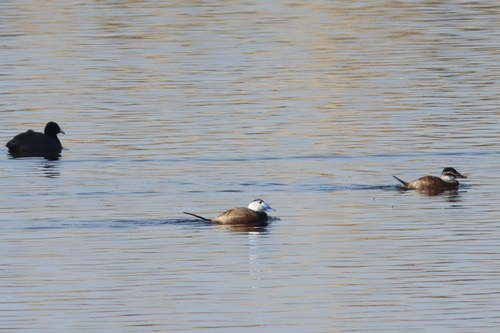 White-headed Duck
In short
The best field mark to separate Long-tailed Duck from White-headed Duck is the male Long-tailed Duck's extremely long, pointed tail, which is never matched by White-headed Duck. In flight or on water, Long-tailed Duck (especially males) shows a striking tail and a complex, seasonally variable plumage with bold white and dark contrasts, while White-headed Duck is compact, short-tailed, and shows a distinctive white head with a black cap (male) or a white face with a dark cheek stripe (female). Juvenile and female Long-tailed Ducks can be confused with female White-headed Ducks at a distance, but the tail length and head pattern remain reliable. Bill color is also a key difference: male White-headed Ducks have a bright blue bill, never seen in Long-tailed Duck. Both are diving ducks, but their structure, head pattern, and tail shape are consistently different.
Identification tips
- Tail length and shape: Male Long-tailed Duck has an extremely long, pointed tail (10–15 cm), visible both in flight and on water. Female and juvenile Long-tailed Ducks have shorter but still pointed tails. White-headed Duck's tail is always short and stiff, never elongated.
- Head pattern (male): Male Long-tailed Duck in winter has a mostly white head with a dark cheek patch; in summer, the head is dark with a white cheek. Male White-headed Duck always has a white head with a black crown and nape, never with a cheek patch.
- Head pattern (female): Female Long-tailed Duck in winter has a white head and neck with a dark crown, but lacks the strong cheek stripe of female White-headed Duck. Female White-headed Duck shows a white face with a dark cap and a distinct dark cheek stripe.
- Bill color: Male White-headed Duck has a broad, bright blue bill, unique among ducks in its range. Long-tailed Duck males have a dark grey bill with a pink band; females have a dark bill. Bill color is a strong separator in adult males.
- Body shape: Long-tailed Duck is more elongated and slender, especially in males due to the tail. White-headed Duck is compact, chunky, and sits low in the water.
- Plumage contrast: Long-tailed Duck (all ages) shows strong contrast between white underparts and darker upperparts, especially in winter. White-headed Duck is more uniformly grey-brown (female) or reddish-grey (male) on the body, with the head pattern standing out.
- Flight silhouette: In flight, Long-tailed Duck (especially males) shows a long, trailing tail and a more streamlined shape. White-headed Duck appears short-tailed and compact, with no tail projection.
- Juvenile confusion: Juvenile Long-tailed Ducks resemble adult females but still have a pointed tail and a less distinct cheek patch than White-headed Duck females. Juvenile White-headed Ducks are not described in detail but would lack the long tail and show a dark cheek stripe.
- Habitat context: Long-tailed Duck is found on open seas, large lakes, and arctic waters; White-headed Duck is restricted to inland lakes with dense vegetation in southern Europe, North Africa, and Asia.
- Vocalization: Only Long-tailed Duck is notably vocal, with a yodelling call, especially in winter flocks. White-headed Duck is generally silent or quiet.
- Behavior on disturbance: White-headed Duck tends to swim away rather than fly when disturbed, often appearing sluggish. Long-tailed Duck is more likely to take flight or dive actively.
- Flock size: Long-tailed Duck often forms large winter flocks; White-headed Duck is usually seen in small groups or singly.
- Seasonal changes: Long-tailed Duck's plumage changes dramatically with season and sex, so check for tail length and head pattern rather than relying on overall color. White-headed Duck's head pattern and bill color are more consistent year-round.
- Bill structure: White-headed Duck's bill is broad and swollen at the base (especially in males), while Long-tailed Duck's bill is slimmer and more typical of sea ducks.
- Pitfall: At great distance, a female or juvenile Long-tailed Duck with a short tail may be mistaken for a female White-headed Duck, but the absence of a strong cheek stripe and the habitat context should help resolve confusion.
Size
White-headed Duck is a small, chunky diving duck, typically around 45 cm (18 in) in length and weighing about 665 g [wikidata]. Long-tailed Duck is described as medium-sized but no precise mass is given; it is generally lighter and more slender in impression, especially due to the long, thin tail in males. On water, White-headed Duck appears more compact and sits lower, while Long-tailed Duck (especially males) appears longer and sleeker, accentuated by the tail. Females and juveniles of both species are closer in size, but the Long-tailed Duck still tends to look more elongated.
Plumage
Juvenile and female Long-tailed Ducks in autumn resemble adult females, with brown backs and pale faces, but always show a relatively pointed tail (longer in males, shorter but still pointed in females and juveniles). Their cheek patch is less distinct than in adults. In flight, Long-tailed Ducks of all ages show white underparts and a variable pattern of white and dark on the head and neck, changing with season and sex. Males in winter have a mostly white head with a dark cheek patch and a long, black tail; in summer, the head and neck are dark with a white cheek patch. Females in winter have a white head and neck with a dark crown, and in summer the head becomes darker. White-headed Duck males are unmistakable in breeding plumage: white head with a black crown and a broad blue bill, reddish-grey body. Females have a white face with a dark crown and cheek stripe, and a dark bill. There is no seasonal tail elongation, and the tail is always stiff and spiky but short. No mention of distinctive upperwing patterns for either species in flight, so separation relies on head pattern, tail, and bill color.
Behaviour
Both species are diving ducks, but White-headed Duck is more likely to swim away from disturbance rather than fly, often appearing sluggish and low in the water. Long-tailed Duck is gregarious in winter, forming large flocks, and is an agile, deep diver, often seen diving repeatedly. In flight, Long-tailed Duck is swift and buoyant, with the male's long tail trailing behind. White-headed Duck is more reluctant to fly and appears more compact and stiff-winged when it does. Feeding behavior is similar, though Long-tailed Duck is known for exceptionally deep dives.
Habitat
Long-tailed Duck breeds in Arctic tundra and taiga pools, wintering along northern coastlines and large lakes, especially in the Baltic Sea and North Atlantic. It is a bird of open, cold waters, often seen far offshore in winter. White-headed Duck breeds and winters on lakes with open water and dense marginal vegetation, mostly in Spain, North Africa, and western/central Asia. It is rarely found far from reedy or vegetated lakes and is not a sea duck. Thus, context is helpful: a bird on a cold, open sea or arctic lake is almost certainly a Long-tailed Duck, while a bird on a reedy inland lake in southern Europe or Asia is likely a White-headed Duck.
Voice
Long-tailed Duck males are notably vocal, with a musical yodelling call ("ow, ow, owal-ow"). No distinctive vocalization is mentioned for White-headed Duck in the notes, so voice is only useful for Long-tailed Duck, especially in winter flocks.