

Motmot

Little Ringed Plover vs Kentish Plover

Thinornis dubius versus Anarhynchus alexandrinus

Play a quiz with Little Ringed Plover and Kentish Plover

Little Ringed Plover (Thinornis dubius) Little Ringed Plover
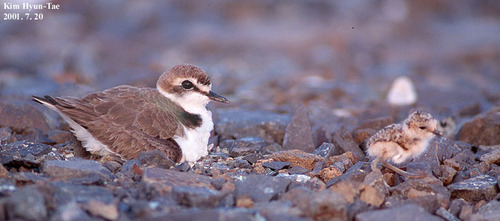
Kentish Plover (Anarhynchus alexandrinus) Kentish Plover

Media

Loading…

In short

The most reliable field mark to separate Little Ringed Plover from Kentish Plover is the Little Ringed Plover’s bright yellow eyering, which is always obvious at close range and never shown by Kentish. In addition, Little Ringed Plover has flesh-colored legs and a complete, crisp black breast band, while Kentish Plover has dark legs and only partial breast markings (especially on males). Both species are small, sandy-brown plovers with white underparts, but careful attention to head pattern and leg color is key. Immature and non-breeding birds can be trickier, but the eyering and leg color remain reliable. Watch for habitat differences as well: Little Ringed prefers inland stony or muddy margins, while Kentish is more coastal.

Identification tips

  1. Eyering: Little Ringed Plover always shows a bright yellow eyering, visible even at moderate distance. Kentish Plover never has a yellow eyering; its eye appears dark and plain.
  2. Leg Color: Little Ringed Plover has pale, flesh-colored legs. Kentish Plover has dark (blackish or grey) legs. This is reliable in all plumages and ages.
  3. Breast Band: Adult Little Ringed Plover has a complete, crisp black breast band. Kentish Plover males show only partial, dark breast patches on each side of the breast (never a complete band), and females are even paler or lack breast patches altogether. In non-breeding or immature birds, breast markings may be faint or absent in both, so rely on other marks.
  4. Head Pattern: Little Ringed Plover has a black mask around the eye, white above the mask, a brown cap, and a white forehead. Kentish Plover males in breeding plumage have a horizontal black bar on the head, black ear coverts, and a rufous nape and crown; females are duller and lack strong head markings. Outside the breeding season, these head patterns become less distinct, but Little Ringed Plover’s mask and eyering remain.
  5. Bill: Both species have short, dark bills, so this is not a useful separator.
  6. Upperparts: Both are sandy-brown above and white below; upperpart color alone is not diagnostic.
  7. Juvenile/Immature Flight: No distinctive juvenile upperwing or flight marks are described for either species; do not rely on flight pattern for separation.
  8. Habitat: If the bird is on a stony inland riverbank or gravel pit, Little Ringed Plover is more likely; on a sandy coastal beach or saltmarsh, expect Kentish Plover. However, both can overlap in some areas.
  9. Sexual Dimorphism: Kentish Plover is sexually dimorphic in breeding plumage, with males showing darker and more extensive head and breast markings. Little Ringed Plover is not strongly sexually dimorphic.
  10. Seasonal Change: Kentish Plover males lose some of their dark markings as the breeding season progresses, making them paler and more like females. Little Ringed Plover’s key marks (eyering, leg color, mask) remain year-round.
  11. Behavior: Both species run and pause on open ground, but behavioral differences are subtle and not reliable for separation.
  12. Size: Both are similar in size; do not use bulk or length as a separator.
  13. Voice: No diagnostic vocal differences are described in the sources; do not rely on calls for separation.
  14. Pitfalls: In dull light or at distance, the yellow eyering and leg color may be hard to see—try to get a close look or a photo for confirmation. Beware of non-breeding or immature Kentish Plovers, which can appear very plain and may lack obvious breast patches.
  15. Best Practice: Prioritize the yellow eyering and leg color, then check for breast band and head pattern. If these are not visible, use habitat and context, but be cautious with out-of-range or vagrant birds.

Size

Both species are very similar in size and structure, with Kentish Plover averaging about 47 g in body mass (Little Ringed Plover mass not provided, but they are comparable). Neither species is noticeably larger or bulkier in the field. Bill length and shape are similar, with both showing short, dark bills. Size is not a reliable separator between these two.

Plumage

For all ages, the most diagnostic plumage mark is the Little Ringed Plover’s bright yellow eyering, which is never present on Kentish Plover. Both have brown upperparts and white underparts, but Little Ringed Plover always shows a complete black breast band (adults), while Kentish Plover males have only partial, dark breast patches and females are even paler. The head pattern is also key: Little Ringed Plover has a black mask and a white forehead, with a brown cap, while Kentish Plover males show a horizontal black bar and black ear coverts, plus a rufous nape and crown in breeding plumage (females are duller). Leg color is diagnostic: Little Ringed Plover has flesh-colored legs, Kentish Plover always has dark legs. In non-breeding or immature birds, the head pattern and leg color remain the best clues, as breast bands and rufous tones may be reduced or absent. No distinctive juvenile upperwing or flight pattern marks are described for either species in the sources.

Behaviour

Both species are active, ground-feeding plovers, often seen running and pausing on open mud or sand. Kentish Plover males can be more aggressive in territory defense and display distraction behaviors near nests, but these are rarely diagnostic in casual field encounters. Both species may perform distraction displays if approached near a nest, but this is not a useful field mark for separation.

Habitat

Little Ringed Plover is more likely to be found inland, breeding along stony or muddy margins of rivers, lakes, and gravel pits. Kentish Plover is more coastal, favoring saline lakes, lagoons, sandy beaches, and saltmarshes, though it can also occur inland in suitable habitat. Overlap is possible, but if you are well inland on a stony riverbank, Little Ringed Plover is more likely; on a sandy coastal beach, expect Kentish Plover.

Submit a better description

Use the same sections as the comparison. Your text is published immediately.

The most reliable field mark to separate Little Ringed Plover from Kentish Plover is the Little Ringed Plover’s bright yellow eyering, which is always obvious at close range and never shown by Kentish. In addition, Little Ringed Plover has flesh-colored legs and a complete, crisp black breast band, while Kentish Plover has dark legs and only partial breast markings (especially on males). Both species are small, sandy-brown plovers with white underparts, but careful attention to head pattern and leg color is key. Immature and non-breeding birds can be trickier, but the eyering and leg color remain reliable. Watch for habitat differences as well: Little Ringed prefers inland stony or muddy margins, while Kentish is more coastal.

  1. Eyering: Little Ringed Plover always shows a bright yellow eyering, visible even at moderate distance. Kentish Plover never has a yellow eyering; its eye appears dark and plain.
  2. Leg Color: Little Ringed Plover has pale, flesh-colored legs. Kentish Plover has dark (blackish or grey) legs. This is reliable in all plumages and ages.
  3. Breast Band: Adult Little Ringed Plover has a complete, crisp black breast band. Kentish Plover males show only partial, dark breast patches on each side of the breast (never a complete band), and females are even paler or lack breast patches altogether. In non-breeding or immature birds, breast markings may be faint or absent in both, so rely on other marks.
  4. Head Pattern: Little Ringed Plover has a black mask around the eye, white above the mask, a brown cap, and a white forehead. Kentish Plover males in breeding plumage have a horizontal black bar on the head, black ear coverts, and a rufous nape and crown; females are duller and lack strong head markings. Outside the breeding season, these head patterns become less distinct, but Little Ringed Plover’s mask and eyering remain.
  5. Bill: Both species have short, dark bills, so this is not a useful separator.
  6. Upperparts: Both are sandy-brown above and white below; upperpart color alone is not diagnostic.
  7. Juvenile/Immature Flight: No distinctive juvenile upperwing or flight marks are described for either species; do not rely on flight pattern for separation.
  8. Habitat: If the bird is on a stony inland riverbank or gravel pit, Little Ringed Plover is more likely; on a sandy coastal beach or saltmarsh, expect Kentish Plover. However, both can overlap in some areas.
  9. Sexual Dimorphism: Kentish Plover is sexually dimorphic in breeding plumage, with males showing darker and more extensive head and breast markings. Little Ringed Plover is not strongly sexually dimorphic.
  10. Seasonal Change: Kentish Plover males lose some of their dark markings as the breeding season progresses, making them paler and more like females. Little Ringed Plover’s key marks (eyering, leg color, mask) remain year-round.
  11. Behavior: Both species run and pause on open ground, but behavioral differences are subtle and not reliable for separation.
  12. Size: Both are similar in size; do not use bulk or length as a separator.
  13. Voice: No diagnostic vocal differences are described in the sources; do not rely on calls for separation.
  14. Pitfalls: In dull light or at distance, the yellow eyering and leg color may be hard to see—try to get a close look or a photo for confirmation. Beware of non-breeding or immature Kentish Plovers, which can appear very plain and may lack obvious breast patches.
  15. Best Practice: Prioritize the yellow eyering and leg color, then check for breast band and head pattern. If these are not visible, use habitat and context, but be cautious with out-of-range or vagrant birds.

Both species are very similar in size and structure, with Kentish Plover averaging about 47 g in body mass (Little Ringed Plover mass not provided, but they are comparable). Neither species is noticeably larger or bulkier in the field. Bill length and shape are similar, with both showing short, dark bills. Size is not a reliable separator between these two.

For all ages, the most diagnostic plumage mark is the Little Ringed Plover’s bright yellow eyering, which is never present on Kentish Plover. Both have brown upperparts and white underparts, but Little Ringed Plover always shows a complete black breast band (adults), while Kentish Plover males have only partial, dark breast patches and females are even paler. The head pattern is also key: Little Ringed Plover has a black mask and a white forehead, with a brown cap, while Kentish Plover males show a horizontal black bar and black ear coverts, plus a rufous nape and crown in breeding plumage (females are duller). Leg color is diagnostic: Little Ringed Plover has flesh-colored legs, Kentish Plover always has dark legs. In non-breeding or immature birds, the head pattern and leg color remain the best clues, as breast bands and rufous tones may be reduced or absent. No distinctive juvenile upperwing or flight pattern marks are described for either species in the sources.

Both species are active, ground-feeding plovers, often seen running and pausing on open mud or sand. Kentish Plover males can be more aggressive in territory defense and display distraction behaviors near nests, but these are rarely diagnostic in casual field encounters. Both species may perform distraction displays if approached near a nest, but this is not a useful field mark for separation.

Little Ringed Plover is more likely to be found inland, breeding along stony or muddy margins of rivers, lakes, and gravel pits. Kentish Plover is more coastal, favoring saline lakes, lagoons, sandy beaches, and saltmarshes, though it can also occur inland in suitable habitat. Overlap is possible, but if you are well inland on a stony riverbank, Little Ringed Plover is more likely; on a sandy coastal beach, expect Kentish Plover.

Discard your changes?

You have unsaved edits. If you leave now, those changes will be lost.

Little Ringed Plover · Kentish Plover · My Tricky Birds