

Little Cuckoo vs Common Squirrel-Cuckoo
Coccycua minuta versus Piaya cayana
Play a quiz with Little Cuckoo and Common Squirrel-Cuckoo
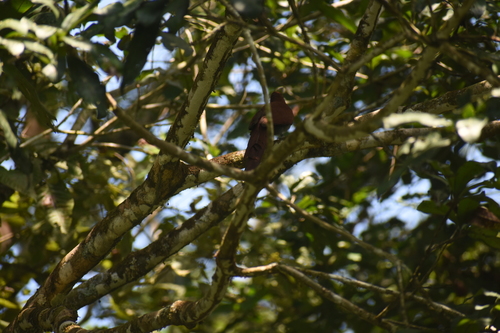 Little Cuckoo
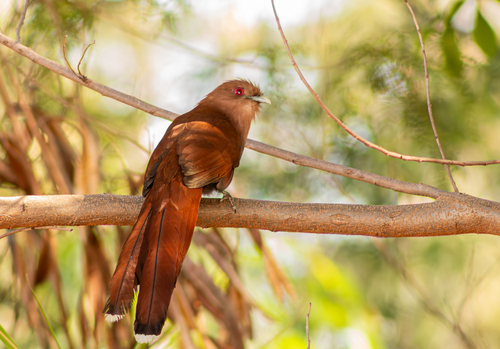 Common Squirrel-Cuckoo
In short
The most reliable field mark for separating Little Cuckoo from Common Squirrel-Cuckoo is size: Little Cuckoo is much smaller and more compact, with a proportionally shorter tail. Immature birds are especially confusing, but Little Cuckoo immatures are dark brown with a black bill and lack white tail tips, while Squirrel-Cuckoo immatures are larger, have a grey bill and less white in the tail. Adults of both have chestnut upperparts and yellow bills, but Squirrel-Cuckoo is paler on the throat and has a much longer, bushier tail with distinct white tips on the outer feathers. In the field, Squirrel-Cuckoo is bolder and more conspicuous, while Little Cuckoo is shy and keeps to dense cover.
Identification tips
- Size and structure: Squirrel-Cuckoo is nearly twice as long and more than twice as heavy as Little Cuckoo. If the bird appears large, lanky, and long-tailed, suspect Squirrel-Cuckoo. Little Cuckoo is compact, with a much shorter tail.
- Tail length and shape: Squirrel-Cuckoo's tail is extremely long and bushy, often fanned or drooping well past the wingtips. Little Cuckoo's tail is shorter and less conspicuous.
- Tail pattern (adult): Both species have white tips to the tail feathers as adults, but Squirrel-Cuckoo's are more prominent, especially on the blackish outer feathers. Little Cuckoo's tail is browner and the white tips are less extensive.
- Tail pattern (immature): Immature Little Cuckoo lacks white tail tips entirely, while immature Squirrel-Cuckoo usually shows at least some white on the outer tail feathers (though less than adults). This is a key mark for separating young birds.
- Bill color (immature): Immature Little Cuckoo has a black bill, while immature Squirrel-Cuckoo has a grey bill and eyering. Adults of both have yellow bills, but Squirrel-Cuckoo's is proportionally longer.
- Throat color: Squirrel-Cuckoo has a noticeably paler throat than Little Cuckoo, which has a darker, more uniform chestnut throat. This is subtle but useful in good light.
- Underparts: Squirrel-Cuckoo shows a grey lower breast and blackish belly, while Little Cuckoo's lower belly is greyish but less sharply demarcated.
- Iris color: Both adults have red irises, but immature Squirrel-Cuckoo has a brown iris; Little Cuckoo immatures' iris color is not specified but is not a primary field mark.
- Behavior: Squirrel-Cuckoo is bold, often seen moving through open branches or flying between trees. Little Cuckoo is shy, usually staying hidden in dense vegetation.
- Habitat: If you are in mangrove or dense wet woodland near water, Little Cuckoo is more likely. In drier or more open woodland, forest edge, or gardens, Squirrel-Cuckoo is the default.
- Voice: Squirrel-Cuckoo's calls are loud, explosive, and often whistled. Little Cuckoo gives harsh, grating notes. If you hear a 'wheep wheep' song, it's Squirrel-Cuckoo.
- Flight style: Squirrel-Cuckoo often makes long, bounding flights and can look almost squirrel-like in its movements. Little Cuckoo moves more furtively and rarely exposes itself in open flight.
- Jizz: Squirrel-Cuckoo's overall impression is of a large, elongated bird with a flowing tail and active, conspicuous behavior. Little Cuckoo is small, compact, and secretive.
- Plumage pitfalls: Both species are chestnut above, but Squirrel-Cuckoo is paler on the throat and has a more contrasting underparts pattern. Immature Little Cuckoo is much darker overall and lacks white in the tail.
- When in doubt: If you see a small, dark, short-tailed cuckoo in dense cover, especially without white in the tail, it's likely Little Cuckoo. A large, long-tailed, conspicuous bird with white-tipped tail feathers is almost always Squirrel-Cuckoo.
Size
Little Cuckoo is significantly smaller (about 27 cm, 40 g) compared to the Common Squirrel-Cuckoo (40.5–50 cm, 95–120 g) [wikipedia][avonet]. The Squirrel-Cuckoo is not only longer but also bulkier, with a notably long tail that can make up nearly half its length. In the field, the size difference is often the first clue: Squirrel-Cuckoo looks lanky and elongated, while Little Cuckoo appears compact and short-tailed by comparison.
Plumage
-
Immature/juvenile birds: Little Cuckoo immatures are dark brown overall, with a black bill and no white tips to the tail. Squirrel-Cuckoo immatures are larger, have a grey bill and eyering, brown iris, and less white in the tail (but some white may be present, especially on outer feathers). These differences are most visible when the birds are perched or in slow flight, and are critical for separating young birds.
-
Adults: Both species have mainly chestnut upperparts and head. Little Cuckoo adults are chestnut brown overall, with a greyish lower belly, a browner tail, and white tips to the tail feathers. The throat is darker than in Squirrel-Cuckoo. Squirrel-Cuckoo adults have a paler throat, a grey lower breast, a blackish belly, and a tail with rufous central feathers and black outer feathers tipped with white. The bill is yellow and decurved in both, but Squirrel-Cuckoo's is longer relative to head size. Both have red irises as adults.
-
Tail pattern: Squirrel-Cuckoo's tail is much longer and bushier, with more obvious white tips on the outer feathers in adults. Little Cuckoo's tail is shorter, with white tips only in adults, and is browner overall.
Behaviour
Little Cuckoo is shy and tends to keep to dense cover, foraging low in mangroves or scrubby woodland near water. It is often difficult to see well. Squirrel-Cuckoo, in contrast, is bold and active, often seen moving through more open woodland and forest edges, sometimes even joining mixed-species flocks or following army ant swarms. Squirrel-Cuckoo is more likely to be seen out in the open, running along branches or making long, bounding flights between trees.
Habitat
Little Cuckoo is most often found in mangrove swamps and dense, scrubby woodland near water, from Panama and Trinidad south through much of South America. Squirrel-Cuckoo has a broader habitat tolerance, found in a wide range of wooded habitats from Mexico to northern Argentina and Uruguay, including forest edges, secondary growth, and gardens, as long as some woodland remains. While their ranges overlap, Little Cuckoo is more tied to wet, dense habitats, and Squirrel-Cuckoo is more adaptable and widespread.
Voice
Little Cuckoo gives harsh 'chek' and 'kak' calls, which are short and grating. Squirrel-Cuckoo has a much more explosive and varied voice, with sharp 'kip!' and 'weeuu' calls, and a distinctive whistled song ('wheep wheep wheep'). If you hear a series of loud, whistled notes, it is almost certainly Squirrel-Cuckoo. Little Cuckoo's calls are less musical and more abrupt.