
Little Crake vs Baillon's Crake
Zapornia parva versus Zapornia pusilla
Play a quiz with Little Crake and Baillon's Crake
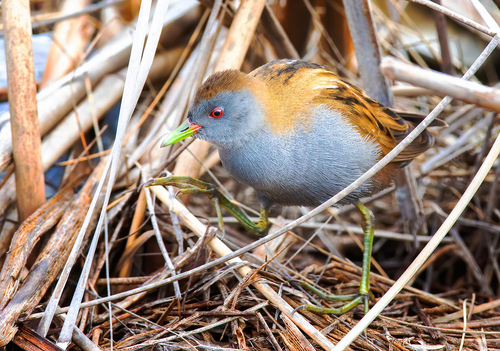 Little Crake
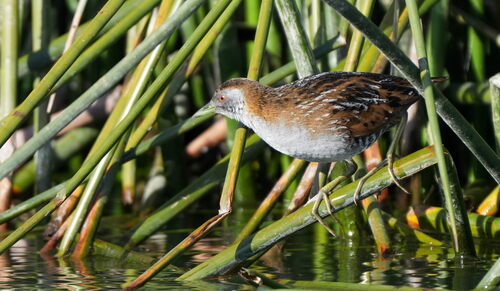 Baillon's Crake
In short
The most reliable field mark to separate Little Crake from Baillon's Crake is the pattern of the flanks and undertail: Little Crake lacks the bold black-and-white barring seen on Baillon's Crake, which is especially obvious in immatures and adults. Bill color is also diagnostic—Little Crake shows a yellow bill with a red base, while Baillon's Crake has a yellow or green bill without any red. Males of Little Crake have blue-grey underparts, contrasting with the paler, more uniformly blue-grey underparts of Baillon's. Both species are small, secretive rails of wet reedbeds, but careful attention to flank pattern, bill color, and subtle plumage differences will separate them in the field.
Identification tips
- Flank and undertail barring (all ages): Baillon's Crake always shows bold black-and-white barring on the flanks and undertail, visible in both perched and flight views. Little Crake lacks this barring entirely—its flanks are plain.
- Immature plumage: Immature Baillon's Crake has dull, extensively barred underparts, while immature Little Crake is paler with a white face and breast and no barring. If you see a young rail with a clean white face and breast, it's Little Crake.
- Bill color: Little Crake's bill is yellow with a red base (most obvious in adults, especially males), while Baillon's Crake's bill is yellow or greenish, never with a red base. This is a key mark at close range or in good light.
- Male underparts: Adult male Little Crake has blue-grey underparts and face, contrasting with brown upperparts. Baillon's Crake adults (both sexes) have paler blue-grey underparts but always with barred flanks.
- Female underparts: Female Little Crake is buff below with a grey face, lacking barring. Baillon's Crake females resemble males and always show barred flanks.
- Upperparts: Baillon's Crake has ochre-brown upperparts with black and white streaks; Little Crake is mainly brown above, less streaked.
- Leg color: Both have greenish or olive-green legs with long toes—this is not a reliable separator.
- Tail pattern: Both have short tails, but only Baillon's Crake shows barring on the undertail coverts; Little Crake's undertail is barred black and white underneath, but the flanks remain plain.
- Size: Little Crake is slightly larger, but overlap is considerable; do not rely on size unless birds are side by side.
- Voice: If heard, Little Crake gives a yapping 'kua', Baillon's a rattling frog-like call. Useful if vocalizing.
- Jizz and behavior: Both are secretive and skulk in dense vegetation; behavior is not a separator.
- Season and context: Both are most often seen on migration, when they may be more approachable. In breeding season, both are elusive.
- Geographic context: Where both species occur, rely on plumage and bill marks rather than location or habitat.
- Confusion with Spotted Crake: Both are smaller than Spotted Crake, but only Baillon's Crake shows strong flank barring; Little Crake is plainer.
- Downy chicks: Both species' chicks are black and indistinguishable at this age.
Size
Both species are very small rails, but Little Crake is slightly larger at 17–19 cm in length, compared to Baillon's Crake at 15–18 cm. Baillon's Crake has a recorded average mass of 35 g; no direct mass data is available for Little Crake, but it is similar or very slightly heavier. In practice, size alone is not a reliable field mark due to overlap and viewing conditions.
Plumage
- Immature/juvenile birds: Immature Little Crake resembles the adult female but shows a white face and breast, lacking the extensive barring on the flanks and undertail that is prominent in Baillon's Crake of the same age. Immature Baillon's Crake has duller, extensively barred underparts, making the barring a key mark at this age.
- Adult males: Little Crake males have brown upperparts and blue-grey face and underparts, with no barring or white spots on the flanks. Baillon's Crake adults have ochre-brown upperparts streaked with black and white, and their underparts are a paler blue-grey, with bold black-and-white barring on the flanks and undertail.
- Adult females: Female Little Crake has buff underparts and a grey face, again lacking flank barring. Baillon's Crake females are similar to males in pattern, with barred flanks and undertail.
- Bill color: Little Crake shows a yellow bill with a red base; Baillon's Crake's bill is yellow or green without red.
- Legs: Both have green or olive-green legs with long toes, not reliably separable.
Behaviour
Both species are highly secretive, especially during the breeding season, and are more often heard than seen. They probe in mud or shallow water for insects and aquatic animals. Both can be easier to observe during migration. No significant behavioral differences are noted for field separation.
Habitat
Both species breed in reedbeds and marshy wetlands, often in dense vegetation near water. Little Crake breeds mainly in eastern Europe and western Asia, wintering in Africa, while Baillon's Crake has a broader range including Europe, Africa, Asia, and Australia. However, habitat use is very similar where they overlap, so habitat is not a reliable separator.
Voice
Little Crake gives a yapping 'kua' call, while Baillon's Crake produces a rattling call reminiscent of an edible frog or Garganey. Both are most vocal in the breeding season, but calls are distinct if heard well.