

Little Bittern vs Squacco Heron
Botaurus minutus versus Ardeola ralloides
Play a quiz with Little Bittern and Squacco Heron
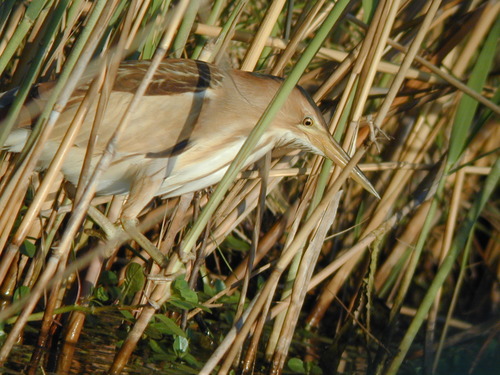 Little Bittern
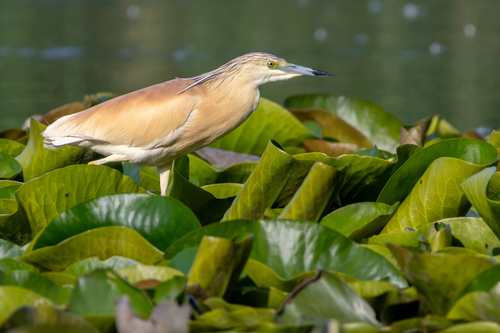 Squacco Heron
In short
The most reliable separation between Little Bittern and Squacco Heron is their size and structure: Little Bittern is much smaller, with a slender, almost rail-like jizz, while Squacco Heron is notably larger and stockier. In flight, both show pale wings, but the effect is different: Little Bittern reveals a distinctive pale forewing panel (especially in males), whereas Squacco Heron appears almost entirely white-winged. Juvenile Little Bitterns are heavily streaked above and below, unlike the paler, less streaked Squacco. Bill shape and neck length also differ, with Little Bittern showing a longer, finer bill and thicker neck relative to its tiny body. These differences are most apparent when birds are seen side-by-side, but even singly, careful attention to size, flight pattern, and wing coloration will separate them.
Identification tips
- Size is the first check: Little Bittern is half the mass of Squacco Heron and much shorter in both length and wingspan. If the bird appears dainty, rail-like, or almost half the size of a typical heron, suspect Little Bittern. This is reliable at all ages and seasons.
- Flight silhouette: Little Bittern flies with rapid, shallow wingbeats and a compact, short-necked, short-tailed profile, almost like a crake or rail. Squacco Heron is bulkier, with a heavier body, broader wings, and a more typical heron flight, neck retracted but not as tightly as Little Bittern.
- Wing pattern in flight (all ages): Adult male Little Bitterns show a pinkish-buff oval panel on the inner forewing, sharply contrasting with black outer wings; females and juveniles have a duller, less obvious panel but still show some contrast. Squacco Heron, in all plumages, appears almost entirely white-winged in flight, with no dark panel or contrasting marks.
- Juvenile/immature plumage: Juvenile Little Bitterns are heavily streaked above and below, including the wing coverts, and have a rufous cast. Juvenile Squacco Herons are paler, with lighter streaking and a tawny wash, lacking the dense streaking of Little Bittern.
- Perched plumage (adult males): Male Little Bitterns have glossy black upperparts with a greenish sheen, pale buff underparts, and a sharply defined pale forewing panel. Squacco Heron is buff-brown above, paler below, and lacks any black or greenish gloss.
- Perched plumage (females/juveniles): Female and juvenile Little Bitterns are browner and more streaked, but still show a thicker neck and more compact body than Squacco. Squacco Heron is always paler, with less streaking and a more uniform buff appearance.
- Bill and neck structure: Little Bittern has a long, fine, sharp bill and a thick neck (relative to its tiny body), often held vertically when alarmed. Squacco Heron has a shorter, thicker bill and a short, stocky neck, giving a more robust appearance.
- Behavior: Little Bittern is highly secretive, rarely leaving dense cover except when flying between reedbeds. Squacco Heron is more likely to be seen in the open, feeding at the water's edge or perched on exposed branches.
- Habitat: If the bird is deep in reeds or rarely emerges, favor Little Bittern. If it is in open marsh, on floating vegetation, or in a mixed heron colony, Squacco Heron is more likely.
- Seasonal context: Both are migrants, but Little Bittern is more likely to be found in Europe from mid-April to September, with few juveniles lingering into October. Squacco Heron follows a similar migration schedule but is less strictly tied to dense reedbeds.
- Sex differences: Male Little Bitterns are more contrasting and glossy above, while females and juveniles are duller and more streaked. Squacco Heron shows little sexual dimorphism, with both sexes similar in appearance.
- Confusion risk: In poor light or at a distance, both can appear pale-winged in flight, but the size and flight style differences remain reliable. Juvenile Little Bitterns can be mistaken for Squacco Heron if the heavy streaking and compact size are overlooked.
- Mixed flocks: In mixed heron colonies, compare directly: Little Bittern will always be the smallest, most compact, and most secretive species present.
- Voice: Not diagnostic with current information.
- Fallback: When in doubt, prioritize size, flight pattern, and wing coloration over subtle plumage details, especially for distant or flying birds.
Size
Little Bittern is dramatically smaller than Squacco Heron: 147g vs 288g in body mass, and 33–38 cm in length with a 52–58 cm wingspan compared to Squacco's 44–47 cm length and 80–92 cm wingspan [wikidata][wikipedia]. Little Bittern is the smallest European heron, appearing dainty and compact, while Squacco Heron is much bulkier and more robust, with a noticeably heavier build and longer wings. This size gap is often obvious even at a distance or in mixed heron colonies.
Plumage
Juvenile and immature plumages are key: Juvenile Little Bitterns are heavily streaked both above and below, including the wing coverts, with a generally rufous tone. This streaking is much more pronounced than on Squacco Heron juveniles, which are paler, less streaked, and have a tawny wash. In flight, adult Little Bitterns (especially males) show a distinctive pinkish-buff oval panel on the inner forewing, contrasting with otherwise dark wings, and a completely whitish underwing; females and juveniles have a duller, less obvious panel. Squacco Heron, by contrast, looks almost entirely white-winged in flight, with the upperparts and body much paler than Little Bittern, and lacks any contrasting dark wing panel. Perched, male Little Bitterns have glossy black upperparts with a greenish sheen and pale buff underparts, while females and juveniles are browner and more streaked. Squacco Heron shows a buff-brown back, short neck, and, in breeding plumage, long neck feathers, but always appears paler and less patterned than Little Bittern.
Behaviour
Little Bittern is secretive, often skulking in dense reedbeds and rarely venturing far from cover, moving with a slow, creeping gait. It often adopts a vertical, bittern-like stance when alarmed. In flight, it appears rapid and low, with quick, shallow wingbeats and a compact, rail-like profile. Squacco Heron is less secretive, often seen out in the open at the edge of marshes or on floating vegetation, feeding with slow, deliberate movements. In flight, Squacco Heron is more direct and steady, with broader, slower wingbeats and a bulkier, more heron-like silhouette.
Habitat
Both species breed in marshy wetlands, but Little Bittern is more strictly tied to dense reedbeds and thick emergent vegetation, rarely straying into open water. Squacco Heron prefers marshes, ponds, and slow-flowing rivers with open patches and scattered trees or shrubs for nesting, and is more likely to be seen feeding in the open or perched on exposed branches. Both are migratory in Europe, wintering in Africa, but Squacco Heron is more often found in mixed heron colonies and is less strictly reedbed-dependent.