

Little Bittern vs Little Egret
Botaurus minutus versus Egretta garzetta
Play a quiz with Little Bittern and Little Egret
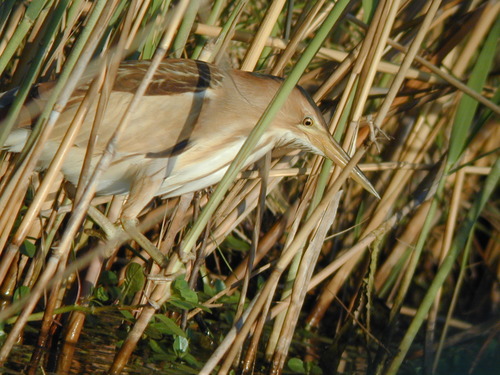 Little Bittern
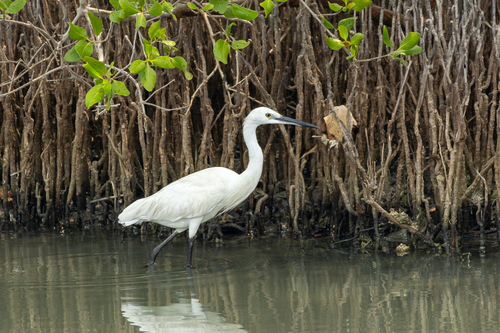 Little Egret
In short
The most reliable field mark to separate Little Bittern from Little Egret is overall size and plumage: Little Bittern is much smaller and never all-white, while Little Egret is a larger, slender, entirely white heron. In flight or perched, Little Bittern of any age shows a compact, chunky profile with dark upperparts and pale wing panels (especially obvious in males), whereas Little Egret is elegant, long-necked, and gleaming white, with black legs and yellow feet. Juvenile Little Bitterns are heavily streaked and rufous, never white. If you see a small, streaky, brownish heron with a pale wing patch, it's a Little Bittern; if it's pure white and graceful, it's a Little Egret.
Identification tips
- Size: Little Bittern is much smaller than Little Egret—about half the length and wingspan. If the bird appears as small as a moorhen or kingfisher, it's not a Little Egret.
- Plumage (all ages): Little Bittern is never all-white; it is brown, buff, black, or rufous with streaks (especially in juveniles and females). Little Egret is always entirely white (except for rare dark morphs, which are bluish-grey, not streaked or rufous).
- Juvenile/Immature Pattern: Juvenile Little Bitterns are heavily streaked above and below, with rufous and brown tones and streaked wing coverts. Juvenile Little Egrets are white, sometimes with a few greyish or brownish feathers, but never streaked or rufous.
- Wing Panel (in flight/perched): Little Bittern shows a pale or pinkish-buff oval panel on the forewing (most obvious in adult males, less so in females and juveniles); Little Egret's wings are pure white with no panels or contrasting marks.
- Bill Shape and Color: Little Bittern has a long, sharp, but relatively thick bill (yellowish or horn-colored); Little Egret has a slender, straight, entirely black bill.
- Legs and Feet: Little Bittern's legs are greenish or yellowish; Little Egret has long, black legs with bright yellow feet (duller in juveniles, but never greenish).
- Neck and Posture: Little Bittern is short-necked and chunky, often with the neck retracted; Little Egret is long-necked and elegant, with a slim profile.
- Flight Style: Little Bittern flies low and quickly, with rapid wingbeats, often dropping into cover; Little Egret flies higher, with slow, deep wingbeats, neck retracted, and long legs trailing well beyond the tail.
- Breeding Plumes: In breeding season, Little Egret has long, wispy nape and scapular plumes; Little Bittern never shows such plumes.
- Behavior: Little Bittern is secretive and rarely seen in the open; Little Egret is bold, often feeding in open water or on mudflats.
- Habitat: Little Bittern is almost always in dense reedbeds; Little Egret is found in a wide range of open wetland habitats, often away from reeds.
- Sex Differences: Male Little Bitterns are more boldly marked (black upperparts, clean buff underparts, obvious wing panel); females and juveniles are browner and more streaked, but still never white.
- Seasonal Context: In Europe, Little Bittern is present mainly from mid-April to September; Little Egret is resident or present year-round in many areas.
- Confusion Risk: Distant or backlit Little Egrets may appear smaller or less white, but the lack of any streaking, rufous, or buff tones is key. Little Bitterns never look white, even in poor light.
- Group Size: Little Bittern is usually solitary or in pairs; Little Egret may be seen in small flocks or mixed heron groups.
Size
Little Bittern is dramatically smaller: body mass averages 147 g versus 532 g for Little Egret. In the field, Little Bittern is the smallest European heron, about half the length and wingspan of Little Egret (Little Bittern: 33–38 cm long, 52–58 cm wingspan; Little Egret: 55–65 cm long, 88–106 cm wingspan). Little Egret appears tall, slim, and long-legged, while Little Bittern is compact, short-necked, and squat by comparison.
Plumage
Juvenile and immature Little Bitterns are heavily streaked above and below, with rufous and brown tones and streaked wing coverts; their upperparts are never white. Both sexes and ages show a pale or pinkish-buff forewing panel, most obvious in adult males (contrasting with black wings and back), less so in females and juveniles. The underwing is whitish in all Little Bitterns. Adult male Little Bitterns have glossy black upperparts with a green sheen, pale buff underparts, and a distinct pale wing panel. Females are browner above with paler feather margins and streaked underparts; their wing panel is less obvious. Little Egret, by contrast, is entirely white in all plumages, with no streaking or colored panels. In breeding season, adult Little Egrets have long, elegant nape and scapular plumes, but even juveniles are white, sometimes with a few greyish or brownish feathers, and never show the streaked or rufous tones of Little Bittern. Little Egret's bill is always black, legs black, and feet yellow (duller in juveniles).
Behaviour
Little Bittern is secretive, skulking in dense reedbeds and rarely seen in the open; it often freezes with its bill pointed upward when disturbed. In flight, it appears short-necked and compact, with rapid, fluttery wingbeats and a tendency to drop quickly back into cover. Little Egret is much more conspicuous, often feeding in open shallow water, actively stalking or running after prey, sometimes with raised wings. It is gregarious, often seen in small groups, and flies with slow, deep wingbeats, neck retracted, and long legs trailing well beyond the tail.
Habitat
Little Bittern prefers dense reedbeds and marshes with thick emergent vegetation, where it remains hidden and rarely ventures far from cover. Little Egret is found in a wider range of wetland habitats, including open lakeshores, estuaries, mudflats, and rivers, often in more open situations and sometimes far from reeds.