
Levant Sparrowhawk vs Eurasian Sparrowhawk
Tachyspiza brevipes versus Accipiter nisus
Play a quiz with Levant Sparrowhawk and Eurasian Sparrowhawk
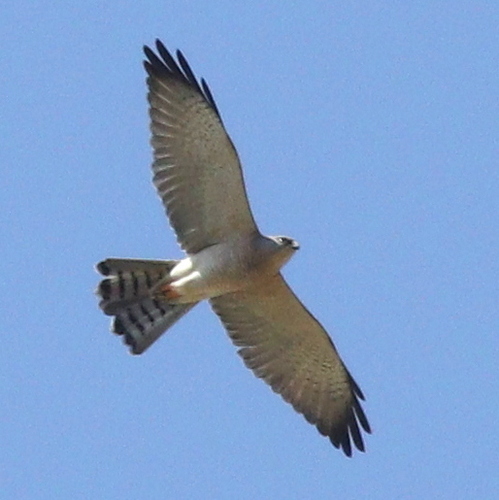 Levant Sparrowhawk
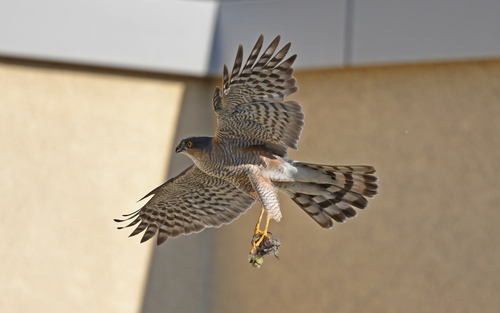 Eurasian Sparrowhawk
In short
The most reliable field mark between Levant Sparrowhawk and Eurasian Sparrowhawk is the overall structure in flight: Levant Sparrowhawk has shorter, more pointed wings and a shorter tail, giving it a more falcon-like appearance, while Eurasian Sparrowhawk shows broader, more rounded wings and a longer, squarer tail. Juvenile plumage is similar, but Levant Sparrowhawk juveniles show a dark throat line, while Eurasian Sparrowhawk juveniles lack a midline throat stripe. Adult males of both species are blue-grey above and barred below, but Levant is smaller and more compact. Sex and age differences can complicate identification, so structure and flight jizz are often more reliable than plumage alone.
Identification tips
- Wing and tail shape in flight: Levant Sparrowhawk shows shorter, more pointed wings and a shorter tail, giving a compact, falcon-like profile. Eurasian Sparrowhawk has broader, more rounded wings and a longer, squarer tail. This is most reliable in direct comparison or with experience.
- Size and sexual dimorphism: Eurasian Sparrowhawk, especially females, is noticeably larger and bulkier. Levant Sparrowhawk is smaller overall, and the size difference between sexes is less pronounced.
- Juvenile throat pattern: Juvenile Levant Sparrowhawks have a dark throat line (sometimes faint), while Eurasian Sparrowhawk juveniles have a streaked throat but lack a midline stripe. This is a key mark in perched or close views of young birds.
- Adult male underparts: Levant Sparrowhawk males have fine rufous and white barring below; Eurasian Sparrowhawk males have orange-barred underparts that can look plain orange at a distance.
- Adult female upperparts: Levant Sparrowhawk females are slate-grey above with darkish wingtips; Eurasian Sparrowhawk females are dark brown or greyish-brown above.
- Adult female underparts: Levant Sparrowhawk females are barred reddish brown below and may show a dark throat line; Eurasian Sparrowhawk females are brown-barred below without a midline throat stripe.
- Iris color: Eurasian Sparrowhawk adults have orange-yellow to orange-red irides (males brighter), while Levant Sparrowhawk has yellow eyes (less emphasized in the notes, but can be helpful in good light).
- Leg and cere color: Both species have orangish-yellow legs and yellow cere, so this is not diagnostic.
- Flight style: Levant Sparrowhawk may appear more falcon-like, with faster, more pointed wingbeats and occasional hovering. Eurasian Sparrowhawk uses a flap-flap-glide pattern with undulating flight.
- Perched jizz: Levant Sparrowhawk appears more compact and short-tailed when perched, while Eurasian Sparrowhawk is longer-tailed and bulkier, especially in females.
- Habitat and range context: If in southeastern Europe or the Middle East during migration, Levant Sparrowhawk is more likely, especially in migration hotspots. Eurasian Sparrowhawk is widespread and common across Eurasia.
- Sex confusion: Female Levant Sparrowhawk can approach the size of male Eurasian Sparrowhawk, so structure and plumage details are more reliable than size alone in these cases.
- Plumage overlap: Both species can look similar in poor light or at a distance, especially juveniles. Use a combination of structure, throat pattern, and flight style for best results.
- No strong vocal differences noted: Calls are not described as diagnostic in the provided notes, so rely on visual marks.
- Beware overlap with other Accipiters: In some regions, other small Accipiters (e.g., Shikra, Besra) may be present; always confirm with multiple field marks.
Size
Eurasian Sparrowhawk is generally larger and heavier, especially in females. Adult female Eurasian Sparrowhawk can reach 35–41 cm in length with a wingspan of 67–80 cm and a mass of 185–342 g, while Levant Sparrowhawk is smaller at 32–38 cm in length and 65–75 cm wingspan (mass not specified, but less than Eurasian). The size difference between sexes is much more pronounced in Eurasian Sparrowhawk, with females up to 25% larger than males. Levant Sparrowhawk shows a less marked sexual size dimorphism.
Plumage
- Juveniles: Both species are brown above and barred or streaked below, but Levant Sparrowhawk juveniles have a distinctive dark throat line, sometimes faint, while Eurasian Sparrowhawk juveniles have a streaked throat but lack a midline stripe. Eurasian juveniles are warm brown above with rusty fringes, and their underparts are coarsely barred or spotted brown.
- Adult males: Both are blue-grey above and barred below, but Levant Sparrowhawk males have finer rufous and white barring and a white throat with a dark central stripe (sometimes faint). Eurasian Sparrowhawk males have orange-barred underparts, which can look plain orange at a distance, and their irides are orange-yellow or orange-red.
- Adult females: Levant Sparrowhawk females are slate-grey above with darkish wingtips and reddish brown barring below, often showing a dark throat line. Eurasian Sparrowhawk females are dark brown or greyish-brown above, with brown-barred underparts and bright yellow to orange irides.
- In flight: Levant Sparrowhawk appears more pointed-winged and compact, while Eurasian Sparrowhawk is broader-winged and longer-tailed.
Behaviour
Both species are adapted for maneuvering through trees, using short, broad wings and long tails. Levant Sparrowhawk often uses soaring-and-gliding flight on migration, sometimes hovering, and is known for high-circling aerial displays during breeding. Eurasian Sparrowhawk has a characteristic flap-flap-glide flight with undulating pattern. Both are secretive and can be difficult to spot except during migration or display flights.
Habitat
Both species breed in woodland or forest edge habitats, often near water. Levant Sparrowhawk prefers open woodland, forest edges, or isolated tree clumps, usually nesting 5–10 m above ground. Eurasian Sparrowhawk is more widespread and adaptable, using a variety of wooded habitats across its range. Both can be found in similar contexts, but Levant Sparrowhawk is more localized in southeastern Europe and southwestern Asia, while Eurasian Sparrowhawk is widespread across Eurasia.