
Lesser Spotted Eagle vs Western Marsh Harrier
Clanga pomarina versus Circus aeruginosus
Play a quiz with Lesser Spotted Eagle and Western Marsh Harrier
 Lesser Spotted Eagle
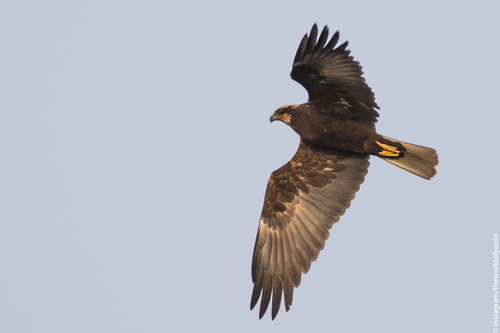 Western Marsh Harrier
In short
The most reliable field mark to separate Lesser Spotted Eagle from Western Marsh Harrier in flight, especially in juveniles and immatures, is the presence of a clear white 'V' on the rump and prominent white spots on the remiges in the eagle, versus the harrier's lack of such rump and wing markings. Lesser Spotted Eagle is bulkier and heavier, with a smaller head and bill for an eagle, while Western Marsh Harrier is slimmer, with broader wings and a distinctive three-tone wing pattern in adult males. Female and juvenile harriers are chocolate-brown with a pale head and shoulders, but never show the eagle's white 'V' or wing spots. Both species can appear brown from a distance, but their flight style, structure, and wing patterns are quite different when seen well.
Identification tips
- White 'V' on rump (Lesser Spotted Eagle, all ages): Look for a clear white 'V' on the upper tail/rump in flight; this is always present in the eagle and never in Marsh Harrier.
- White spots on remiges (Lesser Spotted Eagle, juveniles/immatures): Juvenile eagles show prominent white spots on the flight feathers, lacking any covert spotting; juvenile harriers never show this pattern.
- Pale cream neck patch (Lesser Spotted Eagle, juveniles): A pale neck patch is visible in young eagles, but not in harriers.
- Absence of covert spotting (Lesser Spotted Eagle, juveniles): Juvenile eagles lack wing covert spots, while harriers have uniformly colored wings.
- Three-tone wing pattern (adult male Marsh Harrier): Adult males show brown forewing, grey secondaries and tail, and black wingtips; eagles never show this combination.
- Pale head and shoulders (female/juvenile Marsh Harrier): Females and juveniles have a distinctly paler yellowish head and shoulders, sharply set off from the dark body, but never a white rump or wing spots.
- Dark eye area (female/juvenile Marsh Harrier): The pale head is offset by a dark eye area, making the pale iris stand out; eagle's head is pale but lacks this facial contrast.
- Bulk and structure: Eagles are heavier, with a shorter, thicker bill and smaller head for their size; harriers are slimmer, with longer wings and a more graceful appearance.
- Flight style: Eagles soar with flat wings and steady beats; harriers fly with wings in a shallow V and often dangle their legs while hunting low over ground.
- Habitat context: Eagles are rarely seen over marshes or reedbeds; harriers are typical of wetland environments.
- Sexual dimorphism (Marsh Harrier): Males and females differ strongly in harrier, but both sexes lack the eagle's white rump and wing spots.
- Hypermelanic morph (Marsh Harrier): Rarely, a harrier may appear almost all black, but will still lack the eagle's white rump and wing marks.
- Bill size: Eagle's bill is smaller and less hooked than expected for its size; harrier's bill is proportionally longer and slimmer.
- Voice: The eagle's dog-like yip is rarely heard; do not rely on calls for separation.
- Beware hybrids (eagle): Lesser and Greater Spotted Eagles hybridize and can be very hard to separate; Marsh Harrier does not hybridize with eagles, so if the bird fits harrier structure and behavior, it is not an eagle.
Size
Lesser Spotted Eagle is significantly heavier and larger overall (body mass ~1475 g, length ~60 cm, wingspan ~150 cm) compared to Western Marsh Harrier (female mass up to 800 g, length 48–56 cm, wingspan 115–130 cm). The eagle is bulkier, with a more compact, heavyset build, while the harrier is slimmer and longer-winged relative to its body size. The harrier's size varies by sex, with females being larger than males, but even the largest harrier is noticeably lighter and smaller than the eagle.
Plumage
- Juvenile/immature Lesser Spotted Eagle: Shows prominent white spots on the remiges (flight feathers) and a pale cream neck patch. The upperwing coverts lack spotting, and a white 'V' on the rump is usually visible, though less sharply defined than in adults. These white marks are absent in Western Marsh Harrier of any age.
- Juvenile/immature Western Marsh Harrier: Uniformly chocolate-brown with a paler yellowish head and shoulders, but no white on the rump or wing. The pale areas can be sharply defined or washed out, but the eye area is always darker, making the pale eye stand out. Rare hypermelanic morphs can appear almost entirely black.
- Adult Lesser Spotted Eagle: Pale brown head and wing coverts contrast with darker body and wings; white 'V' on rump is always present and diagnostic. No pale head or grey wing/tail patches.
- Adult male Western Marsh Harrier: Shows a three-tone wing pattern (brown forewing, grey secondaries and tail, black wingtips), pale head and shoulders, and yellow legs. No white rump or wing spots.
- Adult female Western Marsh Harrier: Chocolate-brown overall, with a paler yellowish head and shoulders, but never with the eagle's white rump or wing markings.
Behaviour
Lesser Spotted Eagle soars with steady, deep wingbeats and often glides on flat wings, typical of eagles. It is wary and tends to keep to open or lightly wooded country, hunting from a perch or on the wing. Western Marsh Harrier hunts by gliding low over open ground with wings held in a shallow V and legs often dangling, a classic harrier behavior. The harrier's flight is lighter and more buoyant, with frequent quartering of marshes and fields, whereas the eagle appears heavier and more purposeful in flight.
Habitat
Lesser Spotted Eagle prefers open or lightly wooded country, often near forests or woodland edges, and is rarely seen over wetlands. Western Marsh Harrier is strongly associated with marshes, reedbeds, and wetland habitats, where it hunts over open water or wet fields. If seen over extensive marshland or reedbeds, Marsh Harrier is far more likely; eagles are more often seen over drier, open landscapes.
Voice
Lesser Spotted Eagle gives a dog-like yip, but both species are generally silent away from the nest. Vocalizations are not a reliable field mark in most birding situations.
Lesser Spotted Eagle · Western Marsh Harrier · My Tricky Birds