

Motmot

Lesser Spotted Eagle vs Greater Spotted Eagle

Clanga pomarina versus Clanga clanga

Play a quiz with Lesser Spotted Eagle and Greater Spotted Eagle

Lesser Spotted Eagle (Clanga pomarina) Lesser Spotted Eagle
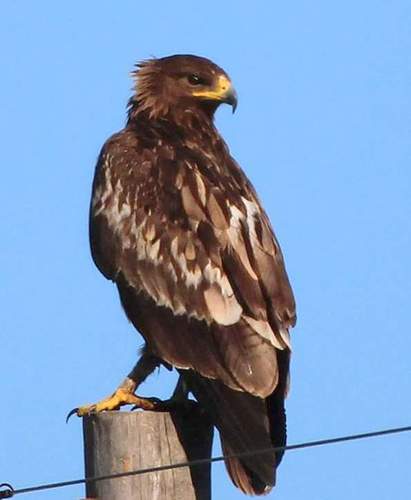
Greater Spotted Eagle (Clanga clanga) Greater Spotted Eagle

Media

Loading…

In short

The most reliable field mark between Lesser Spotted Eagle and Greater Spotted Eagle is the presence of a clear pale 'V' on the upper rump of Lesser Spotted Eagle, visible even in adults, and absent or poorly defined in Greater Spotted Eagle. Juvenile Lesser Spotted Eagles also show a pale cream neck patch and white spots on the remiges, while Greater Spotted juveniles lack the neck patch and tend to be more uniformly dark. Structural differences are subtle but important: Greater Spotted Eagle adults are broader-winged and darker overall, but size overlaps mean this is not always reliable. In flight, focus on the upperwing and rump pattern, especially in immatures, as these are the most consistent separation points.

Identification tips

  1. White 'V' on rump (all ages): Lesser Spotted Eagle almost always shows a clear white 'V' on the upper rump, visible in flight and from above; Greater Spotted Eagle lacks this or has a poorly defined version. This is the single most reliable field mark in most conditions.
  2. Pale neck patch (juveniles): Juvenile Lesser Spotted Eagle has a pale cream or ochre neck patch, contrasting with the rest of the head and nape; Greater Spotted Eagle juveniles lack this, or at best show a slightly paler nape that never appears ochre or orange.
  3. Remige spotting (juveniles): Juvenile Lesser Spotted Eagle shows prominent white spots on the flight feathers (remiges), but not on the wing coverts; Greater Spotted Eagle juveniles may show more extensive spotting and barring overall, but this is variable and not always reliable.
  4. Upperwing coverts (adults): Adult Lesser Spotted Eagle has paler brown wing coverts and head, contrasting with the darker body and flight feathers; Greater Spotted Eagle is more uniformly dark brown, with no strong contrast between coverts and body.
  5. Upperwing patch (adults): Lesser Spotted Eagle often shows a white patch on the upperwing, visible in flight; Greater Spotted Eagle lacks this mark.
  6. Structure in flight (adults): Greater Spotted Eagle adults look broader-winged and bulkier, with a relatively smaller head and shorter tail; Lesser Spotted Eagle is more compact, with a smaller bill and head for an eagle. However, juvenile Greater Spotted Eagles can appear slimmer and longer-tailed, resembling Lesser Spotted Eagle, so use with caution.
  7. Uppertail coverts (adults): Lesser Spotted Eagle has a contrasting pale uppertail/rump; Greater Spotted Eagle's uppertail coverts are dark and blend with the rest of the upperparts.
  8. Carpal arc and primary patch (juveniles): Differences in the appearance of the carpal arc and primary patch can help, but are subtle and best used in combination with other marks.
  9. Bill and head size: Lesser Spotted Eagle has a smaller bill and head for an eagle, but this is only obvious at close range or in direct comparison.
  10. Overall darkness: Greater Spotted Eagle is generally darker and more uniform, especially on the upperparts and wing coverts, while Lesser Spotted Eagle has more contrast between the head, coverts, and body.
  11. Voice: If heard, a dog-like yip points to Lesser Spotted Eagle; Greater Spotted Eagle's call is not distinctive in the field.
  12. Sex and size: Female Greater Spotted Eagles can be much larger than Lesser Spotted Eagles, but males overlap in size, so do not rely on size alone.
  13. Hybrid caution: Hybrids occur and can be extremely difficult to identify, sometimes resembling one parent species more than the other. If a bird shows a mix of features, identification may not be possible without close, in-hand examination.
  14. Perched birds: Perched, both species can look similar, but check for the pale neck patch (juvenile Lesser) and the white rump 'V' (all ages Lesser). Structure is less obvious when perched.
  15. Context: Both species occur in similar habitats and ranges, so do not use location or habitat as a primary separator in overlap zones.

Size

Lesser Spotted Eagle averages around 1475.5g in body mass [wikidata], but there is a broad overlap in size between the two species. Greater Spotted Eagle can be distinctly larger, especially females, but some males are barely larger than Lesser Spotted. In the field, size alone is not a safe separator due to this overlap. Structurally, Greater Spotted Eagle adults often look broader-winged and bulkier, with a relatively smaller head, while Lesser Spotted Eagle is slightly more compact with a smaller bill and head for an eagle.

Plumage

Juvenile and immature plumage is key. Lesser Spotted Eagle juveniles have a pale cream-colored neck patch and prominent white spots on the remiges, but lack white spotting on the wing coverts. They also show a clear white 'V' on the upper rump, which is retained into adulthood. Greater Spotted Eagle juveniles lack the pale neck patch (or it is only slightly paler than the rest of the plumage, never ochre or orange), and their upperparts, including uppertail coverts, are uniformly dark with no clear white 'V'. Juvenile Greater Spotted Eagles may show stronger spotting and barring, but this is variable. Adults of both species are dark brown, but Lesser Spotted Eagle has paler brown head and wing coverts that contrast with the darker body, while Greater Spotted Eagle is more uniformly dark, with no contrasting pale areas. In flight, Lesser Spotted Eagle shows a white upperwing patch and the white rump 'V'; Greater Spotted Eagle lacks these, and its wing coverts and uppertail are dark.

Behaviour

Both species are wary and hunt similar prey, mainly small mammals and birds in open or lightly wooded country. There are no strong behavioral differences noted in the field that would reliably separate them. Both can be seen soaring or perched in trees, and both migrate long distances.

Habitat

Both species breed in Eastern Europe and migrate to Africa, often using similar open or lightly wooded habitats. Habitat preference is not a reliable separator in their overlapping range.

Voice

Lesser Spotted Eagle gives a dog-like yip. No distinctive vocalization is described for Greater Spotted Eagle in the provided notes, so voice is not a reliable separator unless Lesser Spotted Eagle is heard calling.

Submit a better description

Use the same sections as the comparison. Your text is published immediately.

The most reliable field mark between Lesser Spotted Eagle and Greater Spotted Eagle is the presence of a clear pale 'V' on the upper rump of Lesser Spotted Eagle, visible even in adults, and absent or poorly defined in Greater Spotted Eagle. Juvenile Lesser Spotted Eagles also show a pale cream neck patch and white spots on the remiges, while Greater Spotted juveniles lack the neck patch and tend to be more uniformly dark. Structural differences are subtle but important: Greater Spotted Eagle adults are broader-winged and darker overall, but size overlaps mean this is not always reliable. In flight, focus on the upperwing and rump pattern, especially in immatures, as these are the most consistent separation points.

  1. White 'V' on rump (all ages): Lesser Spotted Eagle almost always shows a clear white 'V' on the upper rump, visible in flight and from above; Greater Spotted Eagle lacks this or has a poorly defined version. This is the single most reliable field mark in most conditions.
  2. Pale neck patch (juveniles): Juvenile Lesser Spotted Eagle has a pale cream or ochre neck patch, contrasting with the rest of the head and nape; Greater Spotted Eagle juveniles lack this, or at best show a slightly paler nape that never appears ochre or orange.
  3. Remige spotting (juveniles): Juvenile Lesser Spotted Eagle shows prominent white spots on the flight feathers (remiges), but not on the wing coverts; Greater Spotted Eagle juveniles may show more extensive spotting and barring overall, but this is variable and not always reliable.
  4. Upperwing coverts (adults): Adult Lesser Spotted Eagle has paler brown wing coverts and head, contrasting with the darker body and flight feathers; Greater Spotted Eagle is more uniformly dark brown, with no strong contrast between coverts and body.
  5. Upperwing patch (adults): Lesser Spotted Eagle often shows a white patch on the upperwing, visible in flight; Greater Spotted Eagle lacks this mark.
  6. Structure in flight (adults): Greater Spotted Eagle adults look broader-winged and bulkier, with a relatively smaller head and shorter tail; Lesser Spotted Eagle is more compact, with a smaller bill and head for an eagle. However, juvenile Greater Spotted Eagles can appear slimmer and longer-tailed, resembling Lesser Spotted Eagle, so use with caution.
  7. Uppertail coverts (adults): Lesser Spotted Eagle has a contrasting pale uppertail/rump; Greater Spotted Eagle's uppertail coverts are dark and blend with the rest of the upperparts.
  8. Carpal arc and primary patch (juveniles): Differences in the appearance of the carpal arc and primary patch can help, but are subtle and best used in combination with other marks.
  9. Bill and head size: Lesser Spotted Eagle has a smaller bill and head for an eagle, but this is only obvious at close range or in direct comparison.
  10. Overall darkness: Greater Spotted Eagle is generally darker and more uniform, especially on the upperparts and wing coverts, while Lesser Spotted Eagle has more contrast between the head, coverts, and body.
  11. Voice: If heard, a dog-like yip points to Lesser Spotted Eagle; Greater Spotted Eagle's call is not distinctive in the field.
  12. Sex and size: Female Greater Spotted Eagles can be much larger than Lesser Spotted Eagles, but males overlap in size, so do not rely on size alone.
  13. Hybrid caution: Hybrids occur and can be extremely difficult to identify, sometimes resembling one parent species more than the other. If a bird shows a mix of features, identification may not be possible without close, in-hand examination.
  14. Perched birds: Perched, both species can look similar, but check for the pale neck patch (juvenile Lesser) and the white rump 'V' (all ages Lesser). Structure is less obvious when perched.
  15. Context: Both species occur in similar habitats and ranges, so do not use location or habitat as a primary separator in overlap zones.

Lesser Spotted Eagle averages around 1475.5g in body mass [wikidata], but there is a broad overlap in size between the two species. Greater Spotted Eagle can be distinctly larger, especially females, but some males are barely larger than Lesser Spotted. In the field, size alone is not a safe separator due to this overlap. Structurally, Greater Spotted Eagle adults often look broader-winged and bulkier, with a relatively smaller head, while Lesser Spotted Eagle is slightly more compact with a smaller bill and head for an eagle.

Juvenile and immature plumage is key. Lesser Spotted Eagle juveniles have a pale cream-colored neck patch and prominent white spots on the remiges, but lack white spotting on the wing coverts. They also show a clear white 'V' on the upper rump, which is retained into adulthood. Greater Spotted Eagle juveniles lack the pale neck patch (or it is only slightly paler than the rest of the plumage, never ochre or orange), and their upperparts, including uppertail coverts, are uniformly dark with no clear white 'V'. Juvenile Greater Spotted Eagles may show stronger spotting and barring, but this is variable. Adults of both species are dark brown, but Lesser Spotted Eagle has paler brown head and wing coverts that contrast with the darker body, while Greater Spotted Eagle is more uniformly dark, with no contrasting pale areas. In flight, Lesser Spotted Eagle shows a white upperwing patch and the white rump 'V'; Greater Spotted Eagle lacks these, and its wing coverts and uppertail are dark.

Both species are wary and hunt similar prey, mainly small mammals and birds in open or lightly wooded country. There are no strong behavioral differences noted in the field that would reliably separate them. Both can be seen soaring or perched in trees, and both migrate long distances.

Both species breed in Eastern Europe and migrate to Africa, often using similar open or lightly wooded habitats. Habitat preference is not a reliable separator in their overlapping range.

Lesser Spotted Eagle gives a dog-like yip. No distinctive vocalization is described for Greater Spotted Eagle in the provided notes, so voice is not a reliable separator unless Lesser Spotted Eagle is heard calling.

Discard your changes?

You have unsaved edits. If you leave now, those changes will be lost.

Lesser Spotted Eagle · Greater Spotted Eagle · My Tricky Birds