

Motmot

Lesser Kestrel vs Saker Falcon

Falco naumanni versus Falco cherrug

Play a quiz with Lesser Kestrel and Saker Falcon
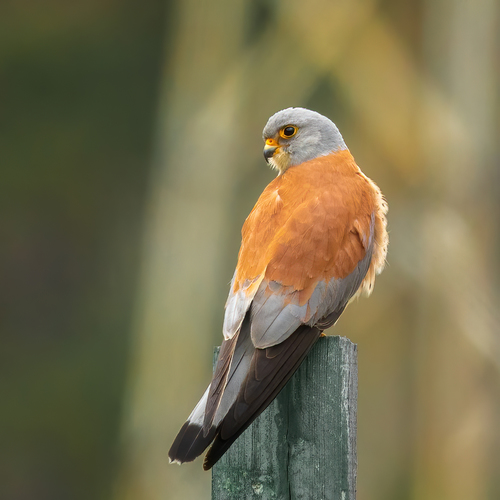
Lesser Kestrel (Falco naumanni) Lesser Kestrel

Saker Falcon (Falco cherrug) Saker Falcon

Media

Loading…

In short

The most reliable way to separate Lesser Kestrel from Saker Falcon is by size and structure: Saker Falcon is vastly larger and bulkier, with a heavy, broad-winged silhouette, while Lesser Kestrel is a small, delicate falcon with proportionally shorter wings and tail. In flight, Lesser Kestrel shows a more agile, buoyant jizz, whereas Saker Falcon appears powerful and purposeful. Adult male Lesser Kestrels have a plain grey head and tail, lacking the dark malar stripe typical of many falcons, while Saker Falcons are overall brownish and heavily streaked, with no such clean-headed look. Juvenile and female Lesser Kestrels are very similar to Common Kestrel and can be tricky, but Saker Falcons are always much bigger and more robust, regardless of age or sex. Voice is also helpful if heard: Lesser Kestrel gives a harsh chay-chay-chay, while Saker Falcon calls are sharper, more yelping.

Identification tips

  1. Size is the single most decisive mark: Saker Falcon is six times heavier and much larger in every dimension; even a distant silhouette should show the Saker's bulk and broad wings versus the Lesser Kestrel's small, slim frame.
  2. Flight style: Lesser Kestrel is agile, buoyant, and often hovers; Saker Falcon is powerful, deep-winged, and purposeful, rarely hovering.
  3. Adult male Lesser Kestrel has a plain grey head and tail: No dark malar stripe, no dark spotting on the back, and grey patches in the wings—none of which are shown by Saker Falcon.
  4. Female and juvenile Lesser Kestrel are paler than Common Kestrel but otherwise similar: Brown back, barred underparts, and a generally delicate look; Saker Falcon is always much browner, more heavily streaked, and robust.
  5. Saker Falcon is variable in plumage but always large and streaked: No clean grey head or tail, and never as pale or dainty as Lesser Kestrel.
  6. Bill and talons: Lesser Kestrel has unusual whitish-horn talons (not black), but this is only visible at very close range and rarely useful in the field.
  7. Facial pattern: Neither species has a strong facial mask, but Lesser Kestrel males lack the black malar stripe; Saker Falcon has a less contrasting face overall.
  8. Habitat context: Lesser Kestrel often nests colonially on buildings or cliffs, sometimes in large groups; Saker Falcon is more solitary and prefers open steppe or grassland.
  9. Season: Lesser Kestrel is a summer migrant, absent from breeding areas in winter; Saker Falcon may be present year-round or migrate depending on location.
  10. Voice: Lesser Kestrel's harsh chay-chay-chay is very different from Saker Falcon's sharp kiy-ee or kyak-kyak-kyak; use voice if heard.
  11. Jizz when perched: Lesser Kestrel appears small, with a relatively short tail and wings; Saker Falcon is large, long-winged, and heavy-billed.
  12. Feeding behavior: Lesser Kestrel often hunts insects on the ground; Saker Falcon takes larger prey and is rarely seen chasing insects.
  13. Group size: Lesser Kestrel may be seen in large communal roosts or colonies; Saker Falcon is usually alone or in pairs.
  14. If in doubt, use a combination of size, flight style, and habitat: Even if plumage is confusing, these combined should separate the two in almost all circumstances.
  15. Plumage pitfalls: Female and juvenile Lesser Kestrel can be mistaken for other small falcons, but never approach the size or bulk of a Saker Falcon.

Size

Saker Falcon is dramatically larger: adult body mass averages around 1000g (males 730–990g, females 970–1300g), with a length of 45–57 cm and a wingspan of 97–126 cm. Lesser Kestrel is tiny by comparison, averaging only 159g, with a length of 27–33 cm and a wingspan of 63–72 cm. Even at a distance or in poor light, the Saker's bulk and broad wings are unmistakable next to the dainty, slim Lesser Kestrel.

Plumage

Age-specific wing pattern is not detailed for either species in the sources, but overall plumage is distinctive. Adult male Lesser Kestrels have a pale grey head and tail, lacking dark spotting on the back and the black malar stripe seen in many falcons; they also show grey patches in the wings. Females and young Lesser Kestrels are paler than Common Kestrel but otherwise very similar, with brown backs and barred underparts. Saker Falcons, regardless of age or sex, are much browner overall, with variable but generally heavy streaking, and lack the clean grey head and tail of male Lesser Kestrel. Juvenile Saker Falcons are darker and more streaked than adults. Neither species shows the strong facial patterning of some other falcons, but Saker is always more uniform and robust in appearance.

Behaviour

Lesser Kestrel is agile and buoyant in flight, often hovering or making quick, fluttery movements. It frequently hunts insects on the ground and is more likely to be seen in loose colonies, especially near buildings or cliffs. Saker Falcon is much more powerful and direct in flight, with strong, deep wingbeats and a purposeful glide. It hunts larger prey and is less likely to be seen in large groups. Lesser Kestrel is a summer migrant, while Saker Falcon can be resident or migratory depending on region.

Habitat

Both species can be found across Central Asia and parts of Europe, but Lesser Kestrel is more closely tied to open country, farmland, and colonial nesting sites on buildings or cliffs. Saker Falcon prefers open steppe, grassland, and semi-desert, often away from human habitation. In winter, Lesser Kestrel migrates to Africa and South Asia, while Saker Falcon's migration is more variable, with some populations resident and others moving to the Sahel or Tibetan Plateau.

Voice

Lesser Kestrel gives a diagnostic harsh chay-chay-chay, which is quite different from the Saker Falcon's sharp kiy-ee or repeated kyak-kyak-kyak. If you hear the call, it is a strong clue to identification, especially since plumage can be confusing in female and juvenile Lesser Kestrels.

Submit a better description

Use the same sections as the comparison. Your text is published immediately.

The most reliable way to separate Lesser Kestrel from Saker Falcon is by size and structure: Saker Falcon is vastly larger and bulkier, with a heavy, broad-winged silhouette, while Lesser Kestrel is a small, delicate falcon with proportionally shorter wings and tail. In flight, Lesser Kestrel shows a more agile, buoyant jizz, whereas Saker Falcon appears powerful and purposeful. Adult male Lesser Kestrels have a plain grey head and tail, lacking the dark malar stripe typical of many falcons, while Saker Falcons are overall brownish and heavily streaked, with no such clean-headed look. Juvenile and female Lesser Kestrels are very similar to Common Kestrel and can be tricky, but Saker Falcons are always much bigger and more robust, regardless of age or sex. Voice is also helpful if heard: Lesser Kestrel gives a harsh chay-chay-chay, while Saker Falcon calls are sharper, more yelping.

  1. Size is the single most decisive mark: Saker Falcon is six times heavier and much larger in every dimension; even a distant silhouette should show the Saker's bulk and broad wings versus the Lesser Kestrel's small, slim frame.
  2. Flight style: Lesser Kestrel is agile, buoyant, and often hovers; Saker Falcon is powerful, deep-winged, and purposeful, rarely hovering.
  3. Adult male Lesser Kestrel has a plain grey head and tail: No dark malar stripe, no dark spotting on the back, and grey patches in the wings—none of which are shown by Saker Falcon.
  4. Female and juvenile Lesser Kestrel are paler than Common Kestrel but otherwise similar: Brown back, barred underparts, and a generally delicate look; Saker Falcon is always much browner, more heavily streaked, and robust.
  5. Saker Falcon is variable in plumage but always large and streaked: No clean grey head or tail, and never as pale or dainty as Lesser Kestrel.
  6. Bill and talons: Lesser Kestrel has unusual whitish-horn talons (not black), but this is only visible at very close range and rarely useful in the field.
  7. Facial pattern: Neither species has a strong facial mask, but Lesser Kestrel males lack the black malar stripe; Saker Falcon has a less contrasting face overall.
  8. Habitat context: Lesser Kestrel often nests colonially on buildings or cliffs, sometimes in large groups; Saker Falcon is more solitary and prefers open steppe or grassland.
  9. Season: Lesser Kestrel is a summer migrant, absent from breeding areas in winter; Saker Falcon may be present year-round or migrate depending on location.
  10. Voice: Lesser Kestrel's harsh chay-chay-chay is very different from Saker Falcon's sharp kiy-ee or kyak-kyak-kyak; use voice if heard.
  11. Jizz when perched: Lesser Kestrel appears small, with a relatively short tail and wings; Saker Falcon is large, long-winged, and heavy-billed.
  12. Feeding behavior: Lesser Kestrel often hunts insects on the ground; Saker Falcon takes larger prey and is rarely seen chasing insects.
  13. Group size: Lesser Kestrel may be seen in large communal roosts or colonies; Saker Falcon is usually alone or in pairs.
  14. If in doubt, use a combination of size, flight style, and habitat: Even if plumage is confusing, these combined should separate the two in almost all circumstances.
  15. Plumage pitfalls: Female and juvenile Lesser Kestrel can be mistaken for other small falcons, but never approach the size or bulk of a Saker Falcon.

Saker Falcon is dramatically larger: adult body mass averages around 1000g (males 730–990g, females 970–1300g), with a length of 45–57 cm and a wingspan of 97–126 cm. Lesser Kestrel is tiny by comparison, averaging only 159g, with a length of 27–33 cm and a wingspan of 63–72 cm. Even at a distance or in poor light, the Saker's bulk and broad wings are unmistakable next to the dainty, slim Lesser Kestrel.

Age-specific wing pattern is not detailed for either species in the sources, but overall plumage is distinctive. Adult male Lesser Kestrels have a pale grey head and tail, lacking dark spotting on the back and the black malar stripe seen in many falcons; they also show grey patches in the wings. Females and young Lesser Kestrels are paler than Common Kestrel but otherwise very similar, with brown backs and barred underparts. Saker Falcons, regardless of age or sex, are much browner overall, with variable but generally heavy streaking, and lack the clean grey head and tail of male Lesser Kestrel. Juvenile Saker Falcons are darker and more streaked than adults. Neither species shows the strong facial patterning of some other falcons, but Saker is always more uniform and robust in appearance.

Lesser Kestrel is agile and buoyant in flight, often hovering or making quick, fluttery movements. It frequently hunts insects on the ground and is more likely to be seen in loose colonies, especially near buildings or cliffs. Saker Falcon is much more powerful and direct in flight, with strong, deep wingbeats and a purposeful glide. It hunts larger prey and is less likely to be seen in large groups. Lesser Kestrel is a summer migrant, while Saker Falcon can be resident or migratory depending on region.

Both species can be found across Central Asia and parts of Europe, but Lesser Kestrel is more closely tied to open country, farmland, and colonial nesting sites on buildings or cliffs. Saker Falcon prefers open steppe, grassland, and semi-desert, often away from human habitation. In winter, Lesser Kestrel migrates to Africa and South Asia, while Saker Falcon's migration is more variable, with some populations resident and others moving to the Sahel or Tibetan Plateau.

Lesser Kestrel gives a diagnostic harsh chay-chay-chay, which is quite different from the Saker Falcon's sharp kiy-ee or repeated kyak-kyak-kyak. If you hear the call, it is a strong clue to identification, especially since plumage can be confusing in female and juvenile Lesser Kestrels.

Discard your changes?

You have unsaved edits. If you leave now, those changes will be lost.

Lesser Kestrel · Saker Falcon · My Tricky Birds