

Lesser Kestrel vs Eleonora's Falcon
Falco naumanni versus Falco eleonorae
Play a quiz with Lesser Kestrel and Eleonora's Falcon
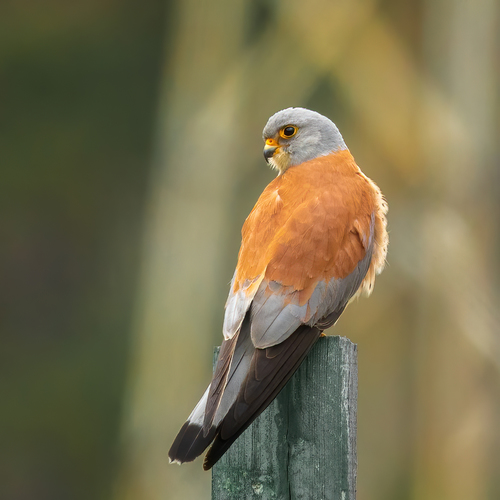 Lesser Kestrel
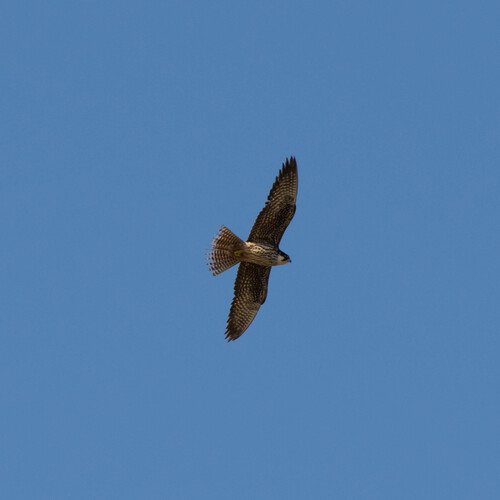 Eleonora's Falcon
In short
The most reliable field separation between Lesser Kestrel and Eleonora's Falcon is size and structure: Eleonora's Falcon is much larger, with long, pointed wings and a long tail, while Lesser Kestrel is notably smaller and more compact. In flight, Eleonora's Falcon (especially dark morphs and juveniles) shows a striking contrast between black underwing coverts and paler flight feathers, unlike the more uniform Lesser Kestrel. Adult male Lesser Kestrels have a grey head and tail, but lack the black malar stripe and dark spotting seen in other kestrels, while Eleonora's Falcon never shows this combination. Female and immature Lesser Kestrels are very similar to Common Kestrel and can be tricky, but Eleonora's Falcon (especially dark morphs) is overall much darker and more hobby-like. Calls are also different, but are only useful if heard well.
Identification tips
- Size and structure: Eleonora's Falcon is much larger and longer-winged than Lesser Kestrel; use this as your first check, especially if seen with other raptors for scale.
- Wing shape in flight: Eleonora's has long, pointed wings and a long tail, giving a slim, hobby-like profile; Lesser Kestrel is shorter-winged and more compact.
- Underwing pattern (juveniles/immatures): Eleonora's (all morphs) shows strong contrast between blackish underwing coverts and paler flight feathers, especially in light morph and juveniles. Lesser Kestrel's underwing is more uniform and lacks this bold contrast.
- Adult male plumage: Lesser Kestrel males have a pale grey head and tail, no black malar stripe, and no dark spotting on the back. Eleonora's never shows this combination—if you see a small falcon with a clean grey head/tail and no malar stripe, it's Lesser Kestrel.
- Dark morphs: Eleonora's Falcon dark morph is all sooty brown, much darker than any Lesser Kestrel at any age or sex.
- Female/immature confusion: Female and young Lesser Kestrels are paler and resemble Common Kestrel; Eleonora's Falcon (light morph) juveniles are buff below with dark wingtips and coverts, still showing more contrast than Lesser Kestrel.
- Bare part color: Lesser Kestrel has pale, whitish-horn talons, but this is only visible at very close range and rarely useful in the field.
- Behavior: Lesser Kestrel often perches on wires or buildings and hunts on the ground; Eleonora's is more aerial, hunting on the wing and rarely seen perched except on cliffs.
- Habitat: In Europe, Eleonora's is almost always on islands or sea cliffs; Lesser Kestrel is more likely inland or near human structures.
- Vocalization: Listen for the harsh 'chay-chay-chay' of Lesser Kestrel versus the more typical 'kek-kek-kek' of Eleonora's Falcon, but don't rely on voice unless you hear it well.
- Season and location: Eleonora's Falcon breeds later (late summer/autumn) and is present mainly on Mediterranean islands; Lesser Kestrel breeds earlier and is more widespread.
- Feeding behavior: Eleonora's Falcon may be seen catching birds in flight or carrying prey to cliffs; Lesser Kestrel is more likely to be seen dropping onto insects or small mammals on the ground.
- Jizz: If the bird looks slim, long-winged, and hobby-like, suspect Eleonora's; if it looks compact and kestrel-like, suspect Lesser Kestrel.
- Direct comparison: If you see both together, the size and structure difference is obvious—Eleonora's is nearly twice the mass and much longer-winged.
- Common pitfalls: Immature Lesser Kestrels can be confused with other kestrels, but rarely with Eleonora's Falcon if size and wing pattern are checked. Eleonora's Falcon dark morph can be mistaken for other dark falcons, but not for Lesser Kestrel.
Size
Eleonora's Falcon is substantially larger and heavier (body mass ~334g) than Lesser Kestrel (~159g). Eleonora's Falcon measures 36–42 cm in length with an 87–104 cm wingspan, giving it a long, slender, and powerful appearance. Lesser Kestrel is much smaller at 27–33 cm long with a 63–72 cm wingspan, appearing more compact and delicate. This size gap is usually obvious in direct comparison or with experience.
Plumage
- Juvenile/immature in flight: Eleonora's Falcon (both morphs, but especially dark morph and juveniles) shows strong contrast between dark underwing coverts and paler flight feathers, giving a two-toned underwing. Lesser Kestrel (all ages) lacks this: its underwing is more uniform, with barred grey underparts and no strong contrast.
- Adult males: Lesser Kestrel males have a pale grey head and tail, no black malar stripe, and no dark spotting on the back. Eleonora's Falcon never shows this combination; both morphs are darker and lack the clean grey head/tail of Lesser Kestrel.
- Females/immatures: Female and young Lesser Kestrels are paler and more uniform, but resemble Common Kestrel closely. Eleonora's Falcon light morph juveniles are buff below with dark wingtips and coverts, still showing more contrast than Lesser Kestrel. Dark morph Eleonora's is all sooty brown, much darker than any Lesser Kestrel.
- Bare parts: Lesser Kestrel has pale whitish-horn talons (unusual for falcons), but this is only visible at very close range and not a practical field mark.
Behaviour
Lesser Kestrel often hunts insects and small prey on the ground, frequently perching on wires or buildings, and is colonial in nesting. Eleonora's Falcon is a highly aerial hunter, catching birds and insects in flight with agile, hobby-like maneuvers; it spends much time cruising along cliffs and open airspace, especially during migration seasons. Eleonora's is also known for unique prey storage behavior, imprisoning live birds for later feeding, which is not seen in Lesser Kestrel.
Habitat
Lesser Kestrel breeds across Mediterranean regions into Central Asia, often nesting colonially on buildings, cliffs, or trees in open country, and winters in Africa and South Asia. Eleonora's Falcon breeds almost exclusively on Mediterranean islands and coastal cliffs, especially off Greece, and winters in Madagascar. In Europe, Eleonora's is strongly associated with remote islands and sea cliffs, while Lesser Kestrel is more widespread and often found inland or near human habitation.
Voice
Lesser Kestrel gives a harsh 'chay-chay-chay' call, which is diagnostic if heard well and differs from the typical falcon 'kek-kek-kek' of Eleonora's Falcon. Eleonora's call is more similar to other falcons and less harsh than Lesser Kestrel. However, both species are often silent away from breeding colonies, so voice is only occasionally helpful.