

Lapland Bunting vs Corn Bunting
Calcarius lapponicus versus Emberiza calandra
Play a quiz with Lapland Bunting and Corn Bunting
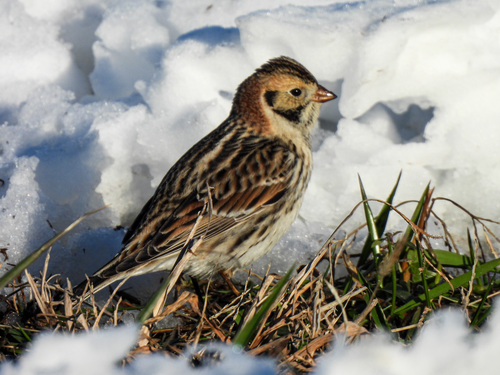 Lapland Bunting
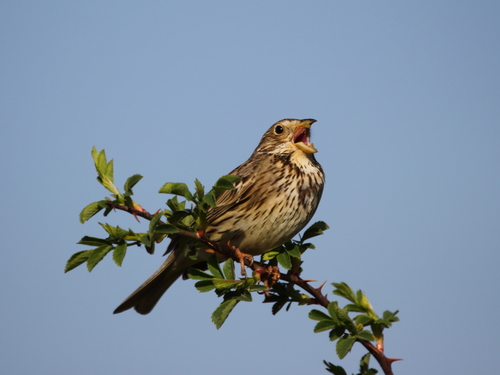 Corn Bunting
In short
The most reliable field mark between Lapland Bunting and Corn Bunting is overall structure: Lapland Bunting is a compact, robust bird with a thick, short bill and, in all plumages, a chestnut nape and often a hint of wing paneling, while Corn Bunting is much larger, bulkier, and lacks any chestnut tones or wing panels, instead showing uniform streaked brown upperparts and a plain brown tail. In flight or at rest, Lapland Bunting’s smaller size and more colorful head (especially the chestnut nape and, in breeding males, black face) contrast with the Corn Bunting’s drab, lark-like appearance and heavy streaking. Juvenile and non-breeding Lapland Buntings can appear dull, but the Corn Bunting’s sheer bulk, plain tail, and lack of any rufous or chestnut always separate it. Both species can be found in open country, but Corn Bunting is a bird of farmland and weedy fields, while Lapland Bunting is more likely in tundra or as a winter visitor in stubble fields.
Identification tips
- Size and bulk: Corn Bunting is much larger and heavier than Lapland Bunting. If the bird looks lark-sized or bigger than a sparrow, suspect Corn Bunting.
- Bill shape: Lapland Bunting has a thick, short, yellowish bill suited for seed-eating, but is proportionally smaller than the Corn Bunting’s heavy, conical bill.
- Head pattern (all ages): Lapland Bunting always shows a chestnut nape, even in juveniles and non-breeding birds. Corn Bunting’s head is plain brown, with no rufous or chestnut.
- Breeding male Lapland Bunting: Shows a striking black head and throat, white eyestripe, and chestnut nape. Corn Bunting never shows black or white on the head, nor any chestnut.
- Non-breeding/juvenile Lapland Bunting: Head is plainer but still orange-brown with chestnut nape and some wing paneling. Corn Bunting is always drab brown and lacks any rufous or orange.
- Wing pattern: Lapland Bunting may show chestnut or rufous wing panels, especially in fresh plumage. Corn Bunting’s wings are uniformly streaked brown, with dark lesser coverts tipped white but never forming a panel.
- Tail: Lapland Bunting has a shorter, more notched tail; Corn Bunting’s tail is broad, square, and plain brown with no white or rufous.
- Underparts: Lapland Bunting has white underparts with less streaking, except on the flanks. Corn Bunting has whitish underparts heavily streaked on breast and flanks, forming a gorget around the throat.
- Flight style: Lapland Bunting is quick and agile in flight, often in tight flocks. Corn Bunting is heavy, slow, and often flies singly or in loose groups.
- Perching behavior: Corn Bunting frequently perches on wires, posts, or bushes in open farmland, often singing. Lapland Bunting is more often on the ground or in low vegetation.
- Song: Corn Bunting’s metallic, jangling song is diagnostic if heard; Lapland Bunting’s vocalizations are not distinctive in this context.
- Habitat: Corn Bunting is almost always in farmland or weedy fields; Lapland Bunting is more likely in rough grassland, stubble, or tundra, especially outside the breeding season.
- Sex differences: Corn Bunting sexes are similar, with males slightly larger. Lapland Bunting males are more colorful in breeding plumage; females and immatures are duller but still show chestnut nape.
- Season: Lapland Bunting is a passage or winter visitor in most of Eurasia; Corn Bunting is resident or locally migratory in farmland.
- Pitfalls: Dull Lapland Buntings can look brown and streaky, but always check for chestnut nape and wing panel. Corn Bunting never shows these features, and its bulk and plain tail are always reliable.
Size
Lapland Bunting is distinctly smaller: 15–16 cm in length, weighing 22–33 g, with a wingspan of 22–29 cm [wikipedia][avonet]. Corn Bunting is much larger and bulkier: 16–19 cm in length, with males up to 20% larger than females, and a noticeably heavier build [wikipedia]. In the field, Corn Bunting often appears as a large, thickset bunting, whereas Lapland Bunting is compact and sparrow-sized. The difference is especially obvious when both are seen together or compared to familiar species.
Plumage
Juvenile and non-breeding Lapland Buntings show a plainer orange-brown head, but always retain a chestnut nape and some contrast in the wing panels. Adults in breeding plumage (especially males) are striking, with a black head and throat, white eyestripe, chestnut nape, and white underparts, plus a heavily streaked back. Corn Bunting of all ages and sexes is drab, with heavily streaked buff-brown upperparts, streaked flanks and breast, and a plain brown tail; the lesser wing coverts are dark with white tips but never form a panel or show rufous. Corn Bunting’s underparts are streaked, forming a gorget on the throat, but the head is plain and lacks any showy color or pattern. In flight, Lapland Bunting may show more contrast in the wing and a shorter, more notched tail, while Corn Bunting’s tail is broad and square. No age of Corn Bunting shows the chestnut nape or wing panel of Lapland Bunting.
Behaviour
Lapland Bunting is often seen foraging on the ground in flocks, picking seeds from bare ground or stubble, and is restless, frequently moving to new areas. It may flush low and fly in tight groups. Corn Bunting is more sedentary, often perched conspicuously on wires, posts, or low bushes, singing or watching over its territory. It walks heavily on the ground and rarely forms tight flocks except outside the breeding season. In flight, Corn Bunting appears heavy and slow, with a broad, rounded tail, while Lapland Bunting is quicker and more agile.
Habitat
Lapland Bunting breeds in arctic tundra but winters in open country, often stubble fields, weedy patches, or coastal grasslands. In Eurasia, it is a scarce winter visitor or passage migrant in farmland. Corn Bunting is strictly a bird of open farmland, weedy fields, and agricultural landscapes, rarely venturing into tundra or coastal grasslands. If seen in arable fields or on wires in lowland farmland, Corn Bunting is much more likely; Lapland Bunting is more likely in rougher, less cultivated ground, especially outside the breeding season.
Voice
Corn Bunting’s song is a distinctive, repetitive metallic jangle, often compared to jangling keys, delivered from a prominent perch. Lapland Bunting’s calls and song are less distinctive in the field and not described in the notes, but the Corn Bunting’s song is unique and diagnostic if heard. Both species may give simple calls in flight, but only Corn Bunting gives the metallic, jangling song.