

Kori Bustard vs Denham's Bustard
Ardeotis kori versus Neotis denhami
Play a quiz with Kori Bustard and Denham's Bustard
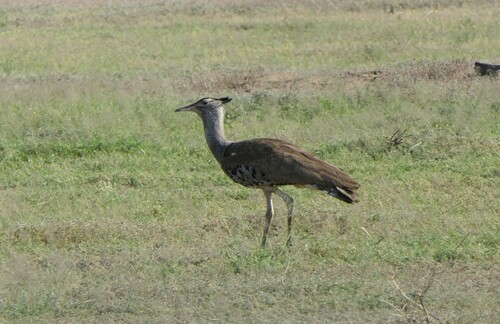 Kori Bustard
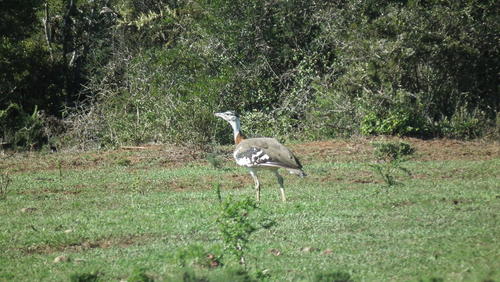 Denham's Bustard
In short
The most reliable field mark between Kori Bustard and Denham's Bustard is overall size and bulk: Kori is significantly larger and heavier, with a more massive, thick-necked, and heavy-bodied appearance even at a distance. In flight, both show patterned wings, but Denham's male has more white on the upperwing, while Kori is more uniformly brown and gray. On the ground, Kori appears grayer and more vermiculated above, with a bushier neck and a prominent black-and-white collar, while Denham's shows a paler gray neck with an orange nape and a plainer brown back. Juveniles of both are similar to females but Denham's are smaller and browner. Both species have pale yellow legs and a pale eye-stripe, but careful attention to size, neck pattern, and wing contrast is key.
Identification tips
- Size is the first check: Kori Bustard is much larger and heavier than Denham's, with a bulkier, more massive build. If the bird looks truly enormous, it's likely Kori.
- Neck pattern: Kori shows a thick, bushy neck with loose feathers and a bold black-and-white collar at the base, while Denham's has a paler gray neck with a distinctive orange nape and no collar.
- Crown and face: Both have a white eyebrow and a black line through the eye, but Denham's has a gray crown bordered with black, which is less pronounced in Kori.
- Upperparts: Kori is finely vermiculated gray and brown above, giving a mottled, cryptic look; Denham's is plainer brown above, especially in males, and less intricately patterned.
- Underparts: Both have white bellies, but Kori's ventral plumage is more boldly patterned with black and buff, while Denham's is cleaner white below.
- Tail: Kori's tail is broadly banded brownish-gray and white; Denham's tail is less distinctive but does not show the same bold banding.
- Leg color: Both have pale yellow legs, so this is not a reliable separator.
- Bill: Both have a pale, horn-colored bill, but Kori's is relatively longer and more flattened at the base.
- Flight pattern: In flight, Denham's male shows more white in the wing than Kori, which is more uniformly brown and gray. This is less reliable for females and juveniles, which show less white.
- Juvenile confusion: Juveniles of both are browner and less contrasting, but Kori juveniles are larger, with more spotting on the mantle and shorter crest and neck plumes. Denham's juveniles are smaller and show less white in the wing.
- Behavior: Kori is more likely to run or crouch at disturbance and avoids flight, taking off with heavy, labored wingbeats. Denham's may be more approachable in some areas and can gather in small groups at food sources.
- Display season: Male Denham's inflates his throat into a conspicuous white balloon during display, which is unique and diagnostic if seen.
- Habitat context: If seen in farmland, burnt fynbos, or at higher elevations, Denham's is more likely; Kori prefers open plains and grassland.
- Sex differences: Female Kori is still larger and longer-legged than female Denham's, but both are slimmer and less contrasting than males.
- When in doubt: Use a combination of size, neck pattern, and upperwing contrast (in flight) for the most reliable separation, especially in mixed-age or distant birds.
Size
Kori Bustard is the largest flying bird in Africa, with males vastly outsizing Denham's Bustard. Kori males are much heavier (often 2–3 times the mass of Denham's males) and longer overall, with females also distinctly larger than Denham's females. Denham's is still a large bird, but stands noticeably shorter and slimmer, with a more upright, less massive stance. In mixed company or with scale, Kori's bulk is unmistakable, but lone birds at a distance can be tricky without a reference.
Plumage
- Juvenile and female birds: Both species' juveniles and females are similar in being browner and less contrasting than adult males. Kori juveniles are browner with more spotting on the mantle and have shorter crest and neck plumes; Denham's young are also browner and show less white in the wing than adult males.
- Adult males in flight: Denham's male shows more white in the wing, especially obvious in flight, while Kori's upperwing is more evenly brown and gray, lacking large white patches.
- On the ground: Kori is cryptically vermiculated gray-brown above with a bold black-and-white collar and a bushy, loose-feathered neck; Denham's has a paler gray neck with an orange nape, a plainer brown back (darker in males), and a white belly. Both have a white eyebrow and a black line through the eye, but Denham's crown is bordered with black.
- Tail: Kori's tail is broadly banded brownish-gray and white; Denham's tail pattern is less emphasized in the notes.
Behaviour
Kori Bustard is typically more wary and spends most of its time on the ground, walking slowly and hesitantly, often running or crouching at the first sign of danger. It avoids flight if possible, taking off with heavy wingbeats and flying low with slow, measured beats. Denham's Bustard is also ground-dwelling and solitary outside the breeding season, but may gather at food sources or during migratory movements. Both species perform elaborate male courtship displays, but Denham's male inflates his throat into a conspicuous white balloon and struts, while Kori's display is less described here.
Habitat
Both species inhabit open grasslands and savannas, but Denham's Bustard is more likely to be found in a wider range of secondary habitats, including farmland, shrubland, dried marsh, and even burnt fynbos. Kori Bustard is more strictly associated with open plains and grasslands, sometimes moving seasonally in response to rainfall. Denham's can occur at higher elevations (up to 3000m) and is more adaptable to altered landscapes.
Voice
Both species are usually silent. Denham's Bustard is noted as being especially quiet outside the display season, when males may call loudly during courtship. No distinctive vocal field marks are described for Kori Bustard in these notes.